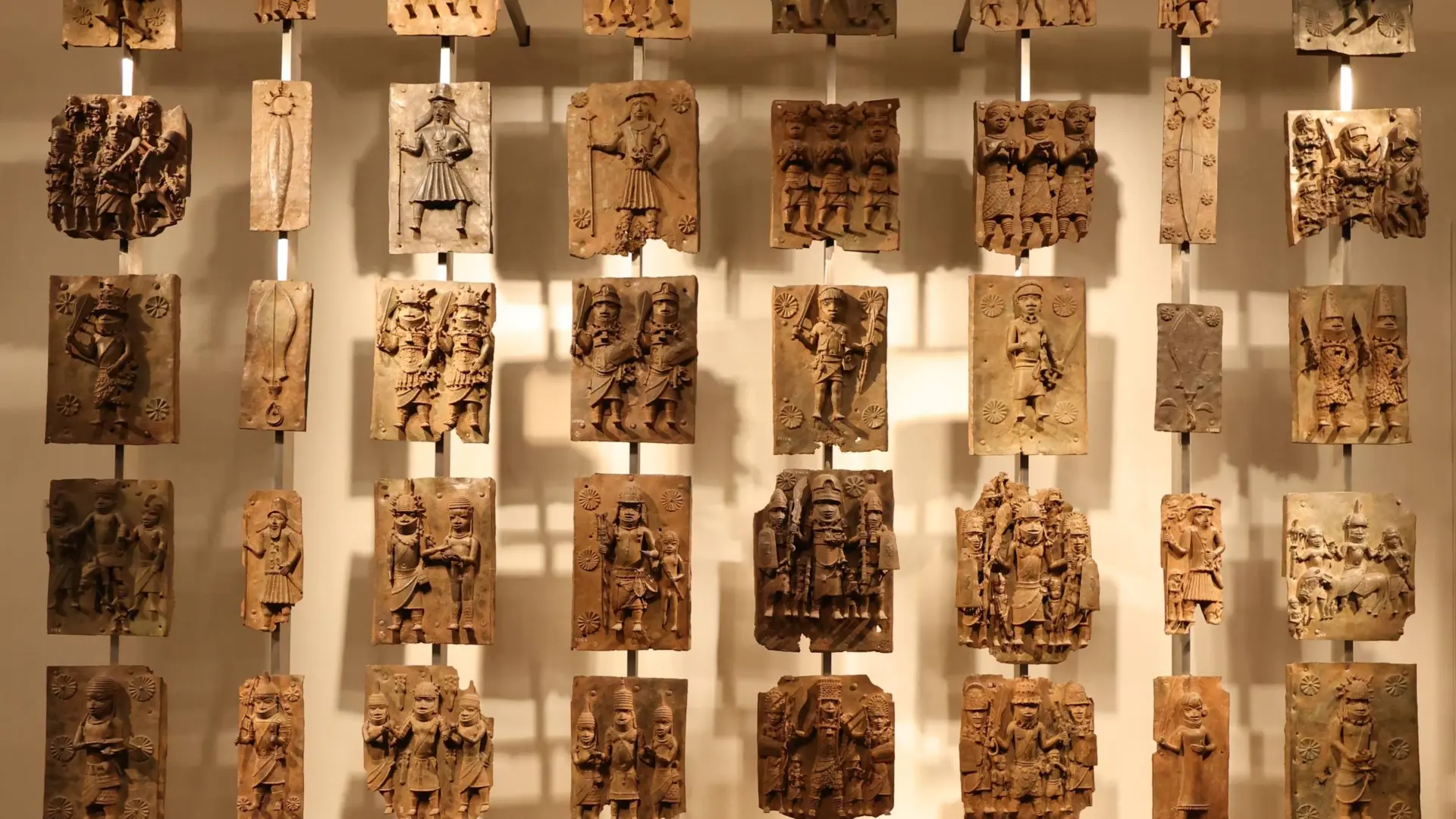
British soldiers looted thousands of bronze plaques, ivory carvings and royal artefacts from the Kingdom of Benin in a punitive 1897 expedition. They were dispersed into museum collections across Europe and North America, where the Bronzes above all became fixtures of institutions such as the British Museum and Berlin’s Ethnological Museum for well over a century. The campaign for their return, sustained by Nigerian activists, scholars and successive governments since the 1930s, achieved its most significant breakthroughs recently. Germany transferred ownership of over a thousand pieces to Nigeria in 2022, and other institutions in Europe have followed with partial returns. The moment looked, briefly, like a clean resolution to one of the most cited cases in the global restitution debate. What followed was a dispute inside Nigeria over who the returned artefacts belong to, which has complicated the position of the museums that returned them.
The 2023 ownership declaration
In 2023, Nigeria’s federal government issued a proclamation, under outgoing president Muhammadu Buhari, vesting ownership of the returned Benin Bronzes not in Nigeria’s National Commission for Museums and Monuments, the public institution that had represented Nigeria throughout decades of restitution negotiations, but in the Oba of Benin, the traditional monarch whose royal court the pieces were looted from in 1897. The legal logic had a genuine historical basis. The Bronzes were royal court property before colonial soldiers seized them, and restoring them to the Oba’s custody could be read as the most direct correction of the original theft.
The proclamation nonetheless unsettled several of the German and British institutions that had negotiated their returns with the expectation that the artefacts would enter public museum collections accessible to researchers and the general public, rather than royal custody where display and access would rest with the Oba’s court rather than any public accountability structure. Germany’s culture ministry, having built the political case for restitution partly on the argument that these objects belonged to the Nigerian public, found that it had transferred ownership into an arrangement whose provisions for public access, its domestic critics could argue, required further explanation.
Giving an object back does not resolve the deeper governance question of who, inside the country receiving it, has the legitimate and lasting authority to hold it in trust.
Heritage and custody
The dispute is not a simple case of bad faith on any side. The Oba of Benin’s court has a legitimate historical and cultural claim as the original owner and the living continuation of the kingdom the objects came from. That claim is distinct from that of the Nigerian federal state, which did not exist in its current form when the looting occurred and inherited the restitution case as the internationally recognised sovereign successor rather than as the original owner. The federal museum system’s claim rests on a different, also legitimate logic. Public heritage institutions provide the access, conservation standards and accountability that keep returned artefacts available to scholarship and public view rather than subject to the discretion of a single court, however historically grounded that court’s claim.
Questions for other restitution cases
The same question sits underneath many African restitution cases, even when it is not stated as bluntly as it has been in Nigeria. Colonial-era looting took objects from specific institutions (kingdoms, chieftaincies, religious bodies) that in many cases still exist in some form. The restitution movement, by contrast, has largely been negotiated government to government, between the modern nation-states that inherited the diplomatic standing to make the claim.
When those two claims align, with government and traditional institution in agreement on custody, restitution proceeds smoothly. When they diverge, as they have over the Benin Bronzes, the returning museum discovers that giving an object back does not resolve the deeper governance question of who, inside the country receiving it, has the legitimate and lasting authority to hold it in trust for the public the restitution campaign was fought in the name of. Nigeria’s dispute is not a reason to slow restitution elsewhere. It is a preview of a question every future case involving a living traditional institution will have to answer. For museums that long questioned whether returned heritage would be cared for, the harder question turns out to be not capacity but governance.
A shared arrangement, such as a dedicated museum built with royal cooperation rather than either party holding the Bronzes exclusively, may prove a more durable model for future cases than either strict state custody or strict traditional custody alone. What the episode has already accomplished, however the Bronzes are finally displayed, is to force both African governments and European museums to confront a question the restitution campaigns long avoided. Repatriation was only ever the first half of the argument. Legitimate custody was always the second half, and it is the harder one to settle.