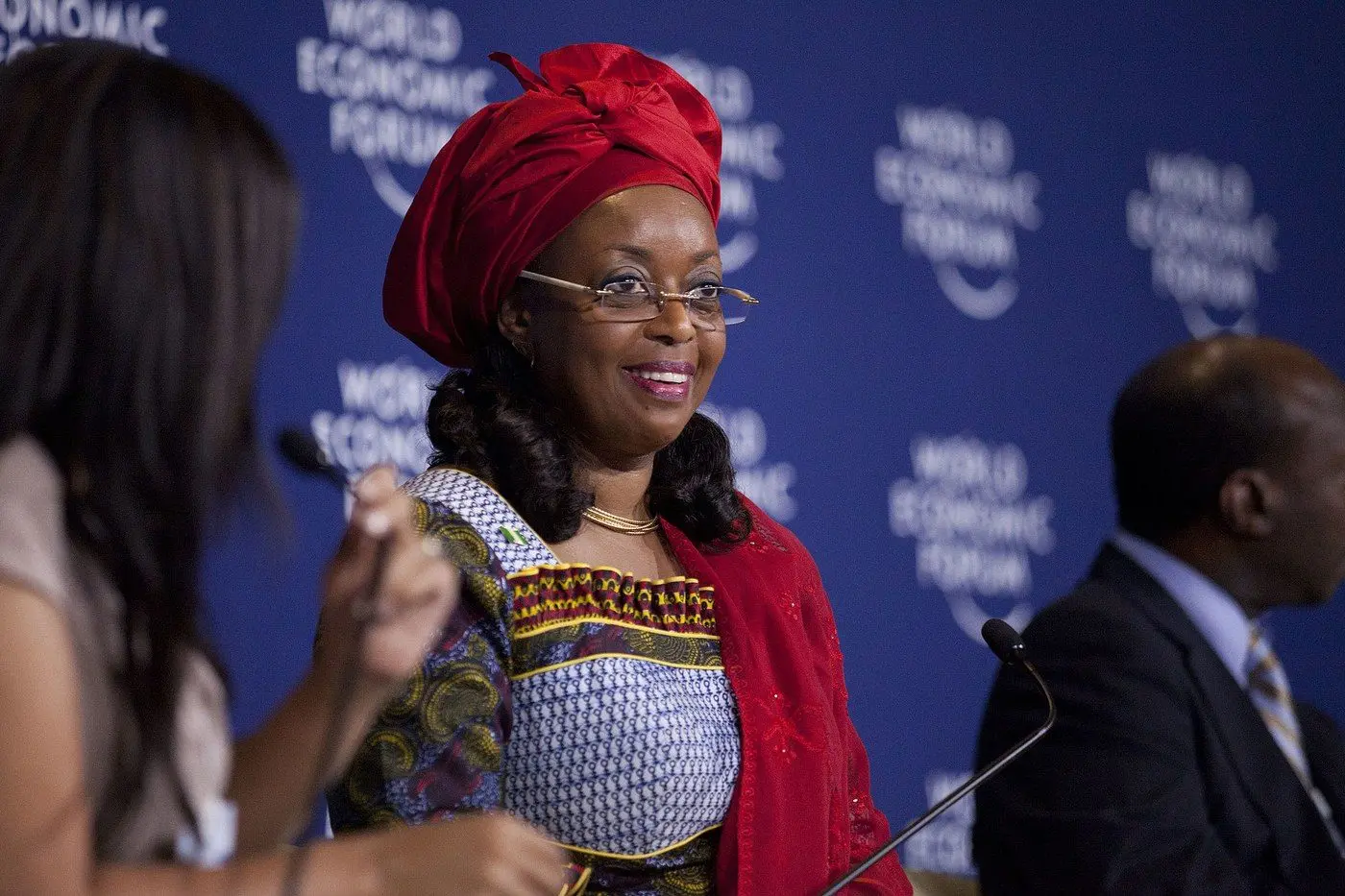
Former Nigerian petroleum minister Diezani Alison-Madueke was acquitted of all six bribery charges against her by a jury at Southwark Crown Court on 17 June 2026. The Diezani Alison-Madueke acquittal ends the UK’s criminal case against her. It does not end the questions Nigeria has left unanswered for a decade, because the charges its own anti-corruption agency filed in 2018 have never been tried.
The Diezani Alison-Madueke acquittal and what the jury decided
The jury returned unanimous not-guilty verdicts after more than 46 hours of deliberation, at the end of a trial that began in January 2026 and lasted five months, according to the BBC’s report of the verdict and a case summary published by the London chambers 2 Hare Court. The indictment, brought after an investigation by the National Crime Agency, contained five counts of accepting bribes and one count of conspiracy to commit bribery under the Bribery Act 2010. She was cleared on every count. No count was left on file or listed for retrial, and in England prosecutors cannot appeal a jury’s acquittal on the facts.
Two co-defendants were also acquitted. Her older brother, Doye Agama, was cleared of conspiracy to commit bribery. Olatimbo Ayinde, an oil industry executive, was cleared of one count of bribery and one count of bribing a foreign public official.
What the prosecution alleged and the defence argued
The Crown’s case covered 2011 to 2015, the period after the Bribery Act came into force on 1 July 2011. Alison-Madueke was Minister of Petroleum Resources from 6 April 2010 to 28 May 2015, and in November 2014 she became the first woman elected president of the OPEC Conference. Prosecutors told the jury she had received benefits in Britain from businessmen who held or sought Nigerian oil and gas contracts, including at least £100,000 in cash, more than £2 million of spending at Harrods, the use of properties in London and Buckinghamshire, private flights and school fees. The jury did not find any of the charges proved.
The case was narrower than its public profile suggested. The Crown Prosecution Service dropped money-laundering charges before trial. Trial reports, including analysis cited by Spotlight on Corruption, record that it did not allege that she awarded particular contracts in return for those benefits. It argued instead that accepting them amounted to improper performance of her ministerial duties. Descriptions of money moving through offshore accounts and shell companies, often attached to her name, come from civil forfeiture complaints filed by the US Department of Justice in 2017, not from this trial.
Alison-Madueke pleaded not guilty and gave evidence. She told the court that Nigerian law barred ministers from operating foreign bank accounts while overseas, so third parties met travel and living costs that were recorded and reimbursed in Nigeria, an account supported by a written statement from former President Goodluck Jonathan. Her counsel, Jonathan Laidlaw KC, argued that the delay of more than a decade was an abuse of process, that the NCA had been denied access to material from the EFCC’s 2015 search of her Abuja home, and that reimbursement records had gone missing in Nigeria. In closing he told the jury: “This should have been a Nigerian case.”
Why a London court had jurisdiction
The Bribery Act’s jurisdiction rules in section 12 work on two bases. UK courts can try anyone, of any nationality, where part of the offence takes place in the UK, such as the receipt of a benefit in London. Conduct entirely abroad is covered only where the defendant has a close connection with the UK. The Crown’s case rested on the first basis: the benefits it alleged were received in Britain. That is why a British jury heard a case about a Nigerian minister, and why it heard only the part of the story that touched British soil.
The Nigerian case that never reached trial
Nigeria did act. On 2 October 2015 the NCA arrested Alison-Madueke in London, and on the same day EFCC officers searched and sealed properties in Abuja and Lagos. In November 2018 the EFCC filed 13 counts of money laundering against her at the Federal High Court in Abuja, involving $39.7 million and N3.32 billion. An arrest warrant followed in December 2018, a court summons in July 2020 and, in October 2023, a fresh warrant and extradition proceedings, according to EFCC statements reported by Premium Times and The Guardian Nigeria. Because she remained in Britain, she was never arraigned. The charges are untested in any court, and she is entitled to the presumption of innocence on them.
The EFCC’s larger results came through civil proceedings. Between 2017 and 2022, Federal High Courts in Lagos and Abuja granted it interim and permanent forfeiture orders over more than 80 properties, jewellery valued at $40 million and funds of $153 million and N23.4 billion. In the United States, civil forfeiture actions from July 2017 targeted about $144 million in assets, including the superyacht Galactica Star, and recovered $53.1 million in cash for repatriation to Nigeria. Forfeiture is a civil remedy against property. It is not a criminal finding against any person. In July 2026, DW reported, a Federal High Court in Abuja allowed Alison-Madueke to tender her UK acquittal in civil asset-recovery litigation that is still running.
Two systems therefore ran in parallel for a decade. One produced asset seizures and a foreign criminal trial on narrow charges. The other produced a Nigerian indictment that no Nigerian court has heard. In this writer’s assessment, the gap reflects choices as much as capacity: extradition was pursued late, and Abuja let a foreign prosecutor carry the only criminal case that reached a jury.
The oil-boom question the verdict leaves open
The jury was never asked about the wider record of the oil years. Nigerian output averaged roughly 2.3 to 2.5 million barrels a day of crude and condensate between 2010 and 2014, according to the US Energy Information Administration, and Brent crude averaged above $111 a barrel in 2011 and 2012. It was one of the largest oil revenue windfalls in Nigeria’s post-independence history, and it ended abruptly when prices fell to $62 by December 2014. It was not the first windfall to pass without broad gains, as Nigeria’s longer record of oil wealth shows. The governance problems of that period are on the public record, and the dispute over NNPC remittances shows they have not gone away. Audits by the Nigeria Extractive Industries Transparency Initiative, and the forensic audit commissioned after the central bank governor raised concerns in 2013 about unremitted oil revenue, found large reconciliation gaps in NNPC’s crude sales accounts, as the Natural Resource Governance Institute’s study of NNPC oil sales sets out.
Did the windfall go into infrastructure, development and legitimate spending, or did it leak away? That question concerns a system, not a defendant. Nigeria’s public debt rose only moderately during the boom, from about $35 billion in 2010 to $63 billion to $65 billion by mid-2015, according to Debt Management Office figures. The failure was in buffers not built. When prices collapsed, the state borrowed heavily, and the IMF’s 2024 Article IV assessment put federal interest payments at 76.8 per cent of federal revenue in 2023 and projected 77.5 per cent for 2024.
Alison-Madueke held office at the top of a sector whose aggregate decisions shaped that fiscal inheritance, but a verdict on her conduct is not a verdict on the system. The London trial tested six charges under British law and the jury rejected them. Questions about where boom-era revenue went, and the money-laundering charges filed in Abuja, can only be settled in Nigeria. Her own counsel made the point to the jury. An accounting for the oil years will come from Nigerian courts and audit institutions, or not at all.



