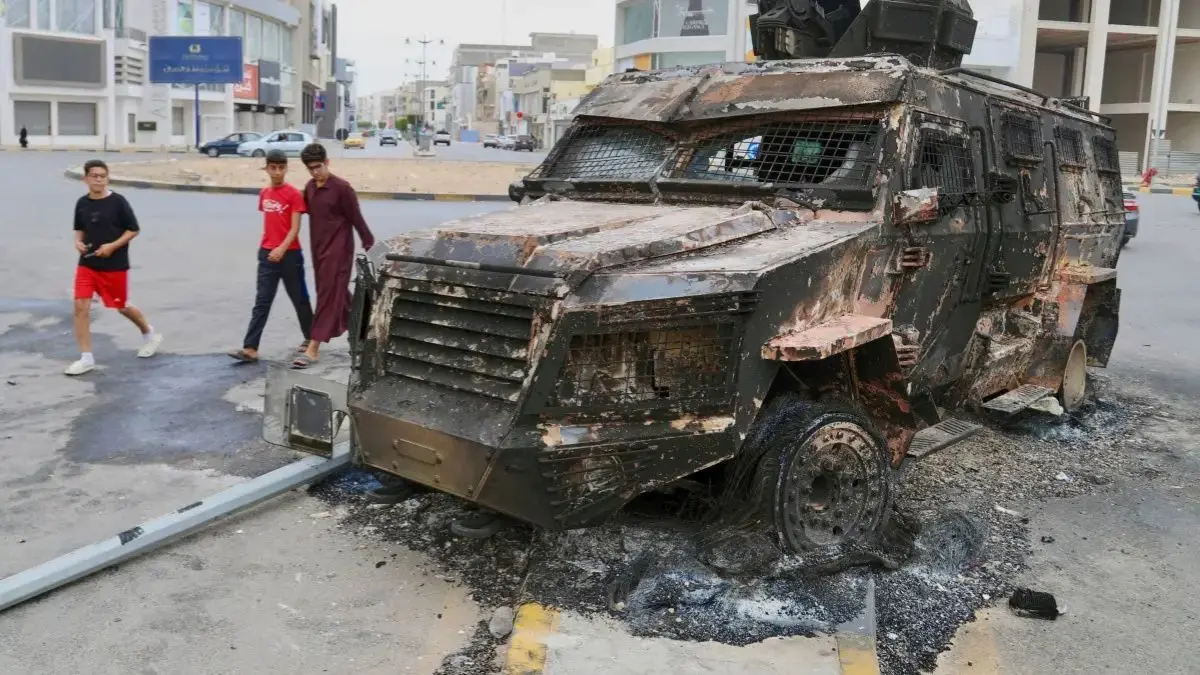
While global attention fixes on Tehran’s nuclear calculus, Libya’s prolonged fragmentation receives far less, despite its consequences for Libyans and neighbouring states. Libya has not simply failed. Foreign interests have kept it divided, and that matters because it determines who bears responsibility and who profits from the disorder.
Since the 2011 NATO intervention removed Muammar Gaddafi, the country has operated as a battleground, its institutions too fractured to govern and its resources too valuable to ignore. The African Union has lacked the leverage to stop a North African state being partitioned by proxy.
Libya has not simply failed. Foreign interests have kept it divided, and that matters because it determines who bears responsibility and who profits from the disorder.
Who holds the pieces
The foreign presence is visible enough to name. Turkey maintains a military presence and supports the Tripoli-based Government of National Unity. Russia’s Wagner Group, since rebranded and redeployed, anchors Khalifa Haftar’s Libyan National Army in the east, protecting Cyrenaican oil infrastructure and Mediterranean projection points. The UAE and Egypt have funnelled arms to the LNA in violation of a UN arms embargo, which has been breached repeatedly despite international enforcement efforts. Each external actor has achieved something, and their security and commercial interests can conflict with efforts to rebuild unified institutions.
The focus on Iran
The focus on Iran works at two levels. At the diplomatic level, Western powers, particularly the United States, the UK and France, have spent enormous strategic attention on the Iranian nuclear file, the Houthi interdiction campaign in the Red Sea and the broader Axis of Resistance network. These are genuine concerns. But they also provide the political cover to treat Libya as a secondary theatre and to tolerate the arms flows and mercenary deployments that prolong the conflict.
At the regional level, Saudi Arabia’s partial detente with Iran, brokered by China in 2023, did not resolve the competition for influence among Gulf states. The UAE has pursued interests in North Africa through resource access, port leverage and ties to local military commanders, in Libya and in Sudan alike, and both theatres are rendered less legible by the sustained focus on Iran as the defining regional story.
The African Union’s test
For the African Union, Libya presents an institutional stress test that the continental body has so far failed. The AU’s Peace and Security Council has repeatedly called for African-led mediation and the withdrawal of foreign forces. None of these calls has produced measurable compliance. The UN-recognised ceasefire signed in October 2020 has held only along geographic lines of exhaustion rather than political resolution. A country on Africa’s northern rim is being partitioned in practice by non-African powers, and the continental diplomatic infrastructure has not developed the leverage to interrupt that process.
Migrants pay the cost
Libya sits at the Mediterranean’s most trafficked migration crossing point. Detention centres operating under the notional authority of Libyan coastguard forces, funded substantially by European Union migration management budgets, have documented records of torture, arbitrary detention and extortion of migrants from sub-Saharan Africa, according to UNHCR in 2024. The EU’s willingness to fund border management in a country with no unified government, and no rule of law capable of providing accountability, is not an oversight. It is a transaction. European states receive reduced migration pressure. Libyan militias receive revenue and legitimacy. Sub-Saharan African migrants pay the cost in conditions that UN bodies have characterised as crimes against humanity.
What Libya shows
Libya shows what happens when external actors can live with failure. When a country’s state capacity collapses below the threshold required to assert resource sovereignty or enforce treaty obligations, it becomes easy to exploit. Libya’s oil wealth flows. Its coastline functions as a buffer zone for European migration politics. Its eastern airbase infrastructure serves Russian Mediterranean ambitions. Its western ports remain available to Turkish commercial and military interests.
Africa cannot afford to treat Libya as a North African problem alone. Its collapse sets a precedent that reaches well beyond Tripoli and Benghazi. African territory can be partitioned by proxy. African migrants can be held in detention systems funded by external powers. Continental diplomatic structures lack the leverage to interrupt either process. Libyan weapons have fed the Sahel’s instability, and the migration systems in which West and Central African citizens are tortured run on Libyan geography.
The war front in Libya is invisible not because nothing is happening, but because international attention has moved elsewhere and diplomacy has not resolved its entrenched divisions.



