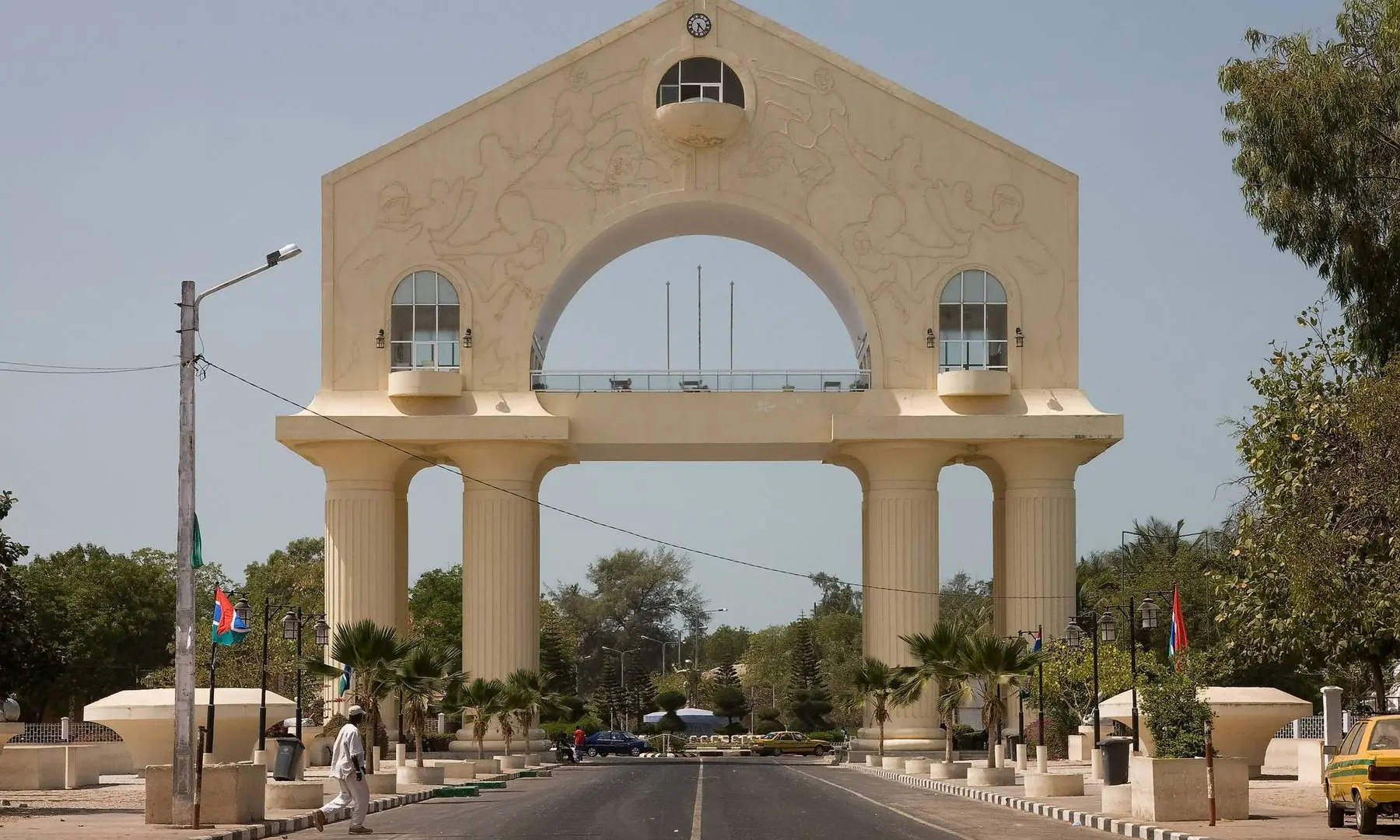
For 22 years Yahya Jammeh ruled The Gambia through fear. Under his rule independent radio stations were shut down or set on fire, Amnesty International reported that his guards escorted witch hunters through villages, and he told people with HIV that his herbs could cure them. His successors accuse him of emptying the treasury on his way out. His rule ended in January 2017, after he lost an election and a West African force moved in to enforce the result.
More than a year later, Gambians speak more freely than they have in a generation. But President Adama Barrow’s government inherited debts it puts at more than $1 billion, and the freedom it promised now depends on an economy its new leaders described as in financial distress.
Two presidents from 1970 to 2017
The Gambia is the smallest country on the African mainland, a strip of land along the Gambia river enclosed by Senegal except for its Atlantic coast. It became independent on 18 February 1965 and a republic on 24 April 1970, with Sir Dawda Jawara as President. Jawara governed until 22 July 1994, when Jammeh, then a 29-year-old army lieutenant, led a bloodless coup. He ruled first as chairman of the Armed Forces Provisional Ruling Council and, from 1996, as elected President.
A long campaign against the press
The press was one of his most consistent targets. According to the Committee to Protect Journalists, the independent station Citizen FM went off air in February 1998, when two of its staff were arrested and its equipment was forfeited to the government. On 6 June 1999 the US-based owner of the Daily Observer, then the country’s most respected independent paper, sold it to a businessman with close government ties, and the new management fired its news editor and deputy managing editor.
On 10 August 2000, seven men armed with tear gas and petrol set fire to the compound of Radio 1 FM, a private station with a pro-democracy stance; its owner and a presenter were badly burned, and the station was off air for two days, CPJ recorded. Weeks earlier, on 23 July 2000, Jammeh had warned that “anybody bent on disturbing the peace and stability of the nation [would] be buried six feet deep.”
The warnings continued. In April 2004, Reporters Without Borders recorded, he called on journalists to obey his government “or go to hell”, and in a broadcast in July 2005 he said he had allowed “too much freedom of expression” in the country. Gambian journalists abroad answered with online outlets such as the US-based Freedom Newspaper; in May 2006, CPJ reported, at least three journalists in The Gambia were detained in a crackdown on its suspected contributors. The pattern of presidents treating the press as an enemy was not unique to The Gambia, as Africa 360° has reported elsewhere on the continent.
Witch hunts and a false HIV cure
In March 2009, Amnesty International reported that up to 1,000 people had been kidnapped from their villages by “witch doctors” escorted by police, soldiers, intelligence agents and the president’s personal guards. Victims said they were held in secret detention centres and forced to drink hallucinogenic concoctions; two people were known to have died of kidney failure. The Guardian reported that the witch hunters arrived after the death of Jammeh’s aunt, which he was said to believe had been caused by witchcraft.
Two years earlier, in January 2007, Jammeh had announced that he could cure HIV/AIDS and asthma with herbs. His treatment required patients to stop taking antiretroviral drugs, Voice of America reported. When Fadzai Gwaradzimba, the most senior UN official in the country, questioned in a Sky News interview whether there was any scientific proof that it worked, and suggested it might encourage risky sexual behaviour, she was given 48 hours to leave. Jammeh later claimed he could also cure infertility in women.
Threats against gay Gambians
At a victory celebration in Tallinding on 15 May 2008, Jammeh promised legislation “stricter than those in Iran” and said he would “cut off the head” of any homosexual caught in the country, the Gambia News reported, and he gave gay people an ultimatum to leave. He took the theme to the UN General Assembly on 27 September 2013, where his statement listed “Homosexuality in all its forms and manifestations which though very evil, antihuman as well as anti-Allah” among the three biggest threats to human existence, adding that “Those who promote homosexuality want to put an end to human existence”.
On 18 February 2014, in a televised independence-day speech reported by Reuters, he said: “We will fight these vermins called homosexuals or gays the same way we are fighting malaria-causing mosquitoes, if not more aggressively.” He added: “As far as I am concerned, LGBT can only stand for Leprosy, Gonorrhoea, Bacteria and Tuberculosis; all of which are detrimental to human existence.”
Bans on FGM and child marriage
Some of his decrees protected women and girls. In November 2015 he banned female genital mutilation, and the information ministry cited him as saying the practice had no place in Islam or in a modern society. A month later the National Assembly wrote the ban into law, with up to three years in prison for anyone who carried out or organised the practice. In July 2016, speaking at Eid celebrations at the end of Ramadan, he banned child marriage, and anyone marrying a girl under 18 faced up to 20 years in prison. The BBC reported that some 30 per cent of underage girls in The Gambia were married.
The money the new government says is missing
The day after Jammeh left, Mai Ahmad Fatty, a special adviser to President Barrow, told reporters that Jammeh had made off with more than $11.4 million in two weeks and had a Chadian cargo plane fly luxury goods, including cars, out of the country. “The Gambia is in financial distress. The coffers are virtually empty. That is a state of fact,” Fatty said, as the Associated Press reported, adding that technicians at the finance ministry and the Central Bank had confirmed it.
On 23 February 2017, two senior ministers told the Guardian that Jammeh had siphoned at least $50 million from social security, the ports and the national telecoms company, that his private jet had been bought with $4.5 million from the state pension fund, and that the country had been left with debts of more than $1 billion. The next day Reuters reported that, according to bank records and interviews with former staff, money from a dollar account of the Jammeh Foundation for Peace, into which more than $8 million was paid in 2012 and 2013, had flowed to Jammeh himself rather than to the foundation’s projects, though Reuters could not determine how the withdrawn money was spent. The foundation did not respond to requests for comment, Reuters could not reach Jammeh in Equatorial Guinea, and his former lawyer, Edward Gomez, said he was unaware of any misspending.
In May 2017 the justice minister, Abubacarr Tambadou, obtained a court order freezing Jammeh’s known assets in The Gambia, including 88 bank accounts and 14 companies. He said Jammeh had directed the unlawful withdrawal of at least $50 million between 2013 and 2017 from central bank accounts linked with the state telecoms company, Gamtel. AFP noted that Fatty’s earlier claim about $11 million had not been backed by the rest of the cabinet.
How Jammeh fell
Barrow won the presidential election of December 2016 with more than 43 per cent of the vote. Jammeh conceded, then on 9 December rejected the result, and in January 2017 declared a 90-day state of emergency. After Barrow was sworn in at the Gambian embassy in Dakar on 19 January, Senegalese troops of an ECOWAS force entered The Gambia. Jammeh left for exile in Equatorial Guinea on 21 January. It was the first time since independence that The Gambia had changed president through an election.
Freedom, and a treasury Barrow says was emptied
A year later, many Gambians said free speech was a right they cherished under Barrow, AFP reported. “There is a democracy, everybody feels free,” said one teacher, Kalipha Dampha. The Gambia Press Union said it was working to reform the laws once used to stifle dissent.
The economy is another matter. “Our coffers not only (have been) emptied, but we are (also) loaded with huge debt,” Barrow said in his end-of-year address, as reported by AFP. He put the debt at more than $1 billion, about 120 per cent of GDP, or roughly $4,500 for each household. He also said the cost of government borrowing had fallen sharply and inflation had begun to ease, and Anadolu Agency reported his projection of 3.8 per cent growth in 2018, against 2.2 per cent in 2016.
The freedom is real, and so is the debt. Rebuilding will take time, and the test for Barrow’s government is whether it can repair the economy without losing the trust that Gambians placed in it when they voted Jammeh out.



