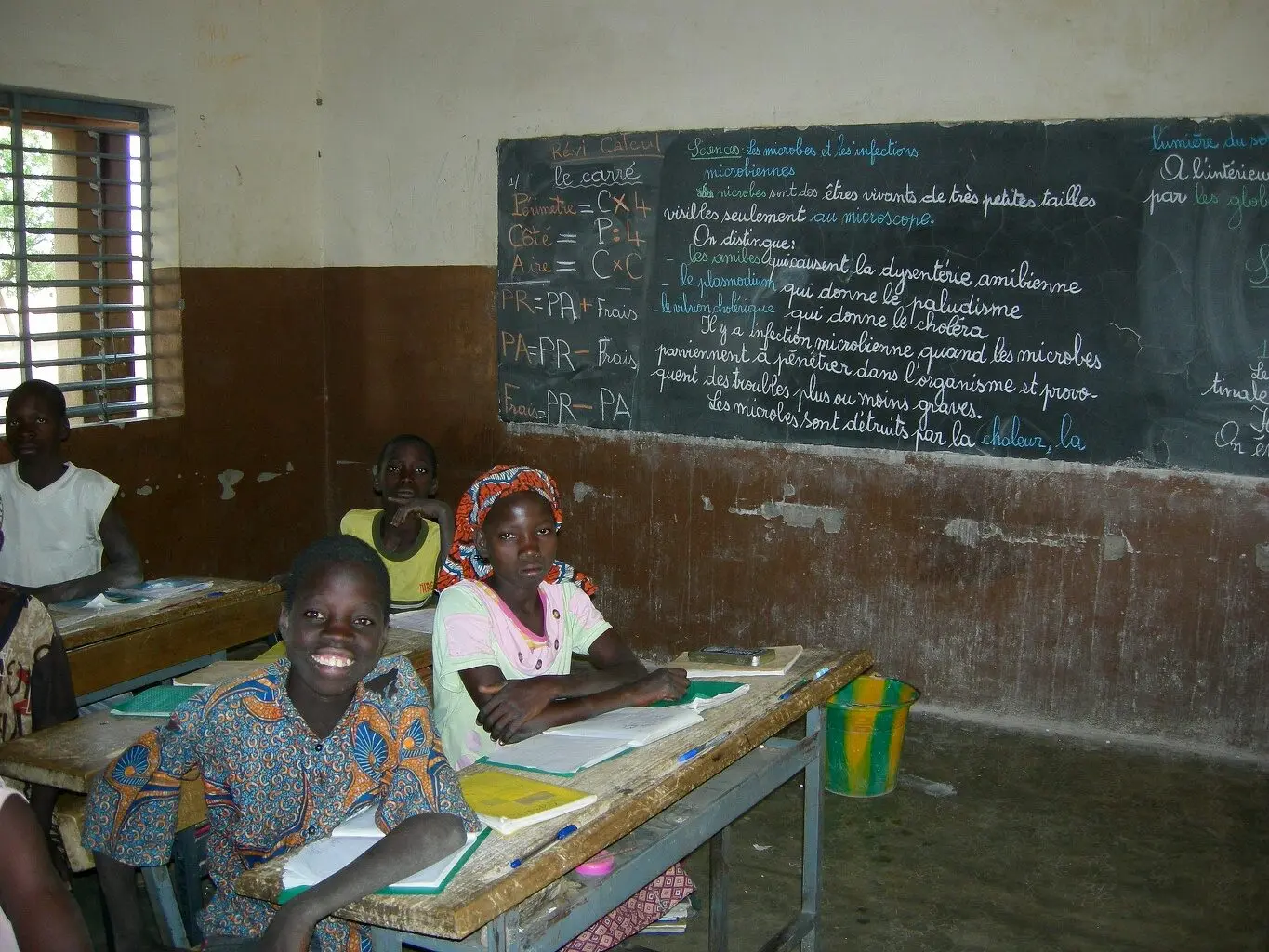
West African governments have written free and compulsory schooling into law and scrapped school fees, and the classrooms have filled. Across sub-Saharan Africa the number of primary pupils roughly doubled between 1999 and 2018, from about 86 million to 177 million, according to World Bank enrolment data. The reforms have not delivered the quality of education they promised.
The failure starts in the classroom. Children are taught in languages they do not speak at home, by teachers who are too few, short of training and short of equipment, in systems whose budgets have not kept pace with their pupils. The evidence from ten countries, some of it years old, points the same way. Governments still underfund their schools, and too many children leave without the knowledge they were meant to gain.
Lessons in a language pupils do not speak
West Africa is a region of very high linguistic diversity. Ethnologue, the reference catalogue of the world’s languages, listed 520 living indigenous languages in Nigeria alone when read in November 2026. The mother tongue is rarely the language of instruction. That comes at a cost. The mother tongue is devalued, and children struggle both to follow the lesson and to make themselves understood.
A child raised in one language and taught in another is at a loss in class unless the child has grown up bilingual. UNESCO’s Global Education Monitoring Report made the same case in a policy paper of February 2016, If you don’t understand, how can you learn? In many western African school systems, its summary said, French remains the main language of instruction, “so the vast majority of children are taught from the early grades in a language with which they have limited familiarity”.
The paper put a number on the effect. In Côte d’Ivoire in 2008, 55 per cent of grade 5 pupils who spoke the test language at home had learned the basics in reading, against 25 per cent of those who spoke another language. It found the harm greatest for children living in poverty. South Africa’s long argument over the language of schooling since Soweto shows the problem is not confined to one region.
Teachers are seldom equipped to close the gap. The same paper reported that only 8 per cent of trained teachers in Senegal, and 2 per cent in Mali, said they were confident teaching in local languages.
Adult illiteracy compounds the problem, because parents who cannot read can do little to help with schoolwork. The UNESCO Institute for Statistics counted 750 million adults who could not read or write in 2016, two-thirds of them women. It put 27 per cent of them in sub-Saharan Africa and 49 per cent in Southern Asia.
Teachers without training or tools
In late February 2018, photographs of a Ghanaian teacher spread across social media. Richard Appiah Akoto, who taught information and communication technology at Betenase M/A Junior High School in Sekyedomase, had drawn the Microsoft Word window on a blackboard in coloured chalk. His pupils faced a national examination with questions on the subject, and the school had not had a computer since 2011, CNN reported on 1 March 2018.
“I wanted them to know or see how the window will appear if they were to be behind a computer,” Mr Akoto told CNN. He was getting his message across with the only tool he had. Microsoft Africa responded on Twitter by promising him a device and access to its training for teachers. The episode showed how far a lack of equipment holds teaching back, even where the teacher is resourceful.
Shortages of teachers are older than the reforms. In Togo, the US Department of Labor’s child labour findings for 2001 described a system with too few teachers, poorer quality in rural areas and high rates of repetition and dropping out. In the north of the country, parents paid 41 per cent of primary school teachers themselves, against 17 per cent in Lomé, where incomes were much higher.
In Liberia’s universities and colleges, the weakness reported is one of integrity. “Patronage and bribery by administrators, professors, and students are widely reported,” Blair Glencorse, founder of the Accountability Lab, wrote of the country’s universities and colleges in a guest post for the Council on Foreign Relations on 20 August 2012. Abuse of resources, teacher absenteeism and sex for grades appeared common, he wrote, though data was minimal, and a “culture of silence” stopped problems being reported and so blocked reform.
Method matters as well as numbers. Many pupils are still taught by the traditional “chalk and talk” method. Teaching that attends to each pupil’s needs and makes use of spaced learning, in buildings flexible enough for new technology and for children with special educational needs, would serve more kinds of learner. It requires better trained and better qualified teachers than the region has.
Laws that budgets cannot honour
Teacher training, school building and school governance all depend on money, and across the region the law has run ahead of the budget.
In Sierra Leone the law required primary schooling, but a shortage of schools and teachers “has made implementation impossible”, the US Department of Labor found in 2001. The Education Act of 2004 made six years of primary and three years of junior secondary education compulsory. On 20 August 2018 the new president, Julius Maada Bio, launched a free schooling programme for government and government-assisted schools from the school year that began on 17 September. It was to waive tuition and admission fees, and more than 1.5 million children were expected to benefit, the Sierra Leone Telegraph reported on the day.
The Gambia’s Constitution mandates free and compulsory primary education, and fees for the first six years of school were ended in February 1998. The same 2001 findings said a lack of resources and infrastructure had made the mandate hard to deliver. Girls made up about 40 per cent of primary pupils, and far fewer in rural areas, where custom and poverty kept parents from sending daughters to school. About 20 per cent of school-age children attended Koranic schools, which, the report said, “usually have a restricted curriculum”.
Burkina Faso’s Education Act made schooling compulsory from the age of 6 to 16, and free by law. The government did not have the resources to provide universal free primary education, the Department of Labor reported in its findings for 2005. Children had to pay for school supplies, and communities often had to build primary schools and teachers’ housing themselves. Children from poor families could continue without tuition fees through secondary school only if their grades qualified. Net primary enrolment in 2002 was 36 per cent.
Togo waived primary school fees for the school year that opened on 6 October 2008, the UN news service IRIN reported at the time. More children now go to school, and it is easier for poor parents to send them. One head teacher near Lomé, who was also secretary general of the primary teachers’ union, told IRIN that schools had relied on the fees to stock classrooms and pay assistants, and had not been prepared for the change.
In Côte d’Ivoire, about half of adults could read and write in 2016, by World Bank figures. Net primary enrolment had reached 85.6 per cent by 2017, but secondary school remained mostly male. The World Bank’s gender parity index for secondary enrolment stood at 0.74 that year, which means girls enrolled at about three-quarters of the rate of boys.
Nigeria, the region’s largest country, has one of the largest out-of-school populations in the world. UNICEF’s Nigeria office says one in every five of the world’s out-of-school children is in Nigeria, where about 10.5 million children aged 5 to 14 are not in school even though primary education is officially free and compulsory.
What the surge in enrolment requires
The surge in enrolment is the achievement of these reforms and the source of the strain. On the evidence above, fee abolition brought children into school faster than governments trained teachers, built classrooms or paid for supplies. East Africa’s schools show the same gap between attendance and learning.
Better teaching, sound buildings, trained and better paid teachers and lessons in a language children understand are what would turn attendance into learning. Investment in West Africa’s schools is needed to cope with the numbers now in them, because an investment in a child’s education is an investment in that child’s future. Until budgets match the laws, the reforms remain efforts that are not enough.



