Russia wants back the influence in Africa it held as the Soviet Union, and the first Russia-Africa summit, in Sochi in October 2019, showed how it means to get it. Behind the offers of debt relief, trade and partnership, this analysis argues, the real business on show was arms, and the gains from the new relationship are likely to flow mainly to Russia.
As the Soviet Union, Moscow was a major player in Africa. It backed independence movements and trained a generation of African leaders. Those ties fell apart when the Soviet Union collapsed in 1991. In recent years Russia has been looking for ways to return to the top tier of world powers, and that means showing influence on distant continents, not only in neighbouring countries. That ambition, spurred on by the seemingly easy ride China has had as it pushes deeper into Africa, is why Russia is determined to raise its stake on the continent.
Money oils all ambition
Russia knows that its quest for a bigger share of African markets depends largely on how freely it can offer money (aid, hard currency, NGOs and so on) to receptive African leaders.
As it stands, the European Union, China, India, the United States and the United Arab Emirates are Africa’s leading economic partners. The desire to change this order was in part what led to the Russia-Africa forum.
So when he addressed the summit in Sochi, where all 54 African states were represented and 43 heads of state or government attended, President Vladimir Putin made a skilful pitch for a doubling of trade between his country and Africa as a whole, and for the benefits this new partnership would bring.
Debt forgiveness
To show it could be a generous big brother, Russia needed a significant gesture. Almost as soon as the forum opened, Putin announced that Russia had written off more than $20 billion of debt that African countries had run up in the Soviet era. He said the funds from those debts were being used to set up special programmes to support Africa’s economic development.
But in an interview with TASS published before the summit, he added, calmly but tellingly: “It was not only an act of generosity, but also a manifestation of pragmatism, because many of the African states were not able to pay interest on these loans.”
What is driving the interest, according to Putin
Putin did not mince words about why his country wants closer ties with Africa. According to him, Africa is becoming more and more attractive to Russian businesses, as many of its countries have become centres of economic growth. In other words, the promise of growth that has drawn other powers to the continent draws Russia too.
And then the AfCFTA
On paper, 54 African countries have pledged to open their markets to one another, in the manner of the European Union. Russia is not part of the EU, but it would not mind a role in the African Continental Free Trade Area (AfCFTA), if only as a guiding collaborator.
That is what Putin meant when he said Russia was eager to work with Africa to support the implementation of the AfCFTA agreement. He stressed that this mattered in particular because it would help build cooperation with the Eurasian Economic Union, which Russia leads.
The real business was Russian guns
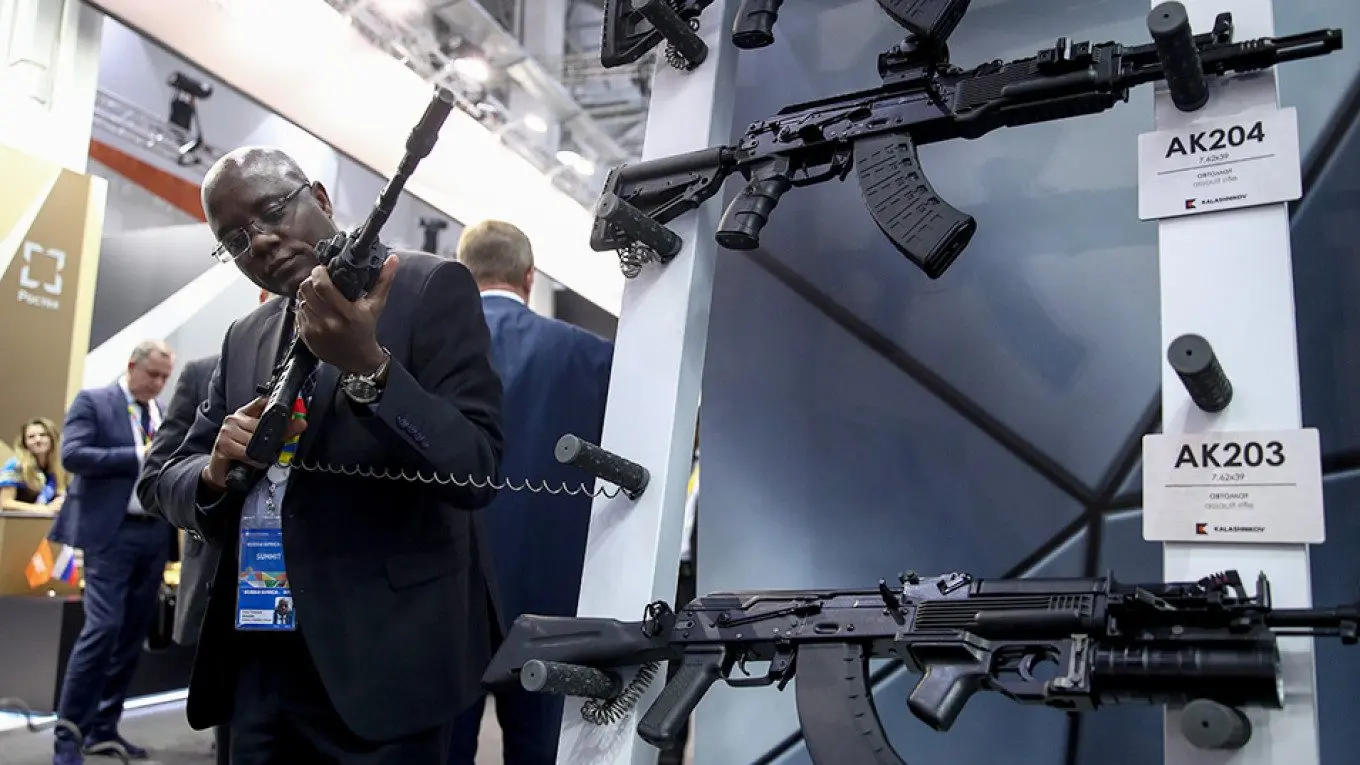
Although the forum covered a range of subjects, from nuclear technology to mineral extraction, it was the seemingly marginal activity that stood out: the stands for arms companies on the sidelines.
Russia displayed its next-generation Kalashnikov assault rifles, helicopters and facial recognition systems to African leaders, whose countries now account for 40% of the orders of the Russian state arms exporter Rosoboronexport. “We would like to expand our presence there, of course,” Rosoboronexport director Alexander Mikheyev told AFP.
Prognosis
In the author’s view, it is not hard to see who stands to benefit most from the new relationship. Russia gains markets, influence and arms orders. For African countries the risk is fresh debt from arms purchases, with gains concentrated among a few in power rather than reaching their citizens, many of whom remain among the poorest in the world.
What happened next
Turnout fell at the second summit, held in St Petersburg in July 2023, where 17 African heads of state attended, compared with 43 in Sochi. A third summit was held in Moscow on 28 and 29 October 2026. In an Africa Day message in May 2026, Mikheyev said that the continent accounted for 30% of Rosoboronexport’s order book, as TASS reported.



