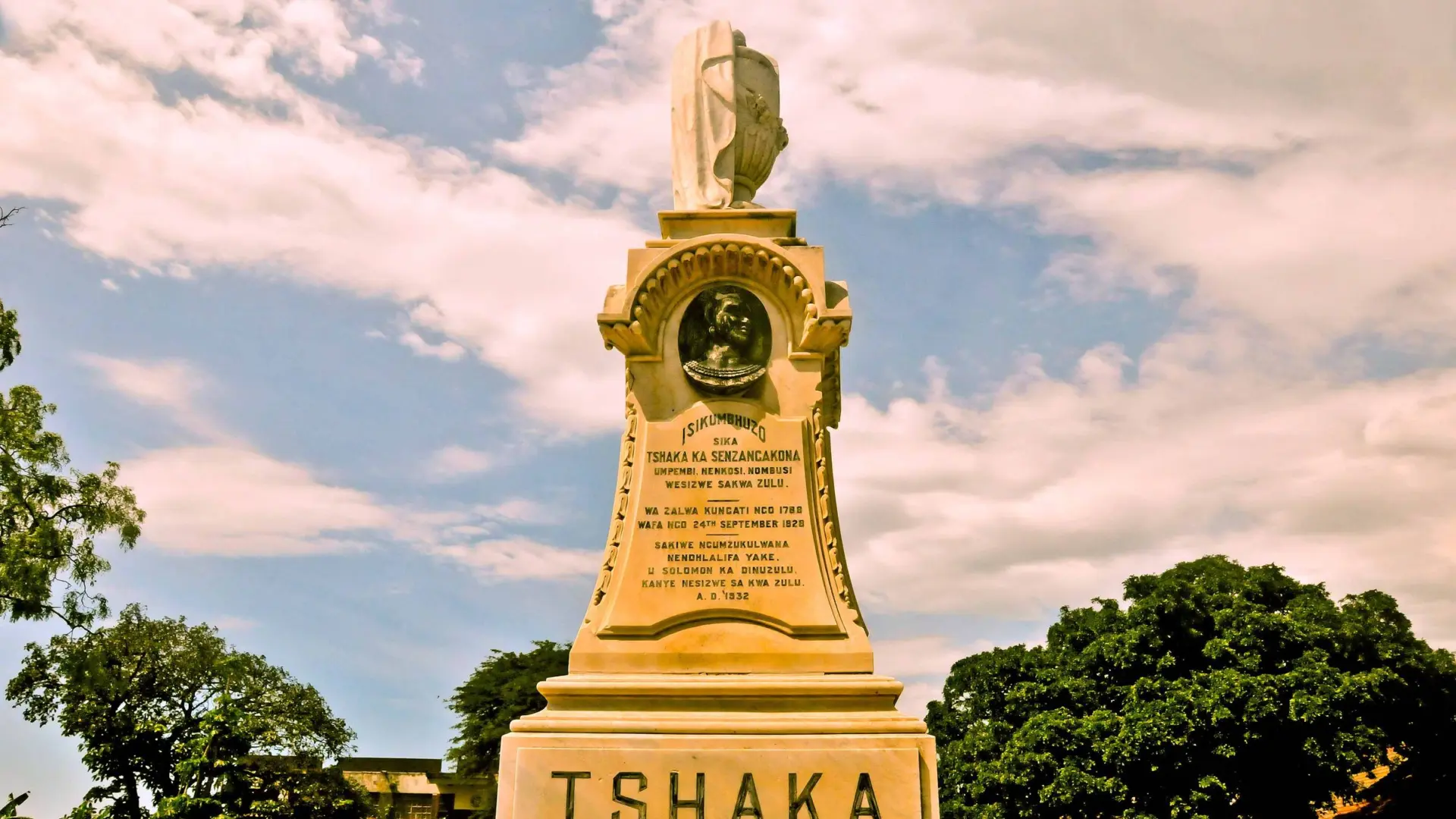
In little more than a decade, Shaka kaSenzangakhona turned a minor chiefdom into the most feared military power in southern Africa. His wars set off upheavals felt as far as the Zambezi, his reforms changed how the region fought, and his reign ended in terror and murder at the hands of his own brothers.
He has been called the “African Napoleon” (HistoryNet) for his military genius and for drawing hundreds of chiefdoms into a single Zulu state.
An outcast childhood
Shaka Zulu was born in the lunar month of uNtulikazi (July) in 1787, near present-day Melmoth in KwaZulu-Natal. His father was the Zulu chief Senzangakhona kaJama and his mother was Nandi. Because he was considered illegitimate, he and his mother were driven from his father’s kraal, a homestead of huts, when he was six.
They went back to Nandi’s people, who did not want them either, and were eventually forced out again. They found refuge with a different people altogether, the Mthethwa. In his late teens Shaka was enrolled in an ibutho, a regiment of young men of the same age group who could be called up for war, labour, policing or hunting. His courage, skill and strength there caught the eye of the Mthethwa paramount chief, Dingiswayo.
Seizing the Zulu chiefdom
When Senzangakhona died in 1816, the chiefdom passed to Shaka’s younger half-brother Sigujana as the rightful heir. Shaka, backed by one of Dingiswayo’s regiments, killed him and took command of the 1,500 Zulus. His new territory covered about one hundred square miles, and he remained Dingiswayo’s subordinate (Military History magazine, via HistoryNet).
That changed in 1817, when Dingiswayo was killed by Zwide, the powerful chief of the Ndwandwe (Nxumalo). Many Mthethwa went over to the Ndwandwe and others joined Shaka. Zwide was at first a dangerous opponent. Shaka rebuilt the Mthethwa remnants and the neighbouring clans into a single force and defeated him in the Ndwandwe-Zulu War, decisively at the Mhlatuze River in 1819. Free of his main rival, he could make alliances, absorb his neighbours and keep enlarging his army.
A new kind of army
His people called him Nodumehlezi, “the one who when seated causes the earth to rumble.” He armed his men with a short stabbing spear with a heavy blade, the iklwa, said to be named after the sound it made as it was driven into a body and pulled out. He banned sandals and hardened his warriors’ feet by running them barefoot over thorny ground, which made them faster over any terrain. Drill and discipline did the rest, and his regiments soon terrorised the region.
His war cry was “Victory or death!” He kept his impi on campaign until he judged that they had earned the isicoco, the head ring of manhood. Only then was a regiment stood down and its men allowed to marry.
His first capital stood on the Mhodi, a small tributary of the Mkhumbane River in the Babanango district. He called it KwaBulawayo, “at the place of the murder”. As the kingdom grew, he built a much larger KwaBulawayo of about 1,400 huts in the Mhlathuze valley, some 27 kilometres from the present town of Eshowe.
War, migration and the Mfecane
Shaka’s wars brought slaughter and mass flight. Leaders such as Zwangendaba, Mzilikazi and Shoshangane fled north to escape him, deep into the interior of central Africa, and the shock was felt well beyond the Zambezi. The wars of 1818 to 1828 fed the wave of forced migration known across southern Africa as the Mfecane, and also as the Difaqane, Lifaqane or Fetcani. Refugees from his attacks, first the Hlubi and Ngwane, later the Mantatees and Mzilikazi’s Matabele, crossed the Drakensberg westwards and broke the chiefdoms in their path. Between the Limpopo and the Gariep, whole communities were wiped out and herds and crops destroyed, and famine and chaos followed. Old chiefdoms disappeared and new ones took their place.
Inside the kingdom, the wars made the community far richer in cattle. Most of the herds belonged to the king, his chiefs and his izinduna, but everyone shared the pride of the great royal herds and of belonging to the strongest military power in the region. Shaka ruled over 250,000 people without a rival for 10 years and could put more than 50,000 warriors in the field at once. Estimates of the number of people killed in his wars vary widely and are contested.
A despot at home
The young king was also known for his cruelty. Accounts of his reign suggest that the more alliances he made, the more chiefs he defeated and the further his kingdom spread, the more brutal and despotic he became. He demanded total loyalty from his warriors. Anyone who insulted him or his mother could be clubbed, speared or have his neck twisted.
In 1826 he built a large military barracks at Dukuza, “the place where one gets lost”, 80 kilometres south of KwaBulawayo, on the site of present-day Stanger (KwaDukuza), so as to be closer to the settlers at Port Natal.
Towards the white newcomers he stayed peaceful, and he even sent envoys to visit them. There was no fighting between the Zulu and white traders in his reign, and although the British won control of Port Natal (now Durban), they never challenged him. The bloody wars between the Zulu and the Dutch-Afrikaner settlers, the Boers, began only after his death.
Grief, terror and murder
He could have a man executed with a nod, and his people’s loyalty frayed as his cruelty grew. It reached its peak after his mother, Nandi, died in October 1827. Shaka seemed to lose his reason. He ordered that no crops be planted during the following year of mourning and that no milk, then the basis of the Zulu diet, be used. Any woman who fell pregnant was to be killed with her husband. At least seven thousand people judged not to be grieving enough were put to death. Cows were slaughtered so that their calves would know what it meant to lose a mother, and his armies were sent to force the neighbouring chiefdoms to mourn too.
His half-brothers Dingane and Mhlangana, with his bodyguard Mbopha, struck while his armies were away. They stabbed him to death near his barracks at Dukuza on 22 September 1828, the date South African History Online gives in its account (some sources give 24 September). His body was hurriedly buried in a nearby grain pit. He left no heir, and Dingane took the throne and killed many of the Zulu likely to stay loyal to Shaka. The kingdom Shaka had built outlived him.



