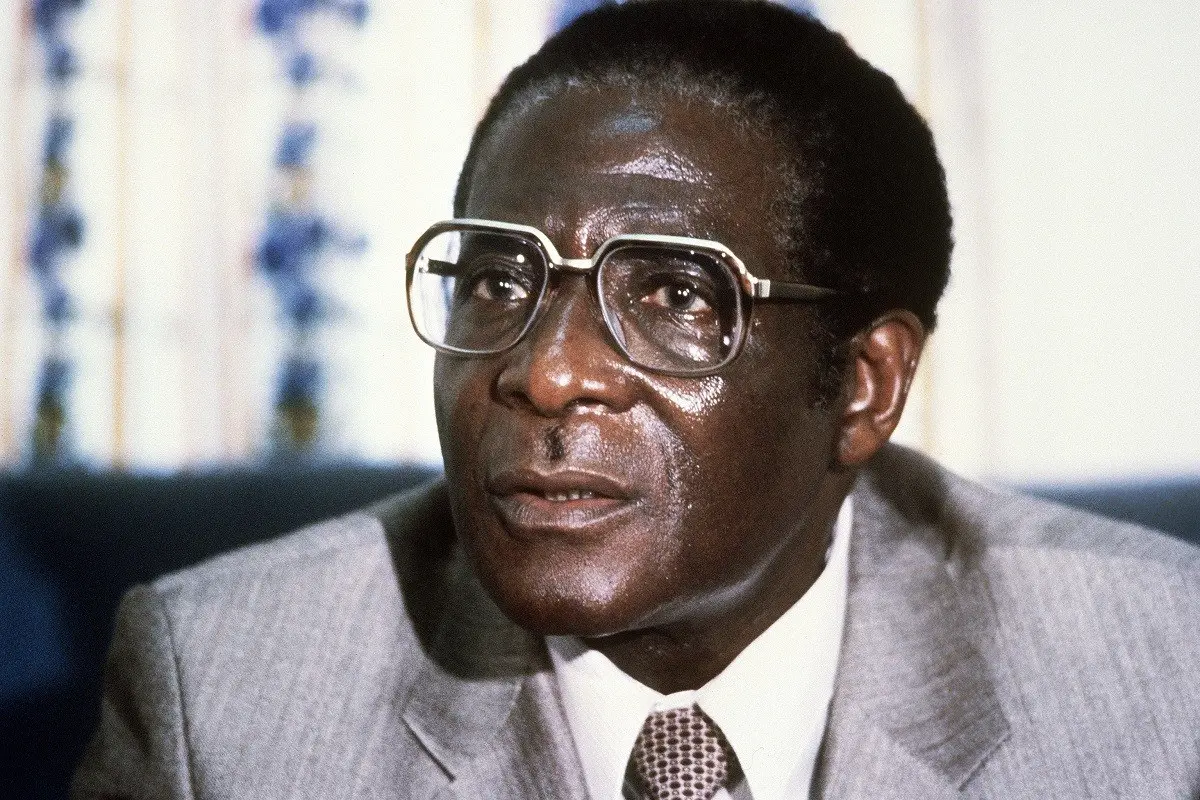
For years before his unthinkable resignation in November 2017, the name Robert Mugabe on the internet, and on social media above all, made people, mostly young ones, wonder what new funny or ludicrous thing the ageing Zimbabwean president had said. His eccentricities had grown into a legend that the era of online fake news was happy to exploit, and all sorts of absurd statements were attributed to the 93-year-old leader, a few of them true and most of them false.
Mugabe had been many things before he became an internet punchline. He was a lonely mission boy, a teacher, a political prisoner, a liberation leader and the man who opened Zimbabwe’s schools. He was also the ruler whose later years brought repression and economic ruin.
The beginning
He was born on 21 February 1924 in what was then Southern Rhodesia, a British colony run by its white minority. That minority numbered about 39,174 in 1924 and reached some 270,000 at its peak in the 1970s, while about six million black Africans faced wide discrimination.
In some of the worst cases, black subsistence farmers were forced off their ancestral land and pushed to the edges of the country, where the soil was dry and the rain scarce. The most fertile areas were kept for white farmers.
The reclaiming of land became one of Mugabe’s main causes. It lay behind the 1970s war that brought him to power.
He has been described as a lonely boy who found comfort in books, with no father figure to look up to. His father, a carpenter, is reported to have abandoned the family when his son was very young.
In her book Dinner with Mugabe, Heidi Holland describes how, at the age of 10, the boy would do anything to please his mother, who had become depressed after her elder son, Michael, died after eating poisoned maize in 1934. It earned the young Mugabe the name “mummy’s boy” at school (Wikipedia, citing Holland).
A teacher influenced by Nkrumah
After his studies in South Africa, Mugabe qualified as a teacher and in 1958 moved to Ghana to work. The timing matters. Ghana had just become the first country in sub-Saharan Africa to win independence from colonial rule.
Mugabe was deeply influenced by the pan-Africanist speeches of Ghana’s leader, Kwame Nkrumah. Encouraged by his Ghanaian wife, Sally, he resolved to achieve the same at home.
Prison and the rise to leadership
He returned to Rhodesia in 1960 and began a vocal campaign against discrimination. He was arrested in December 1963, sentenced in 1964 and held until November 1974, much of that time in detention without trial.
He learned of his son’s death while in prison, and the authorities refused his request to visit his wife in Ghana to console her. According to Father Emmanuel Ribeiro, his priest during his imprisonment, Mugabe got through his grief “partly through the strength of his spirituality”, but also because his “real strength was study and helping others to learn.” It is no surprise that he earned two law degrees through the University of London’s external programme.
In 1974, while he was still in prison, he displaced Ndabaningi Sithole as leader of the Zimbabwe African National Union (Zanu), one of the movements fighting white rule (Britannica).
He was released in November that year and later escaped to Mozambique, from where he directed Zanu’s guerrilla war against the Rhodesian government.
Prime minister and then president
When the white minority government agreed to the black nationalists’ demand for independence, Mugabe won the first election that brought in African majority rule. He was sworn in as prime minister in April 1980, and the country was renamed Zimbabwe.
In 1987, at Mugabe’s urging, Zimbabwe’s parliament amended the constitution to make him executive president. Alongside heading the government, he was now head of state and commander-in-chief of the armed forces.
That change marked a turning point for the once-feted revolutionary, who would slide gradually into autocracy. His later years were marked by the violent repression of political opponents and by chaotic political decisions that ruined Zimbabwe’s economy.
A teacher who educated his country
One of Mugabe’s lasting legacies is in education. From 1980 his government widened access to schooling and health care for black Zimbabweans, and for a time the country’s living standards were well above those of its neighbours.
Run by a former teacher, the country reached one of the highest literacy levels in Africa (Wikipedia).
Sally’s death and Grace Mugabe
Various commentators have described Mugabe’s first wife, Sally, as a strong moderating influence on him, especially in politics. The opposite has been said of Grace Marufu, the second wife he married after Sally’s death.
They married in 1996. Grace was 41 years his junior.
“He changed the moment Sally died […],” said Wilf Mbanga, editor of The Zimbabwean newspaper and once a close personal friend of Mugabe.
Mugabe’s government became known not for its education policy but for silencing opposition voices, manipulating and rigging elections, abusing human rights and corruption.
An inglorious exit in 2017
He had boasted that only God, who had appointed him, could remove him from office (Mail & Guardian). In November 2017 he was told to resign or face impeachment, and he was replaced by his former protégé, whom he had sacked barely two weeks before.
Mugabe had been preparing the ground for his wife to succeed him until his own party stopped him.
What Zimbabweans think of Mugabe
On the streets of Zimbabwe, Mugabe’s death has divided people. Some point to the liberation struggle and his strides in education. Others cannot forgive his autocratic rule.
Sithandazile Dube, a 33-year-old vendor, will remember him for his part in the liberation struggle and for opening education to women as well as men.
“I am sad, our father has left us. I don’t know what the future of this country will be like without him. He liberated this country and for me, as a woman, I was able to go to school. Today I can stand for myself as a woman because he did a lot to help us get equality with men,” she told Al Jazeera.
Why he is also so resented is captured by Isaac Maenzanise, a 47-year-old street vendor who spoke to the same outlet.
“We suffered a lot under this man and I’m happy he’s gone. God was late in taking Mugabe, but he has done well by finally taking his life. I can’t say that we’re free now that he’s gone because ZANU-PF is still in power and they are still behaving in the same way, I will be very happy if they [ZANU-PF] could all go the same way,” he said.



