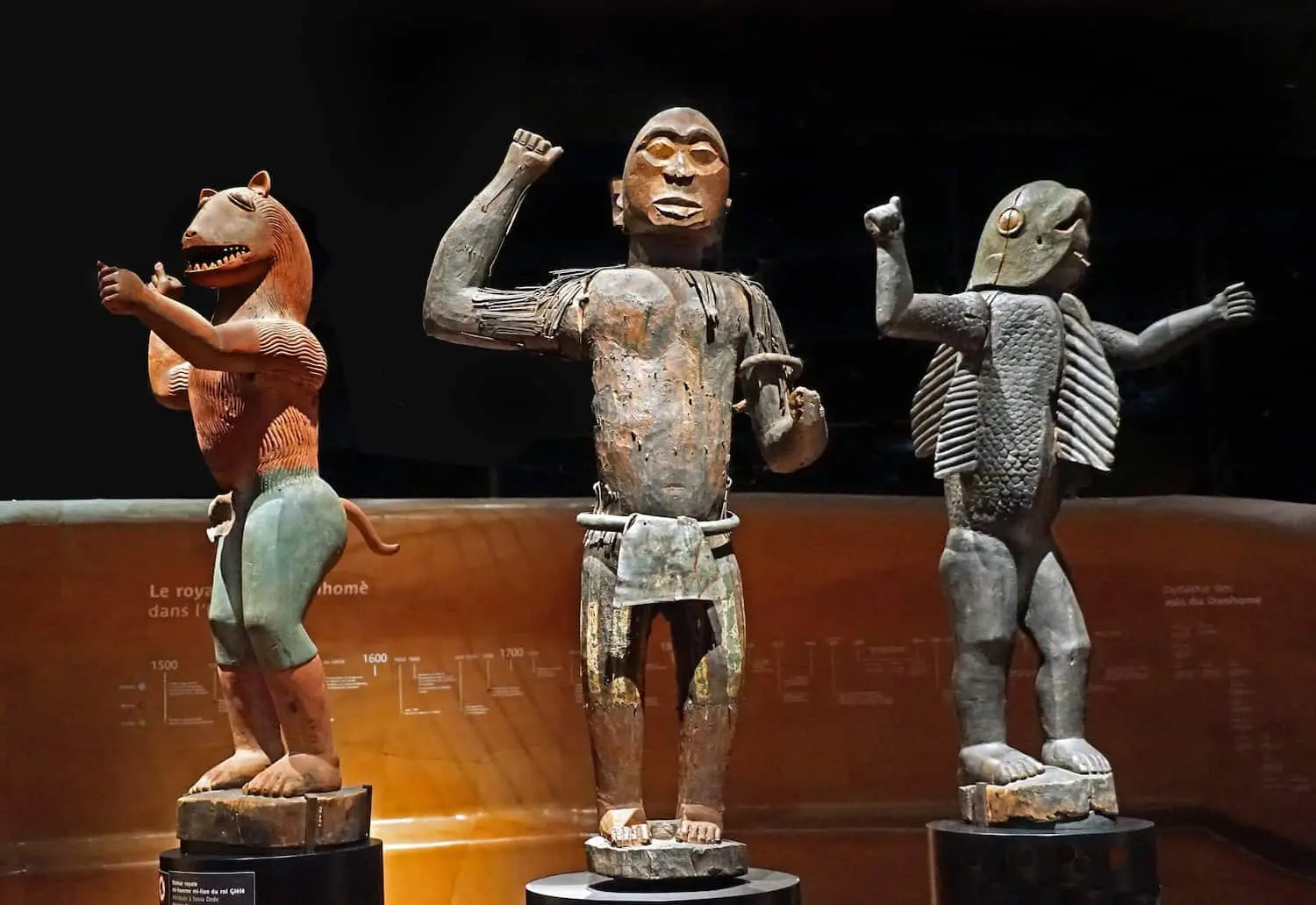
For close to three centuries, the kings of Dahomey ruled one of the strongest states on the West African coast from Abomey, in today’s Benin. They had no written records. Their history was modelled in clay on the walls of their palaces, and those walls, burnt by one king, eaten by rain and swept by bushfire in our own century, are still standing.
The Royal Palaces of Abomey sit at the centre of the town, the old capital of the kingdom. The site covers about 47 hectares (116 acres) and holds 12 royal palaces. The Fon people founded the kingdom in 1625, and between 1625 and 1900, 12 kings ruled it. Each built his own palace inside the same cob-walled enclosure, beside those of his predecessors, in the order of succession.
Kings and builders
King Houegbadja (1645–1685), the founding father of the city, settled the kingdom on the Abomey plateau. He laid down its political rules and its law of succession, and he began the building of palaces. His son Akaba broke the pattern. He built his palace in a separate enclosure on the site, cut off from Houegbadja’s by one of the city’s main roads and by houses.
How the palaces were built
The palaces could house up to 8000 people. All were walled and arranged around three courtyards, outer, inner and private, and each followed the taste of the king who built it. Within that common plan the buildings were distinct. The first inner courtyard ran from the Kpododji to the Honnouwa. The second, the Jalalahènnou, was reached through the Logodo. In the second courtyard stood the Ajalala, a building with openings of many kinds and walls carved with images in bas-relief.
The builders used what the land gave them. Earth formed the foundations, floors and walls. Palm, bamboo, iroko and mahogany supplied the woodwork, and the roofs were of straw and sheet metal.
History written on the walls
With no written documents, the polychrome bas-reliefs served as the kingdom’s record book. They show the military campaigns of the Fon, the powers of the king, and the myths, customs and rituals of the people. They were set into walls and pillars, shaped from ant-hill earth mixed with palm oil and coloured with vegetable and mineral pigments. They are still the most striking feature of the palaces, and many of the originals have been moved to the museum and replaced on the walls by replicas.
The site was nearly lost once before. King Béhanzin (1889–1894) defied the French by ordering the city and its palaces burnt in 1892 as their army advanced. Most of the monuments came through the fire, among them the palaces of Glèlè and Guézo, which were restored and now house the museum. Other damaged parts have since been rebuilt.
Restoring the reliefs has been slow, hands-on work. Since the early 1990s the Getty Conservation Institute has supported conservation of the bas-reliefs, and some fifty badly damaged bas-reliefs from King Glèlè’s Ajalala were conserved with the direct involvement of the staff of Benin’s cultural heritage service. Many of the artists employed at the palaces come from the Ouémé area.
The Abomey Historical Museum
The French colonial administration opened the Abomey Historical Museum in 1943. It occupies about 2 hectares (5 acres) in the palaces of King Guézo and King Glèlè and holds most of the objects taken from the palaces, about 1,050 in all. Most belonged to the kings of Danhomè. Among the most symbolic are the appliquéd “king” quilt, drums, and paintings of ceremonies and of the war between Dahomey and France. Some of the ritual objects on display are still used by the royal family of Dahomey in its religious rites.
World Heritage status and the bushfire
UNESCO inscribed the Royal Palaces of Abomey on the World Heritage List in 1985, under criteria (iii) and (iv), for their cultural importance. The site was also placed on the List of World Heritage in Danger, and it came off that list in July 2007.
Less than two years later, on 21 January 2009, a bushfire of unknown cause tore through the site. Driven by the harmattan wind, it burnt the straw roofs, damaged several surrounding buildings and destroyed the tombs of Kings Agonglo and Ghezo and their wives.
The authorities moved at once to restore what had burnt. Their plan included drying out the damaged structures and installing fire-fighting equipment against a repeat. International organisations helped with the work at the request of the Benin authorities and the World Heritage Centre. The legal framework was already in place. In August 2007 Benin had adopted Law No. 2007-20 of 23 August on the protection of cultural heritage and natural heritage of cultural significance, building on a 2006 urban planning regulation of the City of Abomey that set out how the site should be protected.



