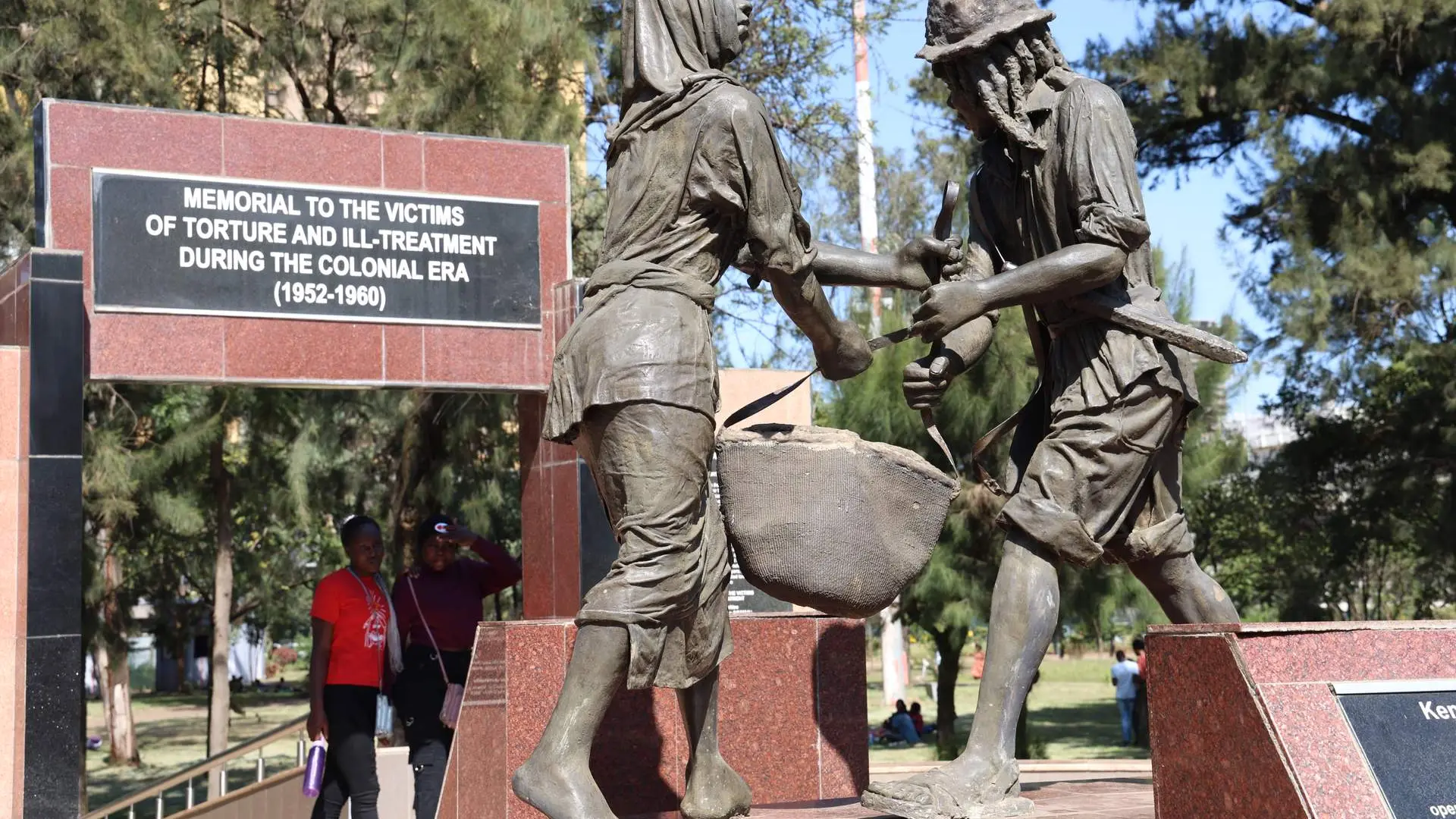
The Mau Mau movement was a revolt against the British colonial state in Kenya, against its policies and against the Africans who served it. It lasted from 1952 to 1960. It lost the war in the forests, yet it helped to hasten Kenya’s independence.
Its causes lay in land and power. Kikuyu tenants were expelled from settler farms, white settlers took African land, poverty deepened, and Africans had no real political voice.
How the movement emerged
The revolt drew mainly on the Kikuyu, the largest ethnic group in the colony. It took shape once radical Kikuyu militants were brought into the nationalist Kenya African Union (KAU). They set aside its moderate, constitutional programme for a militant one and spread oath taking through Kikuyu communities, often by intimidation and threats. An oath was believed to bind the person who swore it to the cause, and breaking one could bring dire consequences, death among them. Where the name Mau Mau came from is unknown, and the ambiguous term has been given many meanings. As the movement grew, popular pressure swept moderate Kenyans aside, and many KAU branches took a more radical line.
The government and the settlers saw the movement growing but offered nothing beyond a few token measures. They kept their repressive policies and even proposed laws that would cut African rights further. That rigidity pushed the Mau Mau into armed resistance. The failure to take the squatter movement seriously showed that colonial officials did not believe Kenyan nationalists could organise real opposition to colonial rule. The British answer was ‘de-oathing’ ceremonies. The revolt was overwhelmingly Kikuyu, but the evidence shows that some individual Luo, Luyia and Maasai took part.
The uprising
When the conflict really began is disputed. Officially, the war started in October 1952, when an emergency was declared and British troops were sent to Kenya. The guerrillas called themselves the Land and Freedom Army, a name that joined the two grievances behind the revolt, one economic and one political. On the political question they never wavered. Kenya had to be independent of Britain.
Kikuyu anger at European settlement and at their exclusion from politics grew through the early 1950s. It broke into the open in the latter half of 1952, when the banned secret society attacked Kikuyu loyal to the government, and then turned on European settlers on their isolated farms. Armed bands made their bases in the forests of the Aberdares and Mount Kenya and came out to strike at officials and settlers.
Mau Mau’s first victims were Africans. In 1952 its fighters went after police witnesses who had given evidence against Africans, above all in Mau Mau cases, and killed prominent Kikuyu collaborators. A few white settlers were attacked as well. The police answered with mass arrests of suspected supporters and preventive detention for others, hoping to cut the movement off from its base. The indiscriminate repression did the opposite and drove many more Kenyans to the movement. The government urged Kikuyu chiefs to denounce Mau Mau and to administer ‘cleansing oaths’ that were meant to release people from their pledges to the anti-colonial cause. KAU officials, Kenyatta among them, also condemned the movement’s actions in public.
The killing that changed official minds came in October 1952. Senior Chief Waruhiu, a prominent collaborator and the harshest critic of Mau Mau among the Kikuyu chiefs, was shot dead near Nairobi. Mau Mau supporters celebrated, and the government was alarmed. Only now did the administration accept that the movement threatened colonial rule itself, and it chose to confront the rebels directly. Two weeks after Waruhiu’s death the Governor, Evelyn Baring, declared a State of Emergency.
The emergency opened with Operation Jock Scott, a coordinated police sweep that arrested 187 Kikuyu the government regarded as Mau Mau leaders. KAU leaders were among them, Jomo Kenyatta, later Kenya’s first president, included, but many members of the Mau Mau Central Committee escaped. The authorities hoped the arrests, with British troops now in the colony, would frighten the rebels into submission. Mau Mau supporters replied by killing another senior Kikuyu chief and several white settlers.
On 26 March 1953 the movement struck twice. At Naivasha, fighters attacked the police station, inflicted a humiliating defeat on the police and freed 173 prisoners, many of them Mau Mau, from the detention camp next door. At Lari, Mau Mau fighters fell on the families of loyalist Home Guards. It was the largest single massacre of the uprising. Approximately 74 people were killed and about 50 wounded. The Home Guard, settlers and colonial forces took revenge, and the massacre and the reprisals together left around 400 people dead, although there is no official number and the real toll may have been much higher. The government used Lari to portray the Mau Mau as brutal savages. For many Kikuyu it was a turning point that forced them to choose a side.
Raids on police and loyalists went on through 1953. In the forests the rebels slowly formed themselves into military units, but they never had enough weapons, supplies or training.
Repression and defeat
The security forces turned to collective punishment, once more to drain popular support from the Mau Mau. If one villager was found to be a supporter, the whole village was treated as one. Many Kikuyu were evicted, forced to leave their homes and possessions behind and sent to areas set aside as Kikuyu reserves. Those suspected of involvement were processed through concentration camps, the most brutal part of the policy. Abuse and torture were commonplace there. Guards used beatings, sexual abuse and executions to extract information and to force prisoners to renounce the anti-colonial cause. The evictions further angered Kikuyu who had already lived through decades of land reallocation, and they drove hundreds of squatters into the forest to fight.
The British troops sent to Kenya had little experience of forest warfare. After a short and ineffective spell in the forests they gave way to units of the King’s African Rifles, the colonial African regiment, and patrolled the forest edges instead. British Army planes bombed Mau Mau camps and strafed the forest with machine guns. The thick canopy limited the military effect, but the long bombing campaign wore down the fighters’ morale. Several large engagements were fought during 1953, and the poorly equipped Mau Mau forces lost heavily. By the end of that year over 3,000 Mau Mau had been confirmed killed and 1,000 captured, and almost 100,000 alleged supporters had been arrested. Waruhiu Itote, the commander known as General China, was captured on 15 January 1954.
The movement still fought on, keeping up its attacks on settlers and collaborators, above all in Nairobi, where it had a large clandestine following. The British set out to destroy that urban base for good, and in 1954 launched Operation Anvil. Police swept through Nairobi and detained anyone they thought suspicious. Tens of thousands of Kikuyu men were sent to concentration camps without being told why they had been arrested or what crime they were accused of. In the countryside the government began ‘villagisation’, moving rural Kikuyu out of their scattered homesteads into new villages under British control.
By the end of 1955, 1 million Kikuyu had been driven from their family homes into these villages, which were little more than fenced camps and were prone to famine and disease. Harsh as they were, the measures in Nairobi and in the countryside cut off much of the material and logistical support on which the forest fighters depended.
In early 1955 British forces began sweeping the forests to drive out the remaining Mau Mau, who were by then short of food and ammunition. Few fighters were killed, but their position was so precarious that the constant disruption weakened them further. In some districts the government turned out the entire African population, in one case as many as 70,000 people, to comb the forest and kill any Mau Mau they found. By the end of the year an estimated 1500 Mau Mau fighters were left in the forests, in a wretched state. The following year Dedan Kimathi, the most important of the remaining commanders, was captured and put on trial. The last fighters could no longer resist in any meaningful way and were simply trying to survive. That effectively ended the uprising. British troops soon left Kenya, and although the State of Emergency stayed in place until 1960, there was little reason for it.
Official government figures put the number of Mau Mau killed at 11,503, and there is little doubt that the true figure was far higher. Mau Mau killed just 32 white civilians.
Legacy
The revolt was aimed chiefly at the colonial forces and the white settlers, but much of the killing was between rebel and loyalist Africans. It often looked like a civil war, with atrocities on both sides.
The Mau Mau forest armies were largely broken by the end of 1956. In 1960 the emergency was declared over, and the British government brought in reforms. Three years later, in 1963, Kenya won its independence from Britain, and Jomo Kenyatta, whom the colonial authorities had accused of leading Mau Mau, became the new nation’s first president.
The Mau Mau was led almost entirely by peasants, many of whom could not read or write. Beaten militarily, it still forced Britain into political reform. African political parties were allowed again in 1955, and a series of constitutional changes followed that ended in independence on 12 December 1963.
The legacy of the revolt remains complex and contested in Kenya, and some still ask how the movement should be remembered.



