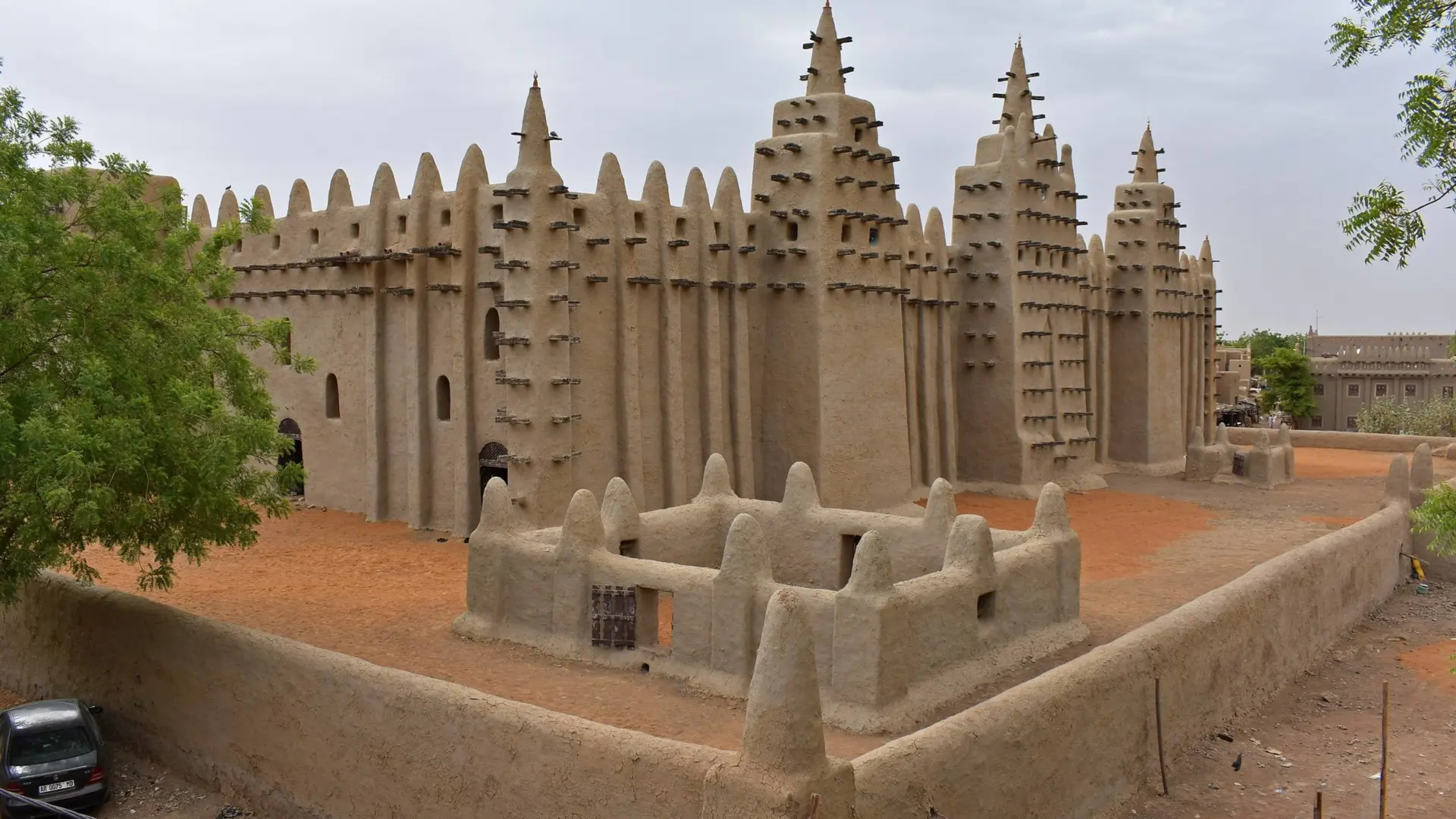
The Great Mosque of Djenné, in central Mali, is the largest mud-brick building in the world and the greatest achievement of Sudano-Sahelian architecture, the building tradition of the Sudanian and Sahel grasslands of West Africa. It is the centre of the town’s religious and cultural life. It is also a building that the rains would wash away within a few years if it were left alone. Every year the people of Djenné climb its walls and replaster it by hand, in a festival known as the Crépissage de la Grande Mosquée.
That makes the mosque something other than a monument. Its form has been held in place less by any single architect than by a community that must remake it each year, and that has repeatedly refused to let others remake it on their terms. The story of the mosque is a story about who decides what Djenné’s heritage is.
A town built of earth
Djenné stands on an island in the inland delta of the Niger River. According to UNESCO, the site and nearby Djenné-Djeno have been inhabited since 250 BC, and building in earth is as old as settlement there. The town grew into a hub for traders moving gold, salt and slaves in and out of Timbuktu, and into a centre of commerce, learning and Islam, which took hold there around the start of the thirteenth century.
The earliest document to mention the mosque is the Tarikh al-Sudan, the chronicle Abd al-Sadi compiled in the mid-seventeenth century, apparently from the oral tradition of his time. In that tradition, Koi Konboro, Djenné’s first Muslim ruler, built the first mosque with local materials and local building methods. Nobody knows exactly when; dates as early as 1200 and as late as 1330 have been suggested. His successors added two towers and an enclosing wall, and the compound kept growing over the following centuries.
Ruin, rivalry and rebuilding
The first European description came from the French explorer René Caillié, who was in Djenné in 1828 and wrote about it in his Journal d’un voyage à Temboctou et à Jenné (Journal of a Voyage to Timbuktu and Djenné). “In Jenné is a mosque built of earth, surmounted by two massive but not high towers; it is rudely constructed, though very large,” he wrote. The building he saw was already falling apart. His account suggests it had gone unplastered for several years, and that the rains had stripped the plaster and worn down the brick beneath. In the Sahel, the belt between the Sahara and the humid savannahs to the south, an earthen building left without regular replastering melts.
The neglect was partly a matter of politics. Seku Amadu, the Fulbe reformer whose Massina state took Djenné, thought the old mosque too lavish. He let it decay and, between 1834 and 1836, built a plainer mosque not far away. When French forces captured Djenné in April 1893, they demolished Amadu’s mosque. The French journalist Félix Dubois, who arrived soon afterwards, found the ruins of the original being used as a cemetery. In Tombouctou la Mystérieuse (Timbuktu the Mysterious), published in 1897, he drew a plan and a picture of how he imagined it had looked.
The present mosque was completed in 1907, under French rule, and it soon became a political symbol both for the town and for the colonial power. Some scholars have argued that the French built it, but no colonial documents support the claim. Newer scholarship credits Djenné’s guild of masons, working with forced labourers whom the colonial authorities brought in from villages in neighbouring regions. Musicians with drums and flutes kept the workers going as they mixed tons of mud, sand, rice husks and water into the bricks that still form the walls. The building now taken as the emblem of Malian tradition was raised by local craftsmen under colonial coercion.
A design shaped by rain and flood
Much of the design answers to the climate. The mosque stands on a platform about 75 by 75 metres, raised 3 metres above the marketplace so that floods from the Bani River cannot reach it. Six stairways, each decorated with pinnacles, lead up to it, and the main entrance is on the north side. The outer walls are not quite at right angles to one another, which gives the plan a slightly trapezoidal outline.
The walls are sun-dried earth bricks, called ferey, laid in a sand and earth mortar and coated with the plaster that gives the building its smooth, sculpted look. Bundles of rodier palm sticks, called toron, project about 60 centimetres from the surface. They are decoration, and they are also permanent scaffolding for the yearly repairs. Ceramic half-pipes carry rainwater off the roof and away from the walls. Vents in the roof, capped with removable fired-clay bowls, let hot air escape and keep the interior cool even on the hottest days.
The qibla wall faces east towards Mecca and looks over the market. It is about a metre thick, strengthened by eighteen buttresses, each crowned with a pinnacle, and dominated by three box-like minarets, the central one around 16 metres high. Their conical pinnacles are topped with ostrich eggs, a symbol of fertility and purity in the region. The imam leads prayers from the mihrab in the central tower and preaches the Friday sermon from the minbar beside it.
Behind the qibla wall, the prayer hall, about 26 by 50 metres, is a forest of ninety massive earthen pillars under a mud-covered palm-wood roof. Little light comes in through its few small windows, and the floor is sandy earth. To the west lies a courtyard of 20 by 46 metres, enclosed on three sides by galleries, the western one reserved for women. Some accounts put the mosque’s capacity at 3,000 worshippers. On the terrace in front of the eastern wall is the tomb of Almany Ismaïla, an important imam of the eighteenth century.
Since 1907 the design has changed only in detail. The mihrab tower once had a pair of large recesses instead of a single niche, and there were far fewer toron, none of them on the corner buttresses. Photographs show that two more rows of toron were added to the walls in the early 1990s.
A festival that is also conservation
At the Crépissage, the whole town takes part. The plaster is banco, a mixture of soil, water, rice bran, shea butter and baobab powder, worked with fine alluvial clay from the Niger and Bani rivers. It shields the walls from the erosion of torrential rain and from the cracks that hot weather opens in them. Men mix the material. Women bring water for the mixture. Musicians play, as they did when the mosque was built. Elders sit on the terrace walls and give advice, and boys sing, run and dash everywhere.
This is conservation, though not of the kind practised in museums. The mosque survives because the people who use it remake it, with their own materials and at their own festival, and the remaking is as much the heritage as the walls are. That is why Djenné’s residents have resisted attempts to change either one. Some have tried to stop the music at the Crépissage. Foreign Muslim investors have offered to rebuild the mosque in concrete and to tile its sand floor. The town has turned them down and kept both the building and the festival as they were.
In 1988 UNESCO inscribed the old towns of Djenné, with the Great Mosque at their heart, on its World Heritage List, and the mosque appears on Mali’s coat of arms. Those honours recognise a choice the town had already made. The building’s survival still depends on what it has always depended on, the people of Djenné climbing its walls each year with fresh mud.



