Thomas Sankara ruled Burkina Faso for only four years, from 1983 to 1987, yet few African leaders of his generation are remembered as vividly. A Marxist and pan-Africanist army captain, he renamed his country, refused to live on foreign aid and set out to remake a poor Sahelian state by its own effort. His followers saw him as a charismatic revolutionary, and he is sometimes called “Africa’s Che Guevara.”
He was killed in a coup, and the man who replaced him undid most of what he had built. That is why his record, and the manner of his death, still matter.
A gendarme’s son
Thomas Isidore Noël Sankara was born on 21 December 1949 in Yako, in what was then French Upper Volta, the third of ten children of Joseph and Marguerite Sankara. His father, a gendarme, was of mixed Mossi–Fulani (Silmi–Moaga) heritage. His mother, Marguerite Kinda, was of direct Mossi descent.
He spent his early years in Gaoua, a town in the humid south-west where his father was posted as an auxiliary gendarme. As the son of one of the few Africans then employed by the colonial state, he grew up in relative comfort. The family lived with other gendarmes’ families in a brick house on a hill above the rest of the town.
School, church and the army
Sankara went to primary school in Bobo-Dioulasso. He worked hard, did well in mathematics and French, and went often to church. Some of the priests, struck by his energy, urged him towards the seminary. He agreed at first, but then sat and passed the entrance exam for the secular secondary system. Going on to the lycée Ouezzin Coulibaly, named after a nationalist of the pre-independence era, was a turning point. The school was in Bobo-Dioulasso, the country’s commercial centre, so he left his father’s household. There he made close friends, among them Fidèle Toé, whom he later made a minister.
His Roman Catholic parents wanted him to be a priest. He chose the army. In 1966, at the age of 17, he joined the first intake of the Kadiogo military academy in Ouagadougou. That year he saw Upper Volta’s first military coup, led by Lieutenant-Colonel Sangoulé Lamizana on 3 January 1966. The academy’s director of studies, Adama Touré, held progressive views he kept to himself in public. He invited a few of his brightest and most political students, Sankara among them, to informal discussions outside class on imperialism, neocolonialism, socialism and communism, the Soviet and Chinese revolutions and Africa’s liberation movements. It was Sankara’s first sustained exposure to a revolutionary reading of his country and the world. He also played the guitar, a passion that stayed with him.
After basic military training in 1966 he began his career as a soldier at 19. A year later he was sent to Madagascar for officer training at Antsirabe. There he witnessed the popular uprisings of 1971 and 1972 against the government of Philibert Tsiranana and first read Marx and Lenin. Those writings shaped his politics for the rest of his life and gave him the tools he would later use to reinterpret his own country’s history.
Soldier and politician
In 1974 he fought in a border war between Upper Volta and Mali and won fame for his conduct. Years later he would call the war “useless and unjust”, a sign of how far his politics had moved. He became a popular figure in Ouagadougou, and in 1976 he took command of the Commando Training Centre at Pô.
By the early 1980s the country was shaken by union strikes and repeated coups. Sankara’s record and charisma made him an obvious choice for political office, but his integrity set him against the military governments that came and went, and he was arrested more than once.
In January 1983 he became prime minister in the new Council for the Salvation of the People (Conseil de Salut du Peuple, CSP), headed by Jean-Baptiste Ouédraogo. The post opened the door to international politics and to leaders of the Non-Aligned Movement. His anti-imperialism and his popularity with ordinary people alarmed conservatives in the CSP, President Ouédraogo among them. In May he was dismissed and arrested again. On 4 August 1983 his close friend and fellow officer Blaise Compaoré led the group that freed him and overthrew Ouédraogo. They formed the National Council of the Revolution (Conseil National de la Révolution), with Sankara as president.
Four years of reform
Sankara called his programme the “democratic and popular revolution”. Its stated aims were to root out corruption, fight environmental degradation, free women, and widen access to schooling and health care, all in the service of ending imperial domination. On the first anniversary of the coup he renamed Upper Volta as Burkina Faso, “land of upright people” in Mooré and Dyula, the country’s two most widely spoken indigenous languages. Among the measures of his four years in power, from 1983 to 1987:
- Roads and a railway were built without foreign aid.
- Women were appointed to senior government posts, encouraged into work and recruited into the army, and pregnant students were given leave.
- Female genital mutilation, forced marriage and polygamy were outlawed.
- About two million Burkinabé were vaccinated between 1983 and 1985.
- A national literacy campaign was launched.
- More than 10 million trees were planted to hold back the desert.
- The government’s fleet of Mercedes cars was sold, and the Renault 5, then the cheapest car on sale in the country, became the official car for ministers.
- Salaries of public servants, his own included, were cut, and government chauffeurs and first-class air travel were banned.
- Sankara, an accomplished guitarist, wrote the new national anthem himself.
- Land was redistributed from feudal landlords to the peasants who worked it.
- Foreign aid was shunned. In Sankara’s words, “he who feeds you, control you.”
- In Ouagadougou the army’s provision store became a state supermarket open to all, the first in the country.
- Civil servants were made to give a month’s salary to public projects.
- Public servants had to wear a traditional tunic woven from Burkinabé cotton and sewn by Burkinabé tailors, so that the state leaned on local industry and identity rather than imports.
No one was exempt from farm work or from gravelling roads, not even the president, his ministers or army officers. Civic and intellectual education was built into military training, and soldiers had to work on local development projects.
The cost of control
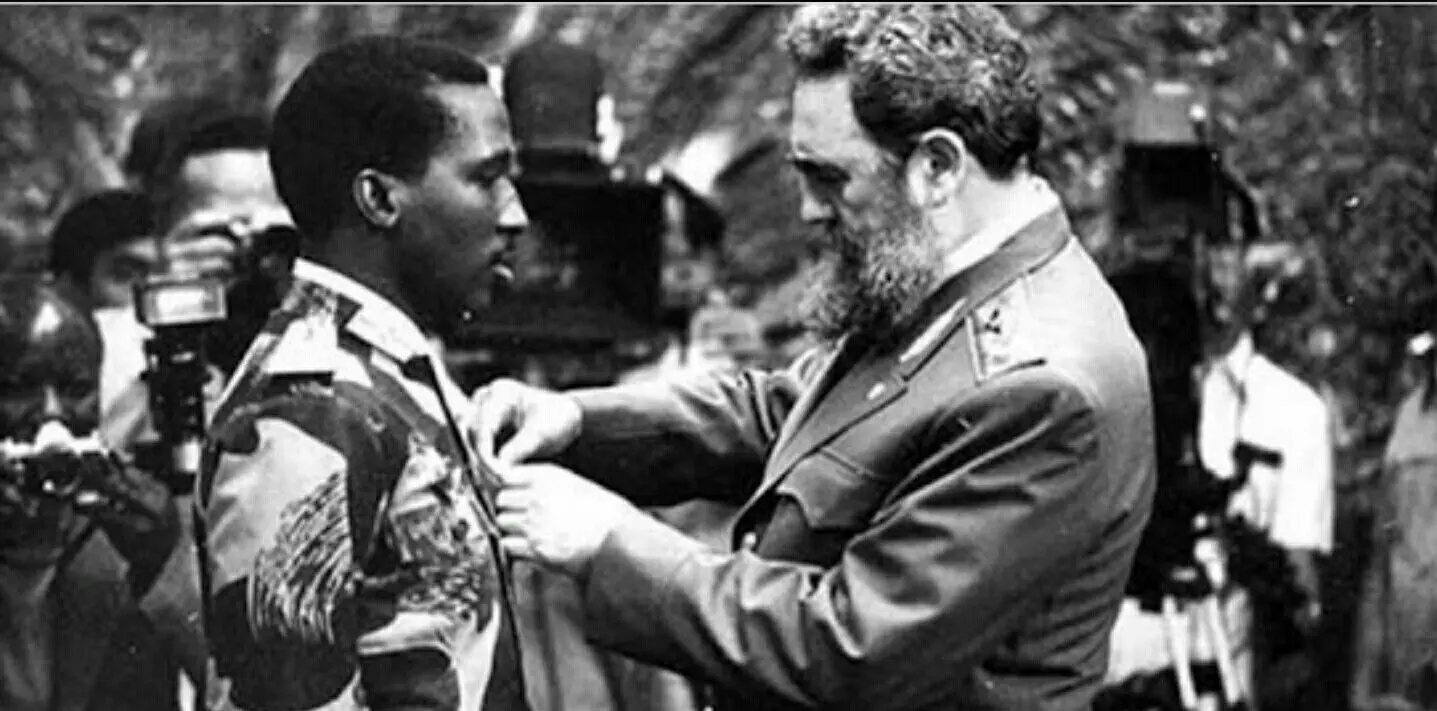
To push through so radical a change, Sankara tightened his grip on the country. Trade unions were harassed and placed under the authority of the Committees for the Defence of the Revolution (CDRs), local bodies he modelled on those of Fidel Castro’s Cuba, which he admired. Popular Revolutionary Tribunals tried corrupt officials, “counter-revolutionaries” and “lazy workers”, the government’s answer to opposition in towns and workplaces.
Dissent grew despite the gains. Some of it came from economic hardship, some from traditional quarters that resented his social reforms. He kept the loyalty of most of the poor, but he made enemies of powerful interests, among them the small Burkinabé middle class, the chiefs whom he stripped of their customary right to forced labour and tribute, France, and France’s ally Côte d’Ivoire. Support for his government ebbed, and rifts opened inside it.
Death and legacy
On 15 October 1987 Sankara and twelve other officials were killed by an armed group in the coup that brought Compaoré to power. Compaoré said that Sankara had damaged relations with France, the former colonial power, and with neighbouring Côte d’Ivoire. On 6 April 2022, long after this article was first published, a military court in Ouagadougou found Compaoré guilty in absentia over the killing and sentenced him to life in prison.
Sankara’s body, riddled with bullets, was buried in an unmarked grave, and his widow, Mariam, fled the country with their two children. Compaoré quickly reversed the nationalisations and overturned nearly all of Sankara’s policies. He rejoined the International Monetary Fund and the World Bank to bring in what he called “desperately needed” funds to restore a “shattered” economy, and set most of Sankara’s legacy aside. Compaoré stayed in power for 27 years, until popular protests drove him out in 2014.
A week before he died, Sankara had said: “While revolutionaries as individuals can be murdered, you cannot kill ideas.” His programme of African self-reliance made him an icon across the continent. He found a listless West African state and left behind, under the proud name of Burkina Faso, a country that had tried one of the most ambitious programmes of reform Africa has seen.



