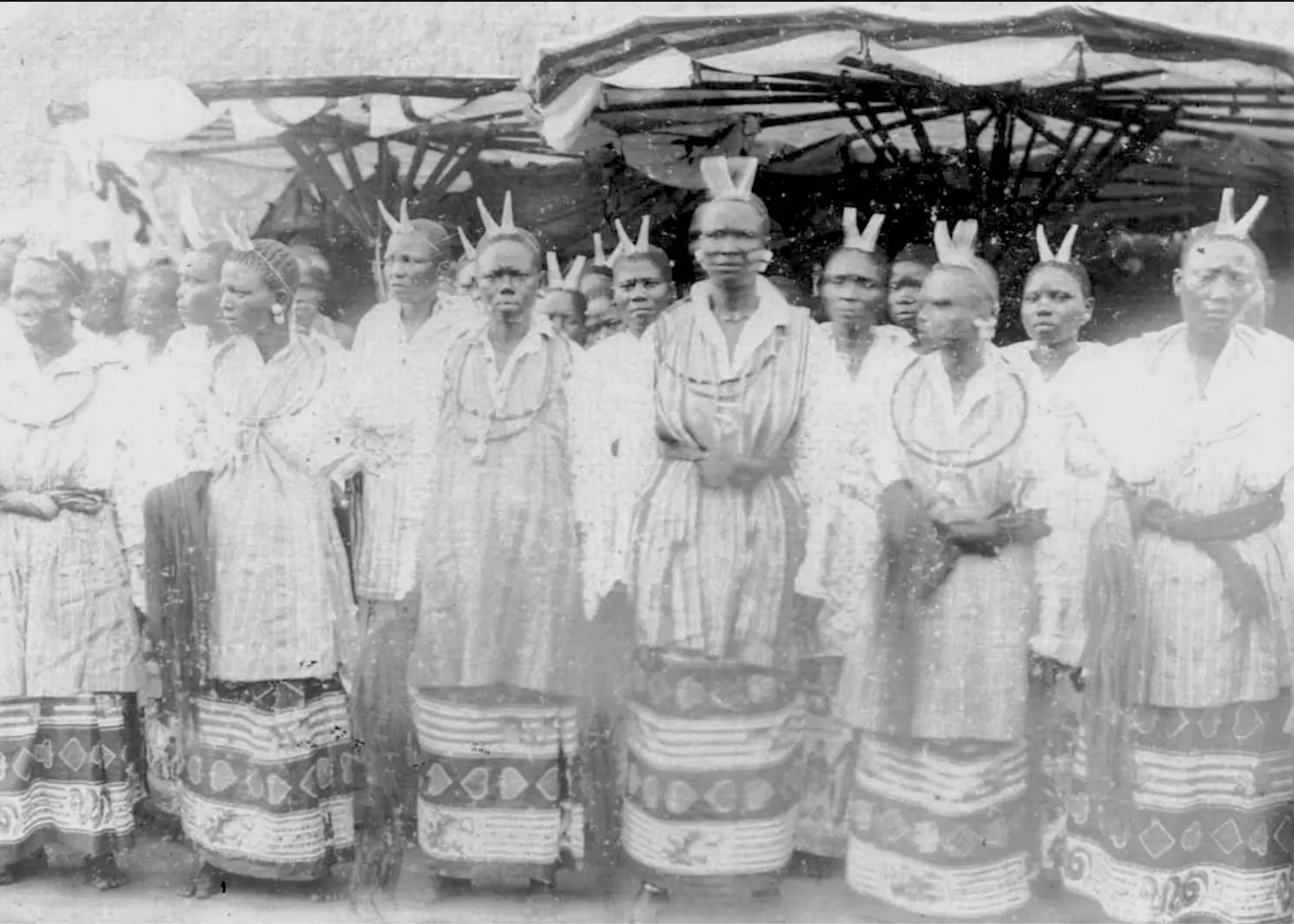
For more than two centuries the Kingdom of Dahomey, in what is now the Republic of Benin, fielded an army of women. They guarded its kings, fought on its front line and were judged by European witnesses to be braver than its men. Stories of elite warriors rooted in local cultures, such as Greece’s Spartans, Scandinavia’s Vikings and Japan’s Samurai, have been told for centuries. The women of Dahomey deserve the same recognition, and have rarely had it.
They called themselves Mino or N’Nonmiton, both meaning ‘our mothers’ in Fon. Western observers called them ‘Amazons’ after the women warriors of Greek mythology. The kingdom was largely made up of the Fon people, in the south of the country, between Togo to the west and Nigeria to the east.
Origins
The exact period when the army was formed is unknown. Some historians date it to the 18th century, when women who were deemed not beautiful enough to share a man’s bed, or who had not borne children, were armed with long poles and acted as police.
Other accounts trace the warriors back to the third King of Dahomey, King Houegbadja, who ruled from 1645 to 1685. He started the group as a detachment of “elephant huntresses”, and his son King Agaja later recognised their talent and loyalty and expanded their use by creating an all-female militia. The warriors are said to have been drawn at first from hunters known as gbeto, and later from the ahosi and from slaves taken in conquests of neighbouring villages and peoples.
By the time of King Agaja, who reigned from 1718 to 1740 (some older lists date his accession to 1708), the Dahomey Amazons were established as bodyguards armed with muskets and were used as a militia to defeat neighbouring kingdoms. King Ghezo, who ruled from 1818 to 1858, went further. He placed great importance on the army, increased its budget and turned it from a ceremonial body into a serious military force. He recruited soldiers from foreign captives, although some were free Dahomean women. At their height the women numbered as many as 6,000, around a third of the entire Dahomey army.
Life in the King’s army
Girls were recruited as young as eight years old. Some women became soldiers voluntarily. Others were enrolled against their will, after husbands or fathers complained of unruly behaviour they could not control. Recruitment was reserved for the strongest, healthiest and boldest.
The Dahomey Amazons were not allowed to have children or any form of family life, as they were formally married to the King. He did not have sexual relations with them, so they remained celibate, although a very few were given in marriage to respected dignitaries of the kingdom. Not even the King dared to break their vows of celibacy, and for anyone else, even to touch these women meant certain death.
The women enjoyed privileges such as a good stock of tobacco and alcohol, and they lived in the King’s palace after dark, which men were not allowed to do. They also had as many as 50 slaves per soldier. The historian Stanley Alpern, author of Amazons of Black Sparta: The Women Warriors of Dahomey, describes what happened when the Amazons left the palace:
“they were preceded by a slave girl carrying a bell. The sound told every male to get out of their path, retire a certain distance, and look the other way.”
For all its harshness, the army offered many women a way out of lives of forced domestic drudgery. In its ranks a woman could rise to command and to real influence, sit on the Grand Council and take part in debating the kingdom’s policy. A soldier could even grow rich as a single, independent woman.
Training
The women were trained to be strong, fast, ruthless and able to withstand great pain. They trained intensely, often in hand-to-hand combat among themselves, and discipline was strongly emphasised as they learned survival skills. Their routine included exercises resembling a form of gymnastics, such as storming walls covered with thorny acacia branches. They were sent on long 10-day expeditions in the jungle without supplies, armed only with a machete.
Training was meant to make the women merciless as well as disciplined and self-reliant, and they were deliberately hardened to the suffering of others. Their indifference to pain and death was tested during initiation, which included executing prisoners. To prove themselves, they had to be twice as tough as the men, and they fought to the death unless the King expressly ordered them to retreat.
In battle
The women’s corps is said to have mirrored the structure of the army as a whole. An elite centre guarded the King, with a wing on either side, each led by its own female commander. Some accounts even pair every male soldier with an N’Nonmiton counterpart.
The Dahomey Amazons played a key role in the conquest of the kingdom of Ouidah, and in 1840 they helped to capture the fortress of the Mahee at Attahapahms. They were armed with Dutch muskets, machetes and razors, and they were known for the speed with which they beheaded their enemies, a custom shared by warriors across the region at the time.
They were defeated for the first time when they attacked the city of Abeokuta, in today’s Nigeria. Even then, Europeans who witnessed the battle judged the Amazons superior to the male soldiers in both skill and bravery, and European records consistently rated them so.
The British explorer Richard Burton reached the coastal kingdom in December 1863 as Britain’s envoy to King Glele, sent to press him to end the export of slaves. Dahomey was a warring state that profited from the slave trade by capturing its enemies and selling them. Burton nicknamed the kingdom a “small black Sparta”. Describing the women he saw dancing on the coast, he wrote:
“Such, on the other hand, was the size of the female skeleton, and the muscular development of the frame, that in many cases femineity could be detected only by the bosom.”
The last battles
Even in the 1890s, as French expansion closed in on Dahomey, the Amazons still inspired fear. In the Franco-Dahomean Wars, many French soldiers hesitated before they would shoot or bayonet a woman. That hesitation, and the special Amazon units detailed to hunt down French officers, cost the French many casualties.
The Amazons fought their last battles in the Franco-Dahomean Wars of 1890 and 1892. The French won the second war only after bringing in the Foreign Legion and its machine guns. The Amazons were the last of the King’s forces to surrender, and most of them died in the battles of that second war. Legionnaires later wrote of their “incredible courage and audacity”.
When the French conquered Dahomey, they prohibited women from serving in the military or bearing arms. The troops were dissolved after the fall of Behanzin (Gbêhanzin), the last independent King of Dahomey, at the end of the nineteenth century. They had lived by their motto, “If soldiers go to war, they should conquer or die.” The last known surviving Amazon of Dahomey is thought to have been a woman named Nawi, who died in 1979 aged over 100 years.
A history still overlooked
Admired in their own country and feared by their adversaries, the women soldiers of Dahomey were central to its military power in the eighteenth and nineteenth centuries. Yet their legend has not found its way into the history books as easily as those of their male counterparts elsewhere, except through the women warriors of Black Panther, who were inspired by them. They struck fear into colonising troops, and their story deserves to be told alongside those of the Spartans, the Vikings and the Samurai.



