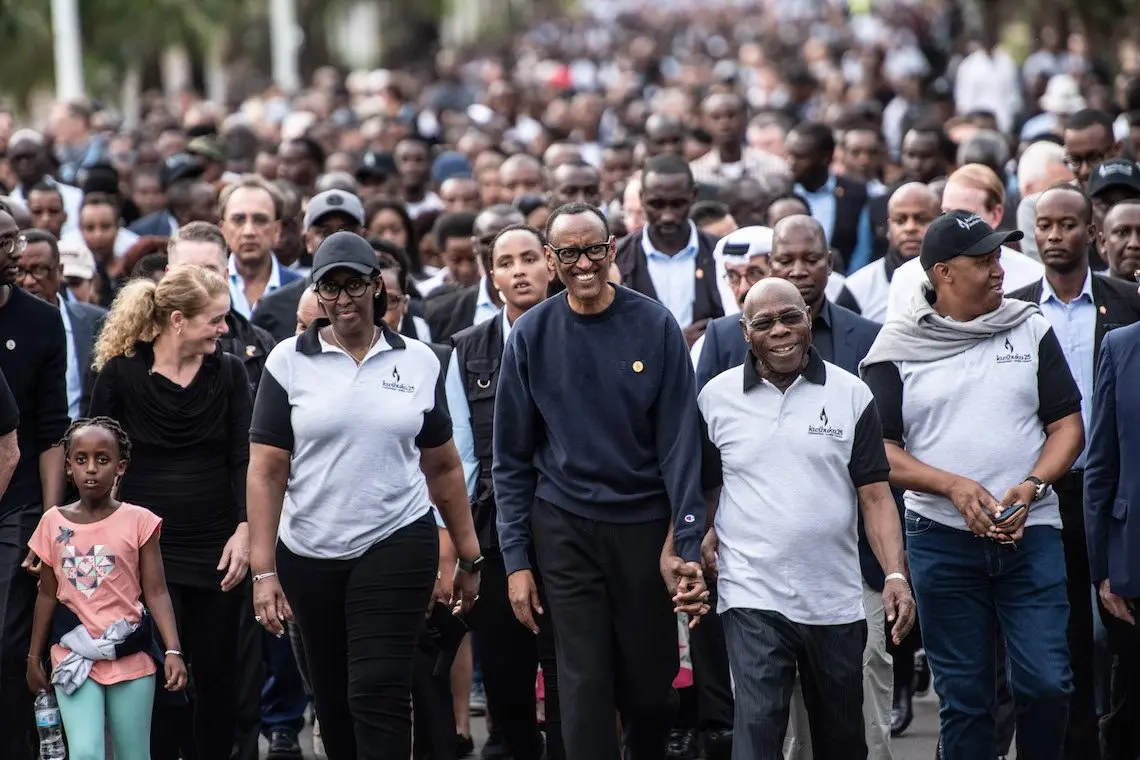
Approximately 800,000 Tutsi and Hutu were killed in Rwanda over about 100 days in 1994, in a carefully organised campaign. Twenty-five years on, three questions still demand attention: how colonial rule hardened Rwanda’s ethnic labels, why the world looked away when it had been warned, and what to make of the government that has ruled since.
The Rwandan author Immaculée Ilibagiza has written: “Rwanda can be a paradise again, but it will take the love of the entire world…and that’s as it should be, for what happened in Rwanda happened to us all – humanity was wounded by the genocide.”
Who are the Hutu and the Tutsi
Rwanda has three main ethnic groups. Nearly 85% of the population identified as Hutu, the majority. Tutsi made up 14% and Twa 1%.
The distinctions are older than colonial rule, but Europeans hardened them. Germany ruled Rwanda first, and Belgium took over in 1916. The Belgians judged the Tutsi superior to the Hutu and the Twa, a hunter-gatherer people, on the strength of supposed physical differences, and they put the Tutsi in charge. In the 1930s they issued identity cards that fixed every Rwandan as Hutu, Tutsi or Twa. Until then, people had thought of themselves first as Rwandan.
Generations of intermarriage made those labels hard to assign. Children were given their father’s group, and where a person’s origin was unclear, wealth in cattle settled it. In the rule most often cited, more than 10 cows made you a Tutsi.
As colonial rule drew to a close, Belgium shifted its favour to the Hutu. Tutsi kings had governed Rwanda until 1959, when King Mutara III died. That year Hutu peasant farmers rose in what became known as the “Hutu revolution”, which ended with the abolition of the monarchy. As the Hutu gained power, they drove Tutsi out of the country in large numbers, many of them to Burundi and other neighbours. By the end of 1964, at least 336,000 Tutsi had fled to neighbouring countries.
Tensions grew more extreme after Rwanda won independence from Belgium in 1962. Hutu leaders now held power, and from the 1960s Tutsi exile fighters were branded inyenzi, or cockroaches. The new leaders were determined to keep the power they had won from the elite that had ruled for generations. In the 1990s the Hutu political elite blamed the Tutsi for the country’s mounting political, social and economic problems, and treated Tutsi civilians as allies of the Rwandan Patriotic Front (RPF) rebels.
From civil war to genocide
Civil war broke out in 1990, when Rwandan exiles organised as the RPF invaded from their base in Uganda. The movement was mostly Tutsi, and it accused the government of failing to deal with the plight of Tutsi refugees. The war sharpened every existing tension. Inside Rwanda, all Tutsi were cast as accomplices of the RPF and every Hutu in the opposition parties as a traitor. A ceasefire was reached in 1992, and talks went on.
In 1993 President Juvénal Habyarimana was pressed into signing a power-sharing agreement with the RPF, the Tutsi-led, multi-ethnic movement that had taken up arms against him in 1990. It opened the political process to both groups. This could have been a moment of redemption for a country divided by ethnic violence for half a century. It was not.
On 6 April 1994, as Habyarimana returned from talks in neighbouring Tanzania, his plane was shot down near Kigali, the capital, and he was killed.
His death was the spark for an organised campaign of violence against Tutsi and moderate Hutu civilians across the country. Within hours, the Presidential Guard and Hutu extremist militias had taken over the streets of Kigali. Within a day, they had wiped out much of Rwanda’s moderate leadership. As the weeks went on, Tutsi, and anyone suspected of any tie to a Tutsi, were hunted down and killed. Radio extremists called on Hutu to kill the “cockroaches”, as RTLM, the station set up in 1993, had been doing for months.
The world looked away
The world had been warned. In January 1994, the Canadian general Roméo Dallaire, who commanded the small UN force sent to oversee the peace agreement, learnt that Hutu extremists were planning a genocide. He told his superiors at the UN and was refused permission to act. The outside world knew what was coming, and once the killing started it could see where it was heading. It still did nothing.
A year after US troops were killed in Somalia, the United States was determined to stay out of another African conflict. Even when the evidence of slaughter could no longer be denied, it actively discouraged the UN Security Council from authorising a stronger force. Belgium and most UN peacekeepers pulled out after 10 Belgian soldiers were killed. France, an ally of the Hutu government, sent special forces to evacuate its citizens and later set up a supposedly safe zone, but was accused of doing too little to stop the slaughter inside it.
Dallaire believes that with an extra 5,000 troops and a stronger mandate he could have saved “hundreds of thousands.” Bill Clinton calls the failure to intervene one of the greatest regrets of his presidency. That failure gave rise to the modern movement for humanitarian military intervention to prevent genocide. Two senior figures in the Obama administration, Susan Rice and Samantha Power, came to the cause partly because of America’s inaction over Rwanda.
Rwanda today
Twenty-five years on, the country is still recovering, and survivors are still struggling to find peace and to live with their pain.
In 2000 Paul Kagame, who had led the RPF, became president, and he remains in power. He has been praised for transforming the shattered country he took over, with policies that encouraged rapid economic growth. He won a third term in the most recent election, in 2017, with 98.79% of the vote.
His record is also contested. Human Rights Watch documented that RPF forces killed thousands of people in 1994, including non-combatants. Kagame has acknowledged that killings took place but blamed rogue soldiers.
Rwanda’s army invaded Zaire, now the Democratic Republic of the Congo, twice, in 1996 and 1998. Kagame said the first campaign was aimed at dismantling the refugee camps where Hutu who had fled Rwanda in 1994, among them many of the killers, had regrouped. In the Congo, the RPF backed militias fighting both the Hutu militias and the Congolese army, which was aligned with them. The Rwanda-backed rebels eventually marched on Kinshasa, the capital, overthrew Mobutu Sese Seko and installed Laurent Kabila as president. An estimated five million people died as a result of the conflict, which lasted until 2003, and some armed groups are still active in the areas near Rwanda’s border.
In 2010 a United Nations report accused the Rwandan army of widespread human rights violations and crimes against humanity in the Congo, charges the Rwandan government denied. A later UN report found that Rwanda created and commanded the M23 rebel group in the eastern Congo in 2012, a charge Rwanda also denied.
We must not forget what happened in those three months of 1994, or the warnings that went unheeded before them.



