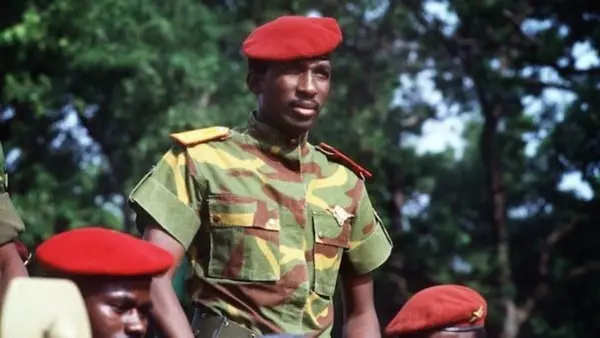
Thomas Sankara, the President of Burkina Faso, was killed in a coup on 15 October 1987. Thirty-two years later, a 5-metre statue in the capital, Ouagadougou, honours a leader whose four years in power still evoke pride in what he attempted and pain at how he died.
Thomas Isidore Noël Sankara was born on 21 December 1949. A captain in the army, a Marxist revolutionary and a pan-Africanist, he led Burkina Faso from 1983 to 1987. His admirers saw him as a charismatic icon of revolution, and he is often called “Africa’s Che Guevara”.
Visionary leader or Marxist revolutionary
Captain Thomas Sankara took power from Jean-Baptiste Ouédraogo in August 1983, after an internal power struggle.
Sankara dreamed of a state free of corruption, independent of the West and united with its African neighbours. He drew inspiration from the Cuban revolution and from his Ghanaian counterpart, Jerry Rawlings.
He launched one of the most ambitious programmes of social and economic change ever attempted in Africa. To mark the country’s new autonomy and rebirth, he renamed it from Upper Volta to Burkina Faso, “the land of upright people”.
His goal was to improve the lives of people in the countryside, where the vast majority of Burkinabè lived. Under his rule, village clinics and community centres received far more support. In 1984 mobile health teams vaccinated more than two million children in just two weeks.
He was fiercely protective of sovereignty, and some of his demands shocked and bewildered the former colonial powers. Pointing to Europe’s colonial exploitation of Africa, he called on African states to stop paying their debts to the West. His pan-Africanist political agenda was plain to see, but so was his vision in health, environmental conservation, education, women’s empowerment and much more.
In October 1987, at an event commemorating the Cuban revolutionary Che Guevara, Sankara declared in a speech: “While revolutionaries as individuals can be murdered, you cannot kill ideas!”
A week later Sankara was shot dead in a coup that brought his deputy, Blaise Compaoré, to power. The two had known each other in the army since the 1970s. A military tribunal in Ouagadougou later sentenced Compaoré in absentia to life imprisonment for complicity in the murder.
Compaoré ruled from 1987 to October 2014, reversing many of Sankara’s policies and achievements. He was forced out by mass protests against his attempt to change the constitution so that he could stay in power. Sankara became the rallying symbol of that uprising once again, as people took to the streets carrying posters of his face.
Charisma and a man of the people
Sankara was seen as humble and as a man of integrity. He never owned much.
He sold off the previous government’s luxury limousines and its fleet of Mercedes cars, and required his ministers, like himself, to drive a Renault 5, then the cheapest car available. The Renault became the official service car for all government officials and ministers. He also cut the salaries of all public servants, his own included, and banned the use of government chauffeurs and 1st-class air tickets.
As President he cut his own pay to $450 a month and kept his possessions to a car, four bicycles, three guitars, a fridge and a freezer.
When asked why he did not want his portrait hung in public places, as other African leaders did, Sankara replied: “There are seven million Thomas Sankaras.”
In support of women’s rights, the pan-Africanist banned female genital mutilation, forced marriage and polygamy, and backed the bans with heavy fines and penalties. He also appointed women to senior government posts, encouraged them to work, recruited them into the army and allowed pregnancy leave during education.
Sankara, an accomplished guitarist, is also credited with writing his country’s national anthem.
Pride, pain and memory
On Saturday 2 March, Burkina Faso unveiled a bronze statue in honour of the man who renamed the country. The statue of Sankara, along with busts of 12 of his comrades, was made by a group of Burkinabè sculptors. It stands five metres high on a four-metre base.
Many people still feel the pain of his death, because it cut short their hopes of complete revolutionary change under his guidance. Thirty-two years after his murder, Sankara, who practised what he preached and lived a selfless life, remains a name that evokes both pride and pain.



