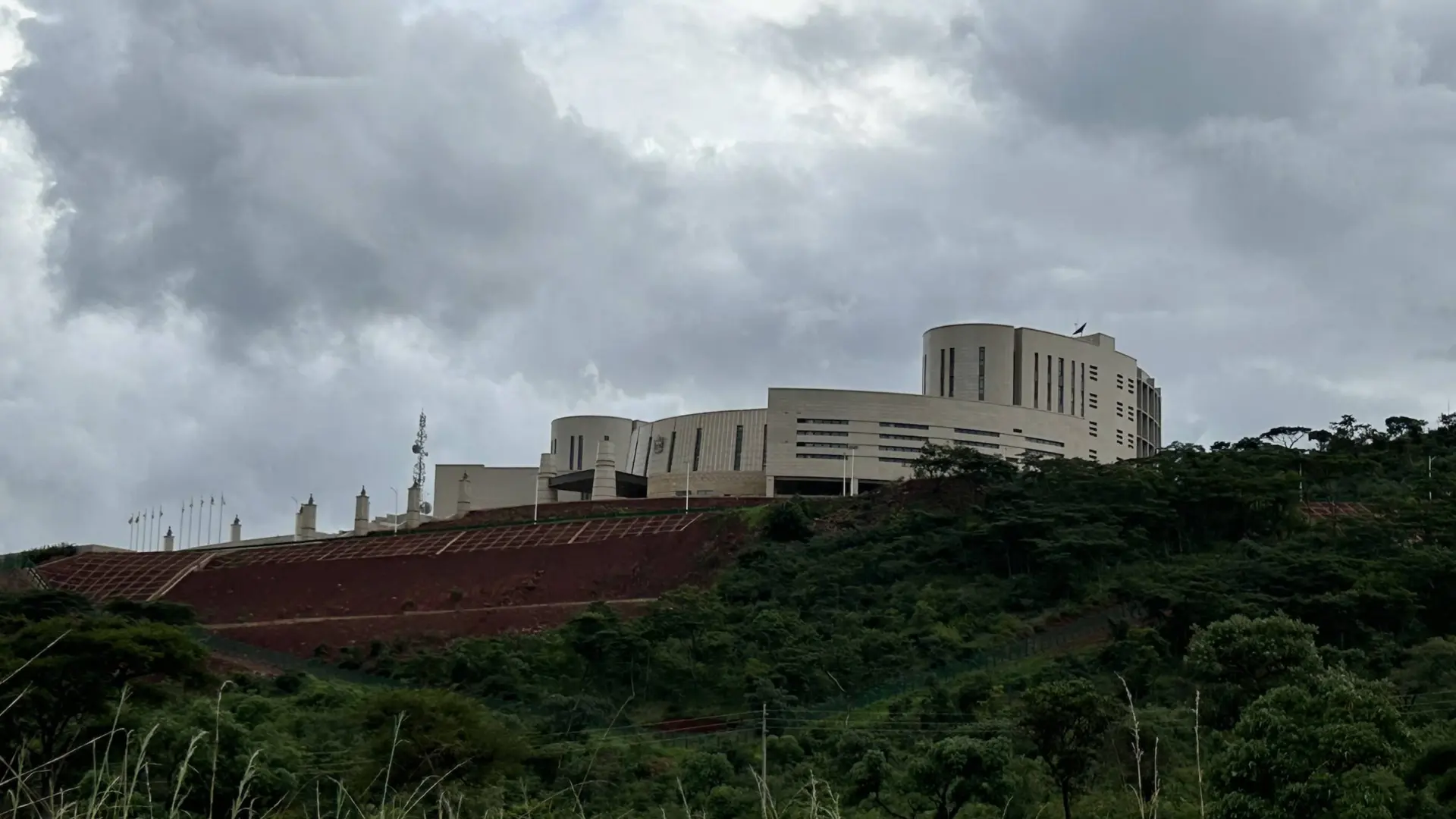
Zimbabwe plans a new administrative capital at Mt Hampden, with a parliament at its centre and a four-phase, ten-year financing plan. A functioning city requires housing, transport, water, power and institutions capable of maintaining them over time. This analysis argues that the project’s real test is one of sequence: the same institutions that have struggled to maintain Harare are the ones being asked to deliver Mt Hampden.
Harare’s water, roads and waste systems face substantial pressure. That supports a case for new urban capacity, but does not establish that upgrading existing infrastructure is impossible or that a new capital is the best use of limited resources.
The proposed plan
The design ambition is large. The parliament building stands as the institutional nucleus around which the city’s other elements are organised, placing democratic governance at the literal and symbolic centre of the new city. A ring and radial road network connecting the new metropolis to Robert Gabriel Mugabe International Airport, Norton and Ruwa provides the transport architecture. Renewable energy systems are designed into the city’s power infrastructure rather than retrofitted.
The four-phase, ten-year construction plan distributes the capital burden across time: public finance for the essential infrastructure frame, public-private partnerships for the middle phases, foreign direct investment for the commercial buildout, and private equity for sustained refinement. Egyptian specialists involved in Cairo’s own capital relocation project to New Administrative City have provided technical consultation. What the plans still need is a documented funding and delivery schedule.
The record of new capitals
The test is always execution, and African capital city projects carry a mixed record.
Egypt’s New Administrative City has progressed, though not without controversy about the social logic of relocating administrative functions away from the population centres they are meant to serve. Nigeria’s Abuja took decades longer than planned and ran far over budget, but ultimately produced a functioning federal capital. Tanzania’s Dodoma was designated as the new capital in 1973, and the relocation took decades. The difference between these trajectories is not primarily architectural. It is political. It turns on whether successive administrations treat the project as a national commitment or as their predecessor’s legacy to be managed, deferred or repurposed.
Zimbabwe’s specific risks
Zimbabwe’s relationship with international capital markets is constrained by debt arrears that complicate the foreign direct investment components of the Mt Hampden financing model. The political stability required to sustain a decade-long construction programme across multiple budget cycles depends on an institutional continuity that Zimbabwe’s recent history has not made reliable. The phased approach, which manages risk by sequencing investments, also creates the risk of phase one remaining the whole project if political conditions or financing arrangements change before phase two capital is committed.
The project will be judged by the gap between its declared ambition and its delivered reality. That gap may close over years and phases in ways that vindicate the ambition. It may instead open, adding Mt Hampden to the list of African infrastructure declarations that did not survive fiscal constraint and political discontinuity.
A new city inherits the old governance
Should a state build a new capital before it has shown it can run the old one? Harare’s failures (the unreliable water, the strained roads, the stressed administration) are not only arguments for new capacity. They are evidence about institutional capacity itself. A new city does not escape the governance that produced the old city’s decay. It inherits it, at greater scale and cost. The question is not whether Zimbabwe can imagine a capital. It is whether it can build and then sustain one, which is the rarer and less photogenic competence, and the one its recent history has most called into question.



