The Anglo-Zulu War of 1879 was a war that the British government never authorised. It was started by officials on the spot who wanted the Zulu kingdom out of the way of their plans for southern Africa. It brought the Zulu kingdom its greatest victory, at Isandlwana, and within months it had ended Zulu independence. It remains a landmark in the region’s colonial history, and its battles were among the bloodiest of the period.
A plan for confederation
The war grew out of a scheme drawn up in London. In 1874 Lord Carnarvon, Secretary of State for the Colonies, who had brought about the federation of Canada in 1867, believed the same approach, backed by military force, could unite the African kingdoms, chiefdoms and Boer republics of southern Africa under British authority. In 1875 he proposed a federation of British and Boer territories, and the Boer leaders refused.
In 1877 Carnarvon sent Sir Bartle Frere to the region as High Commissioner for Southern Africa, on the understanding that Frere would push the confederation through and could then become the first governor of a united British dominion. Frere faced obstacles, chief among them the independent South African Republic and the Zulu kingdom with its army.
On 11 December 1878, without the approval of the British government and probably intending to provoke a war, Frere delivered an ultimatum to the Zulu king, Cetshwayo. It demanded that he disband his army and abandon key cultural traditions. Cetshwayo did not reply, and when the time allowed ran out on 11 January 1879, the British treated it as a state of war.
The invasion and Isandlwana
Lieutenant General Frederick Augustus Thesiger, second Baron Chelmsford, invaded Zululand without authorisation from London. He commanded 5,000 Europeans and 8,200 Africans. Against him Cetshwayo could field about 40,000 men. Of Chelmsford’s force, 3,000 Africans guarded the Natal frontier, and another 1,400 Europeans and 400 Africans were stationed in the Utrecht district. Three columns were to cross into Zululand, from the Lower Tugela, Rorke’s Drift and Utrecht, and converge on Ulundi, the royal kraal.
On 22 January the centre column, which had come from Rorke’s Drift, was camped near Isandlwana. That morning Chelmsford split his force and rode out, leaving Colonel Pulleine in charge of the camp. A Zulu diversion drew Chelmsford and much of the column eastwards, while the main impi, nearly 20,000 strong under Ntshingwayo kaMahole Khoza, fell on the camp. Chelmsford had not set the camp up for defence and had ignored reports that the Zulu army was close.
Isandlwana was the first major battle of the war and the greatest Zulu victory in it. The centre column was destroyed and its camp overrun. It lost 806 Europeans and 471 Africans, together with all its supplies, ammunition and transport. Chelmsford had no option but to pull back out of Zululand.
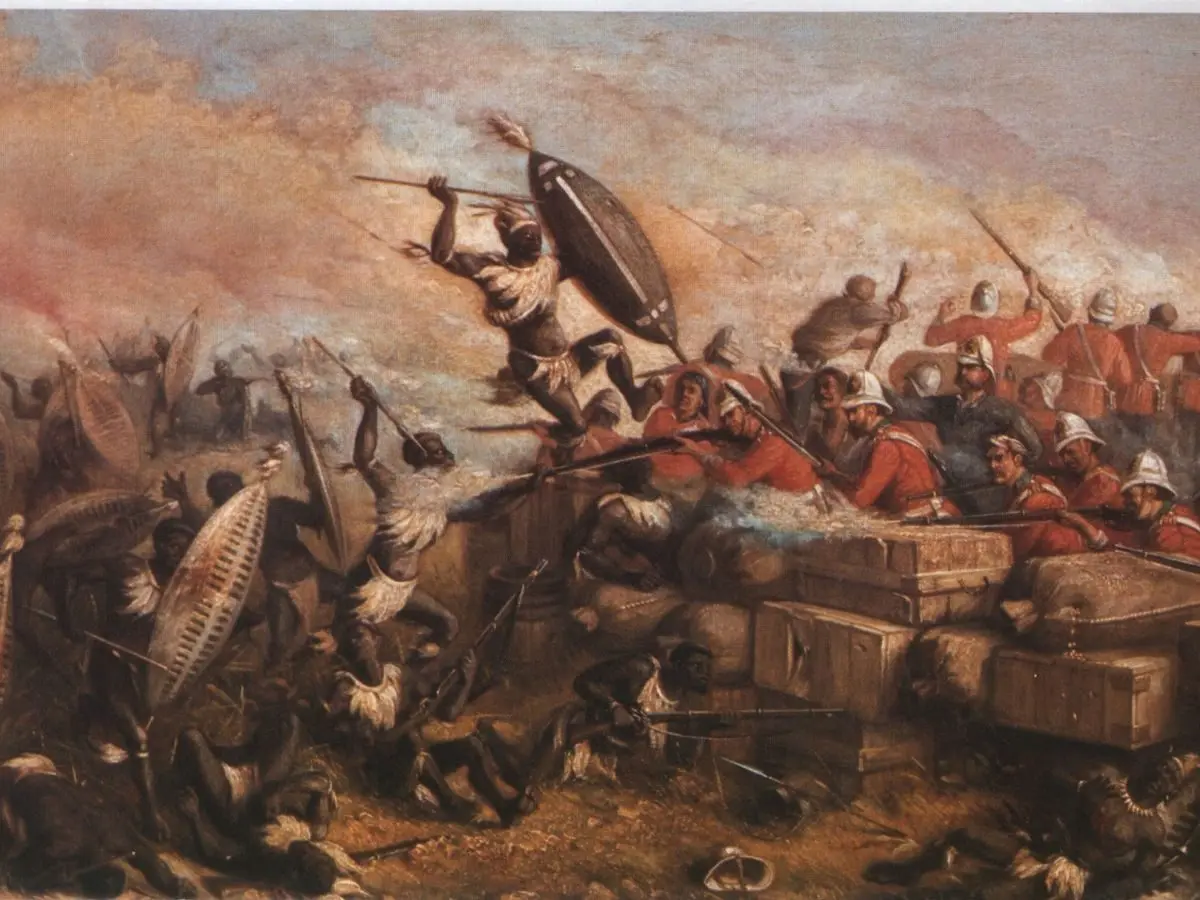
After the battle some 4,000 Zulus made an unsanctioned attack on the border post at Rorke’s Drift and were beaten off after 10 hours of fierce fighting. Chelmsford, knowing he would have to answer to the government and to history, quickly blamed Colonel Anthony Durnford, who had reached the camp later that morning with five troops of the Natal Native Horse and a rocket battery. Chelmsford said Durnford had disobeyed orders to form a proper defensive camp. There is no evidence that any such order was given, and Chelmsford had in fact left Pulleine in charge with orders not to entrench, since the camp was meant to be temporary.
Stalemate on the flanks
On the coast, the right-hand column under Colonel Charles Pearson crossed the Tugela River, fought off a Zulu impi trying to ambush it at the Inyezane River and reached the abandoned mission station at Eshowe. When news of Isandlwana arrived, Pearson considered withdrawing across the Tugela. Before he had decided, the Zulus cut his supply lines, and the siege of Eshowe began.
In the north-west, the left-hand column under Colonel Evelyn Wood, based at Utrecht, was meant to keep the Zulu clans of that region from interfering with the advance on Ulundi. Wood camped at Tinta’s Kraal, 10 miles south of Hlobane Mountain, where 4,000 Zulus had been seen, and planned to attack them on 24 January. The news from Isandlwana made him pull back to the kraal instead. A month into the invasion, only this column was still fit to fight, and it was too weak to act alone.
Chelmsford spent the next two months rebuilding his invasion force, first of all to relieve Pearson at Eshowe. London rushed seven regiments of reinforcements to Natal, with two artillery batteries.
Hlobane, Kambula and Gingindlovu
On 12 March about 500 Zulus overwhelmed an escort on its way to Luneburg at the Battle of Intombe. The British lost 80 killed and all their supplies.
Late in March Chelmsford ordered Wood to attack the abaQulusi stronghold at Hlobane. Lieutenant Colonel Redvers Buller led the attack on 28 March. As the main Zulu army of about 20,000 men came up to support the abaQulusi, the British began to withdraw, and the withdrawal became a rout as 1,000 abaQulusi warriors pursued them. The British lost about 225 men. On 29 March Chelmsford set out to relieve Eshowe with 3,400 British and 2,300 African soldiers.
The same day, without Cetshwayo’s permission, the Zulu army attacked Wood’s 2,068 men in their fortified camp at Kambula. After five hours of heavy assaults the Zulus fell back with severe losses, and British mounted troops rode after them, killing many more of the fleeing and wounded. The British lost 83 men, 28 killed and 55 wounded. The Zulus lost about 2,000 dead. Kambula broke the army’s spirit. Its commander, Mnyamana, tried to lead the regiments back to Ulundi, but many disheartened warriors simply went home.
Chelmsford’s relief column, meanwhile, was attacked in its camp at Gingindlovu on 2 April. The name means “swallower of the elephant” in Zulu, and British soldiers turned it into “Gin, Gin, I love you”. The Zulus lost an estimated 1,200 men, the British two dead and 52 wounded. Eshowe was evacuated on 5 April, and Zulu forces then burned it.
Ulundi
By mid-April most of the reinforcements had arrived, about 17,000 British and 7,000 African troops, and Chelmsford reorganised his army. The first division, under Major General Crealock, was to advance along the coast in support of the second division under Major General Newdigate, which, with Wood’s independent flying column, would march on Ulundi from Rorke’s Drift and Kambula. Transport problems meant Newdigate could not move until the beginning of June.
Cetshwayo knew the reinforced British would be hard to beat and tried to negotiate peace. Chelmsford would not talk. He wanted to restore his reputation before Sir Garnet Wolseley arrived to take over his command, and he pressed on towards the royal kraal to destroy the main Zulu army. On 4 July, within a mile of Ulundi, the Zulus attacked the British, who were drawn up in a hollow square. It was the last major battle of the war, and Cetshwayo’s forces were decisively defeated. The British lost about 100 men and the Zulus about 1,500.
The kingdom dismantled
After Ulundi most of the senior chiefs submitted, the Zulu army scattered and Cetshwayo went on the run. Wolseley, who replaced Chelmsford after the battle, took charge. Cetshwayo was captured on 28 August and sent to Cape Town, and the Zulus were formally told he had been removed. Wolseley dropped Frere’s confederation plan and divided Zululand into thirteen chiefdoms under compliant chiefs. The settlement was designed to stop the Zulu kingdom uniting under one king again, and it set the stage for division and civil war.
In 1883 Cetshwayo was brought back from exile. Lady Florence Dixie, a correspondent for the London Morning Post, had written articles and books on his behalf, and these, together with his own dignified bearing, built public sympathy and a feeling that Frere and Chelmsford had treated him badly. The British then tried to restore him to part of his old territory. But Zibhebhu (Usibepu), a rival chief, went to war over the succession, and on 22 July 1883, with a troop of mounted Boer mercenaries, he made a sudden attack on Cetshwayo’s kraal at Ulundi and destroyed it. Cetshwayo escaped, wounded, into the Nkandla forest. After appeals from the Resident Commissioner, Sir Melmoth Osborn, he moved to Eshowe, where he died soon afterwards.



