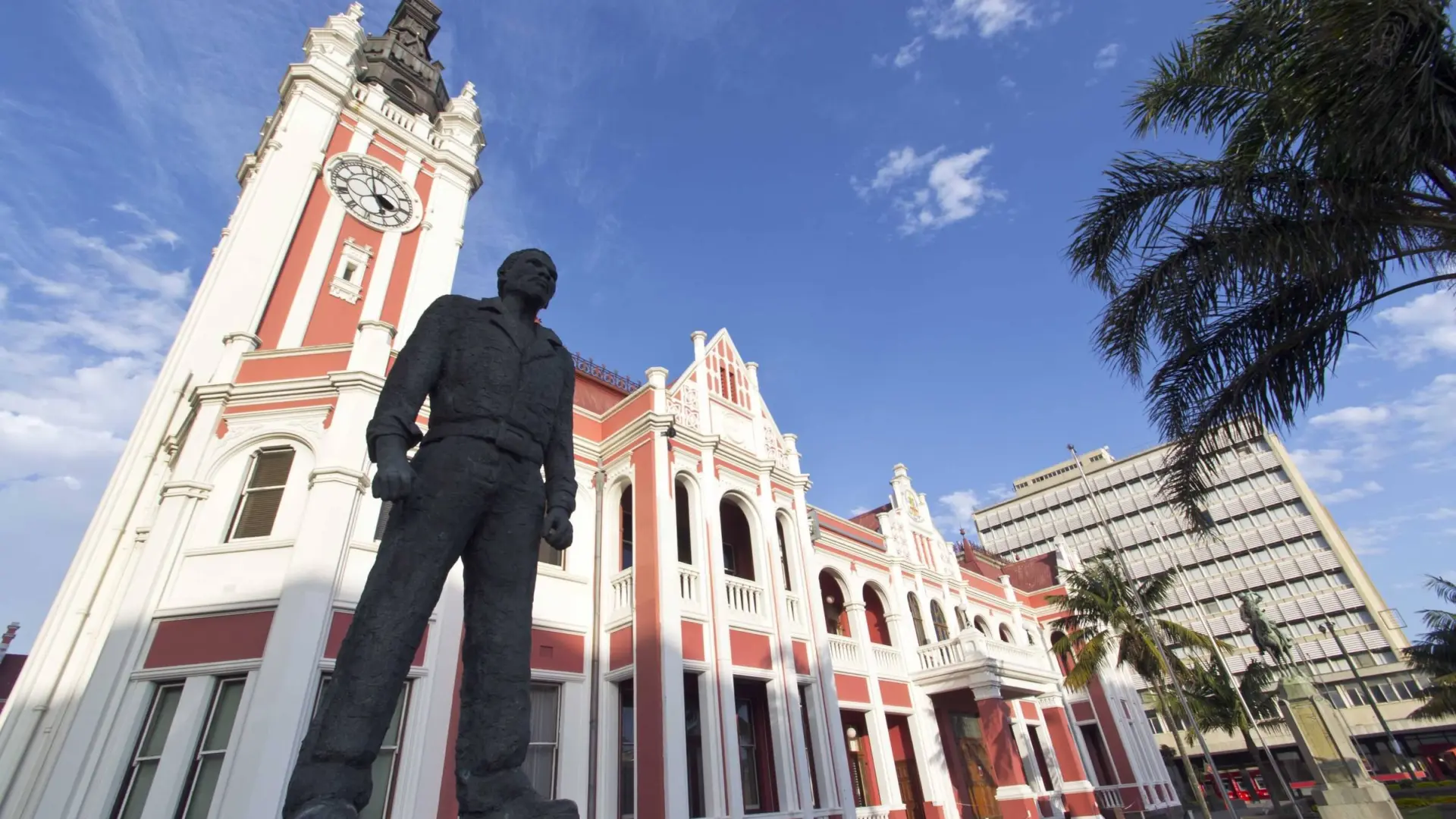
The apartheid state killed Steve Biko on 12 September 1977. It could not kill what he had already released into the world. By the time he was driven the twelve hundred kilometres from Port Elizabeth to Pretoria (shackled, brain-damaged, naked on the floor of a security police Land Rover), the idea he had constructed was irreversible. Black Consciousness had taken root in a generation that would carry it to 1994 and beyond.
Born in King William’s Town on 18 December 1946, Biko came of age at the intersection of the Sharpeville massacre’s aftermath and the systematic intellectual humiliation of Black South Africans by a state that denied their humanity in law, in education and in language. He was admitted to the University of Natal Non-European section to study medicine. It was an institution of segregated learning, and the degradation was structural. He studied it carefully. What he concluded was that the most lethal weapon of apartheid was not the pass book or the Bantustan. It was the mind of the person it had taught to accept all of this as normal.
Biko’s diagnosis was precise. The psychological colonisation of Black South Africans was the precondition for their physical subjugation. A people who believed themselves inferior would not need guards. They would police themselves. The South African Students Organisation (SASO), which he co-founded in 1968 after breaking from the non-racial but white-led National Union of South African Students (NUSAS), was built on this premise. Liberation had to begin in the psyche before it could be fought in the streets.
Black Consciousness was not, as the apartheid government attempted to characterise it, a mirror image of white supremacy. It was not about the exclusion of others. It was a restorative project. It insisted that Black South Africans needed to reconstruct their own sense of worth, capability and historical belonging before they could engage as equals in any political project. “The most potent weapon in the hands of the oppressor is the mind of the oppressed,” Biko wrote. That sentence, written in the early 1970s, remains one of the most compressed analyses of colonial power.
The Soweto Uprising of 16 June 1976 bore his intellectual fingerprints even though he was not physically present. Banned since 1973, he was restricted to the King William’s Town district. The students who marched that morning against the imposition of Afrikaans as a medium of instruction had been shaped by years of SASO community building, consciousness-raising and the Black People’s Convention’s grassroots work. They knew what they were refusing, and they knew why refusal was non-negotiable. That clarity (political, cultural, psychological) was Biko’s inheritance to them.
Biko’s arrest in August 1977 followed years of banning orders, surveillance and detention. His essays, speeches and testimony, later collected in I Write What I Like, set out the argument that liberation required a recovery of Black self-worth as well as political change.
The original inquest did not find anyone criminally responsible for Biko’s death. That outcome remains central to the failure of accountability for the police violence that killed him.
What Black Consciousness contributed to South Africa’s eventual liberation is easy to misread. It is sometimes cast as a waystation, the precursor to the ANC’s unbanning and the multiracial coalition that produced the 1994 transition. That reading reduces it to a phase. Biko’s project was not a phase. It was a reckoning with a question that outlasted apartheid. What does it mean to be free in a system whose material and psychological architecture was designed to make you subordinate? South Africa, with its persistent inequality and its land question unresolved, is still answering that question.
Biko understood that political freedom without psychological decolonisation was incomplete at best and fraudulent at worst. His work continues to shape debates about freedom after apartheid, in South Africa and wherever African-descended people have had to recover a sense of their own worth.



