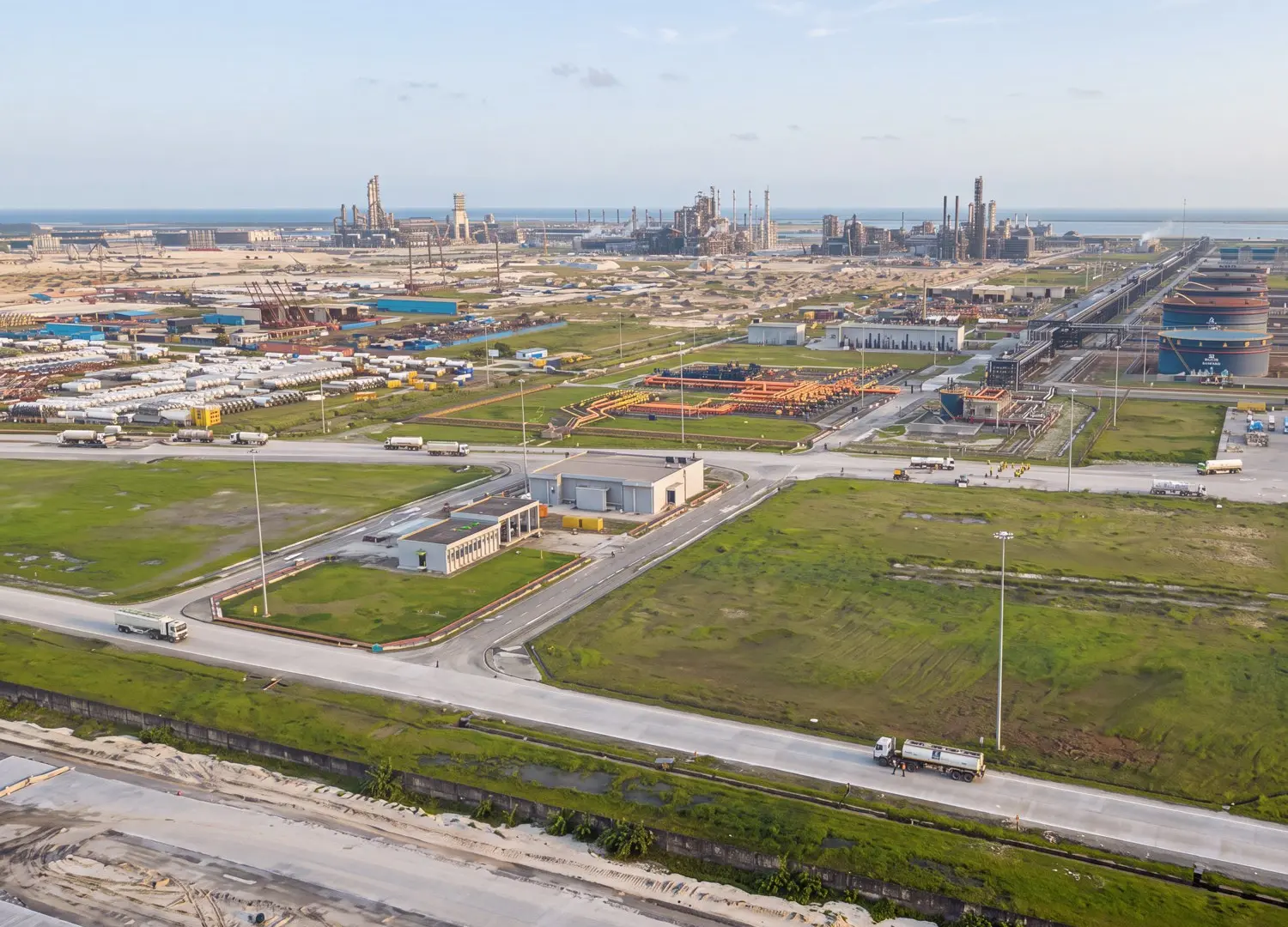
The Dangote refinery at Lekki has a nameplate capacity of 650,000 barrels a day, making it Africa’s largest refinery and the world’s largest single-train plant. Company executives and industry data put its throughput at roughly 500,000 to 550,000 barrels a day in early 2025 as it ramped up. It gives Nigeria a major domestic processing asset. It does not remove exposure to global crude and product prices, or settle questions about supply, competition and consumer costs.
The 2024 disputes with NNPC
Pricing disputes between the refinery and the Nigerian National Petroleum Company Limited erupted publicly in 2024. In July 2024 refinery executives accused international oil companies and NNPC of frustrating domestic crude deliveries, saying the plant had been forced to buy Nigerian crude through foreign trading intermediaries at a premium of $3 to $4 a barrel. In September 2024, as petrol production began, the refinery disputed NNPC’s statement that it was buying Dangote petrol at N898 a litre and said its product was priced in dollars at lower benchmark rates; NNPC said it was paying market-reflective prices under deregulated commercial terms. The refinery set out its side in a statement clarifying the crude supply dispute.
On 6 September 2024 Dangote Petroleum Refinery filed suit FHC/ABJ/CS/1324/2024 at the Federal High Court in Abuja against the Nigerian Midstream and Downstream Petroleum Regulatory Authority, NNPC Ltd and five oil marketers. It sought N100 billion in damages and an order nullifying fuel import licences, arguing that sections 317(8) and 317(9) of the Petroleum Industry Act 2021 permit import licences only where there is a domestic supply shortfall. NNPC and the marketers filed preliminary objections, describing the suit as an attempt to establish a private monopoly, as Premium Times reported.
The disputes exposed a problem that the refinery’s launch had obscured. Nigeria’s crude supply terms were built around an export model, not an in-country refining model. Under section 109 of the Petroleum Industry Act, the Nigerian Upstream Petroleum Regulatory Commission administers a domestic crude supply obligation on a willing-buyer, willing-seller basis, so a domestic refiner buys Nigerian crude at export-parity prices rather than at a preferential rate. Producers had committed cargoes under forward export contracts, and the refinery turned to imported feedstock, chiefly US WTI Midland crude, with cargoes from Brazil, Angola, Ghana and Equatorial Guinea, according to US Energy Information Administration and ship-tracking data. Its strategic importance did not translate into better supply terms.
The naira-for-crude arrangement was the government’s attempt to change that. In late July 2024 the Federal Executive Council approved the Crude and Refined Product Sales in Naira Initiative, under which NNPC supplies crude to local refiners in naira in exchange for naira-denominated refined products. The first cargoes arrived on 1 October 2024 for an initial six-month phase. That phase expired on 31 March 2025 without immediate renewal, and the refinery has halted naira-denominated fuel sales while it awaits a federal decision. The country’s largest refinery is again buying its feedstock on terms it does not control.
Refining capacity is a technology achievement. Pricing sovereignty is a political one. Nigeria built the first. The second requires a different kind of construction, one that the country’s petroleum governance architecture has not yet attempted in full.
Supply terms and regulation
Pricing sovereignty in the oil sector means control over the benchmark against which domestic crude is valued, the terms on which that crude is made available for domestic processing, and the regulatory framework that shapes competition between domestically refined products and imports. None of these is a purely technical question. They are questions of political economy: which interests the regulatory state is designed to serve, and whether the petroleum governance framework was built for a Nigeria that exports crude and imports products, which is what it was built for, or for a Nigeria that processes its own crude and competes in refined product markets on its own terms.
International benchmarks
Nigerian crude and refined products trade against international benchmarks. A domestic refinery may still benefit from differences in transport, crude quality, yields and operating costs. Tariffs or supply obligations that help the refiner do not necessarily lower prices for consumers.
Two decades of import dependence
The history shows what is at stake. Nigeria built four state refineries between 1965 and 1989, two at Port Harcourt and one each at Warri and Kaduna, with a combined capacity of 445,000 barrels a day. Neglected maintenance, pipeline vandalism and weak governance caused their utilisation to collapse in the late 1990s, and fuel imports have dominated since the early 2000s. By 2019 and 2020 all four recorded zero utilisation. For more than two decades Nigeria has exported crude priced in dollars and relied on imports for almost all of its refined fuel, paying freight and conceding the refining margin to processors abroad. The subsidy regime built on top of that dependence cost N4.39 trillion to N4.53 trillion in 2022, roughly $10 billion or 2.2 per cent of GDP, according to NEITI and NNPC records cited by the World Bank and the IMF, before President Bola Tinubu ended it in May 2023. It was also one of the most defended political assets in the country, because every stage of the import chain, from letters of credit to shipping contracts and discharge terminals, feeds an interest with a stake in its continuation. The refinery changes that chain, and the supply disputes raise questions about who has benefited from the gap between what Nigeria pumps and what it consumes, a gap traced in our analysis of Nigeria’s oil wealth.
The regional market
The refinery’s value proposition has always been partly regional: supplying West Africa’s petroleum product market and reducing the region’s dependence on European and Middle Eastern refiners, a dependence that disruption to Red Sea shipping has made more costly. Fuel quality is not the obstacle. Under an ECOWAS directive adopted in February 2020, West African states set a maximum of 50 parts per million of sulphur in petrol and diesel, effective from 1 January 2021 for imported fuel and 1 January 2025 for regional refineries. Dangote produces Euro V-grade fuel at 10 parts per million. By early 2025 it had begun seaborne exports of petrol, diesel and jet fuel into West Africa, including cargoes discharged off Lomé, and Ghana’s National Petroleum Authority said it was exploring direct purchases from the refinery.
Converting those first cargoes into market share requires trade infrastructure, bilateral supply agreements with neighbouring governments and sustained commercial diplomacy. The ECOWAS free trade framework allows this in principle. Port infrastructure, informal sector competition and the entrenched commercial interests of import traders in neighbouring markets make the regional play considerably harder than the nameplate capacity implies.
What the Dangote refinery reveals, more than it resolves, is the gap between African physical capital and African pricing power. The refinery shows what African private capital can build. The disputes over crude supply terms and product pricing are a map of what African institutional architecture has not yet built. Nigeria has shown, through this single facility, that it can construct a large downstream petroleum complex. What it has not yet shown is that it can build the governance architecture that allows that infrastructure to run on domestic crude at terms set at home. That is the next project, and it is harder than the one already completed.



