For more than three decades Ranavalona I held Madagascar against the two greatest empires of her age. She kept the French and British out, let a Frenchman build one of the first industrial complexes outside Europe, and refused to let roads be built that an invading army might use. She also purged her rivals, persecuted Christians and ruled through fear. Her reign is a hard one to judge, and that is why it still matters.
A royal bride
She was born in 1778 and was known as Ramavo before she took the throne. She was of royal birth, the daughter of Prince Andriantsalamanjaka. Her route to power began with a stroke of fortune. Her father discovered a plot to murder King Andrianampoinimerina and warned him, and the plot failed. In gratitude the king betrothed Ramavo to his son, Radama.
In time Radama became King Radama I, and Ramavo was the first of his 12 wives. The marriage seems not to have been close, and she bore him no children, so it was far from clear who would succeed him.
Radama was an able administrator and soldier. He rebuilt the army of the Malagasy, the island’s native people, on European lines, and extended his kingdom at the expense of other peoples on the island. He hoped European help would let him bring the whole island under his rule, but he was also curious about European culture and tolerant of it. He was not a Christian, yet he welcomed Protestant missionaries, who opened churches and schools and brought the printing press. They even persuaded him to end the export of slaves, over the objections of some of his most powerful subjects. He kept European advisers around him.
The seizure of power
Since Radama had no child with Ramavo, his nephew Rakotobe was named heir. Ramavo bided her time. She built up a circle of advisers and military men around her, and she used them to carry out her plans.
Radama died on 27 July 1828, after a long illness. Accounts of his death conflict. Officially it was put down to heavy drinking. Some accounts say he took his own life in a fit of delirium, brought on by malaria, blackwater fever, excessive rum or all three. Six days later, when she might have been mourning her husband, Ramavo staged a coup d’état and had the king’s closest relatives put to death. Among them were Rakotobe, the heir, and the king’s cousins, brothers and queen.
She took the throne under the royal name Ranavalona, wearing a massive crown lined with red velvet and set with seven golden spear points beneath a gold bird, the royal emblem of the Malagasy.
Violence came with strange decrees. As a sign of mourning for her husband, everyone in the kingdom had to keep their head shaved for ten months. The only exceptions were the professional mourners, who were spared so that they would have hair to tear out as they wept. She kept the king’s body on display for weeks, with slaves working in shifts day and night to keep the flies off. While the mourning lasted it was forbidden to dance, bathe, play music, sleep on a mattress, look in a mirror or clap one’s hands. Anyone who broke these rules could be sold into slavery, and the threat was real.
Radama was buried in a coffin made from melted-down silver coins: Spanish piastres, French francs and Mexican dollars. In the royal tomb he lay among his military uniforms and weapons, and among portraits of the European rulers of his day, Frederick the Great of Prussia, Napoleon Bonaparte and George IV of Britain.
Turning away from Europe
Ranavalona soon set about reversing her husband’s policies. In November of that year she refused to receive the British envoy and repudiated the Anglo-Malagasy treaty of friendship that Radama had signed.
On 23 September 1829 she gave birth to a son and heir, Rakoto, her only child. His father was most probably Andriamihaja, a young officer. In September 1830, conservatives at court persuaded the queen to sign his death warrant on charges of witchcraft and treason, and he was killed. Rainiharo rose to fill the space Andriamihaja left, and the queen married him in 1833. Rainiharo ran the island’s foreign policy skilfully, sending envoys to both London and Paris in an attempt to forestall foreign intervention.
More important still was her break with the slave-trade treaty. She annulled the agreement with Britain that had kept the kingdom out of the international slave trade, and slavery, which the British had pressed Radama to curb, became once more a cornerstone of the economy.
Jean Laborde and the factories
Her most valued servant was Jean Laborde, a young Frenchman who had been shipwrecked on the island, and his presence changed the country. Once Ranavalona learnt that he was a skilled craftsman, she set him to building a vast industrial complex. Laborde signed a contract with the government to make rifles and cannon. That began a local industrial revolution. Some 20,000 forced labourers built the complex at Mantasoa, and 1,200 workmen produced everything there from cloth and soap to rum, sugar and many other staples and luxuries. Within a couple of years of his arrival, Madagascar could supply its own weapons, ammunition and gunpowder. It was one of the first industrial revolutions outside Europe.
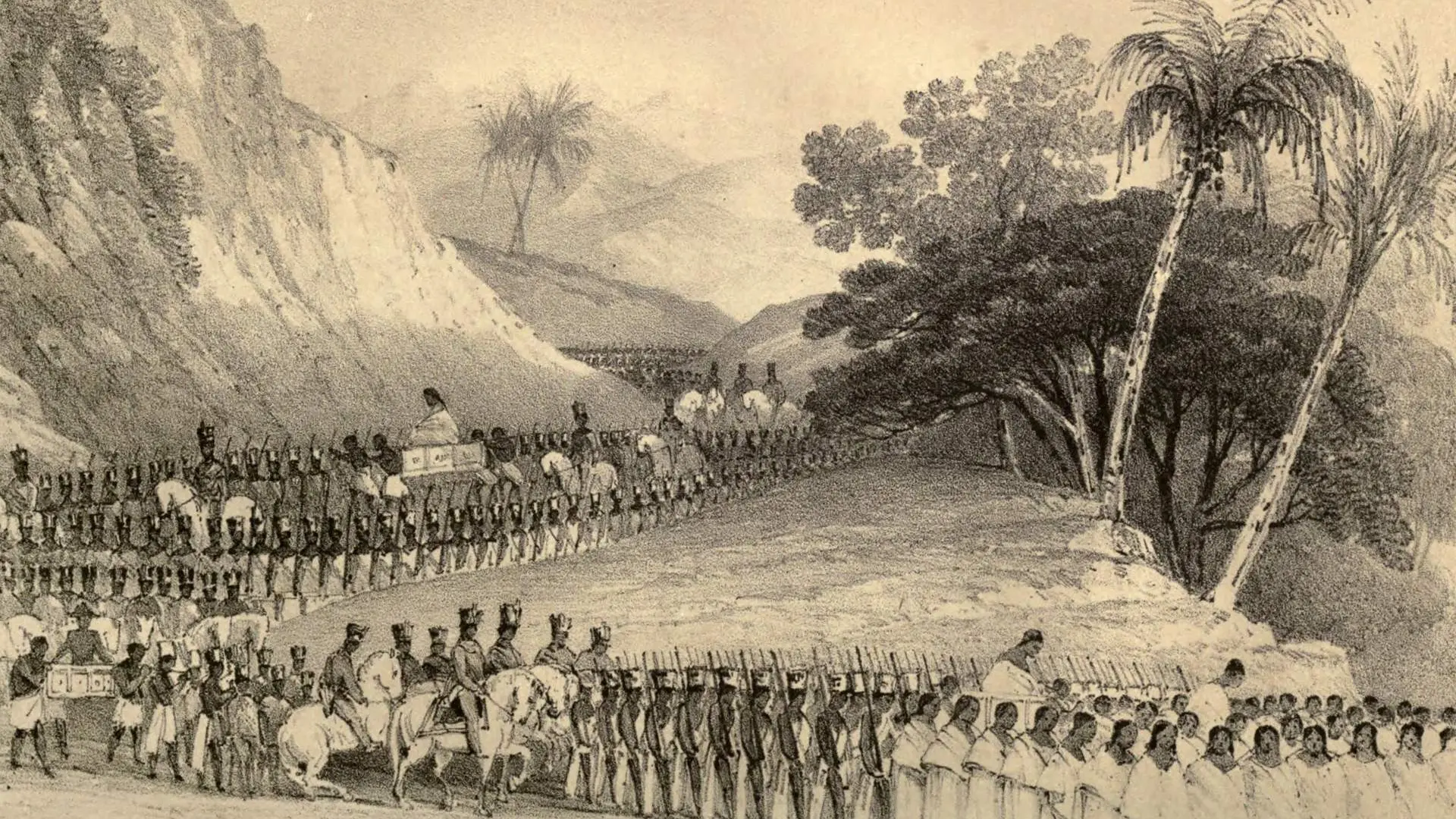
Laborde and the queen worked together reasonably well for many years. There was one innovation she would not allow. No roads were to be built, because they might help a European army invade. The only exception was when the queen herself travelled. Then an army of slaves built the road ahead of her, and each night they put up a whole town for her and her court, which was abandoned the next morning. The policy worked. It helped her keep out the French and the British, whose attempts at intervention failed, and that was no small achievement.
Persecution of Christians
In the seventh year of her reign the queen, then in her late fifties, fell so ill that her life was feared for. She recovered, and she credited her recovery to the devotion she had shown her ancestors while she was ill. These ancestral spirits were embodied in sacred objects, or fetishes, kept in a traditionally decorated hut with a steep roof. No rider on horseback, no European and no pig was allowed into the grounds or the hut. Her faith in Malagasy tradition for her cure only hardened her prejudice against the island’s Christian missionaries.
On 26 February 1835 she ordered all missionaries to respect the nation’s traditions and to stop baptising her subjects. When that failed, she banned Christian worship outright. All missionaries were expelled from Madagascar on 18 June 1835, and every mission school was closed. What began as an effort to protect Malagasy culture soon became a long series of persecutions aimed at the island’s Christian converts and at the queen’s political enemies. On 14 August 1837, Ranavalona ordered the first execution of a Christian convert, a young woman named Rasalama, then in her twenties. She was speared to death, and her body was left for dogs and carrion birds. Many converts, some of the highest rank, were enslaved, burnt at the stake, boiled alive, dismembered, starved to death, flayed alive or thrown from the cliffs on which the capital stood.
Under a new legal system grounded in tradition, any subject could be tried by ordeal, often by being forced to swallow poison. Many were simply executed. Paranoia seems to have gripped the court, and a reign of terror spread across the land. The queen’s vast network of informers kept that terror alive until her death.
In 1845 all Europeans lost their trading rights in the interior and were told they would be made to do forced labour. Those who objected were given a fortnight to leave the island, and many did.
A son’s betrayal
By the early 1850s Prince Rakoto had grown into an educated and intelligent young man. Largely through his friendship with Laborde, he was drawn to European ideas and culture. In January 1854 he sent a secret letter to Napoleon III, asking the French emperor to send a military expedition to Madagascar to remove his mother’s advisers. The letter came to nothing, because France was occupied with the war in the Crimea and elsewhere.
Rakoto was one of the very few people the queen trusted. When the plot came to light in 1857, Ranavalona expelled all Europeans from Madagascar and seized their property, Laborde’s factories among it. She put her son’s part down to youth and bad advice. From then until her death she ruled with an iron hand and crushed the slightest hint of dissent.
Death and legacy
Ranavalona died in her sleep on 16 August 1861 at the Manjakamiadana palace in the Rova of Antananarivo. Her reign of 33 years was brutal, but she was also a capable politician and ruler. She did all she could to preserve her country’s culture, defended it against stronger foreign powers that wanted its resources, and extended her rule over nearly the whole of Madagascar.
The deaths did not stop with her own. During her funeral a spark set off a barrel of gunpowder meant for the ceremony. The blast and the fire that followed killed a number of onlookers and burnt down three historic royal residences in the compound where the rites were held.



