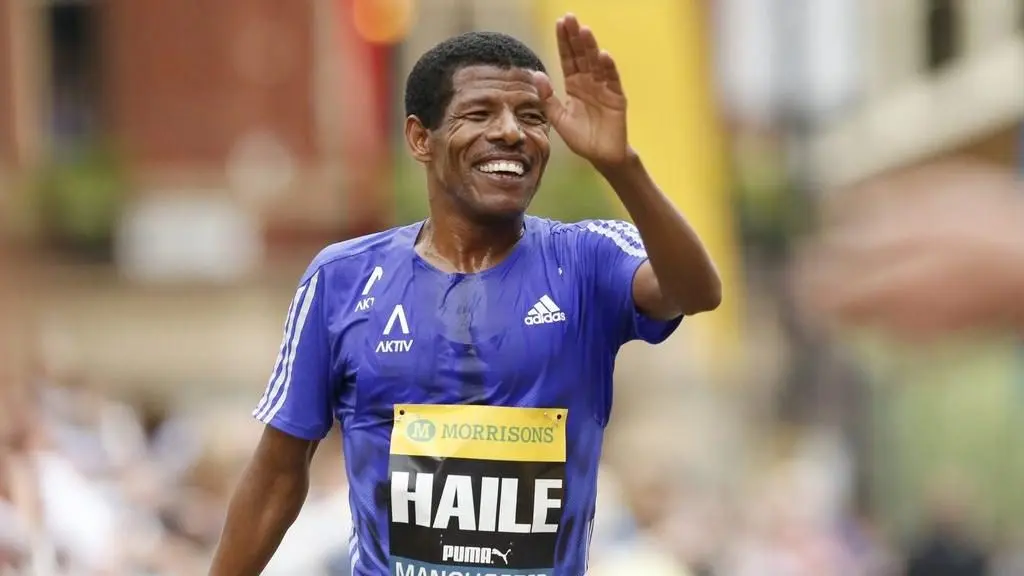
Haile Gebrselassie broke 61 Ethiopian national records, at distances from 800 metres to the marathon, and set 27 world records. He is widely regarded as the greatest distance runner in history. In September 2008, at the age of 35, he won the Berlin Marathon in a world record 2:03:59, breaking his own record by 27 seconds. Few athletes have dominated so many distances for so long.
The record list is long. He won two Olympic gold medals at 10,000 metres (10K) and four world titles at the same distance. He won the Berlin Marathon four times in a row and the Dubai Marathon three times in a row. He also took four world indoor titles and was the 2001 World Half Marathon champion.
A farm boy who ran to school
Haile Gebrselassie was born on 18 April 1973 in Asella, in what is now the Oromia region of Ethiopia, one of ten children. He grew up on a farm and ran 10 kilometres to school every morning and 10 back every evening. The habit left him with his famous running style, the left arm held crooked as if still carrying his school books.
The world first noticed him in 1992. At the 1992 World Junior Championships in Seoul, South Korea, he won the 5K and the 10K, and he took silver in the junior race at the World Cross Country Championships in Boston, United States.
Master of the track
In 1993 he won the first of four successive world titles in the men’s 10K, a run completed at the 1993, 1995, 1997 and 1999 World Championships. In 1994 he took bronze at the IAAF World Cross Country Championships, and later that year set his first world record, running the 5K in 12:56.96 to cut almost two seconds from the old mark.
Hengelo, in the Netherlands, became one of his favourite tracks. There, in 1995, he ran the 10K in 26:43.53, nine seconds inside the world record. That same summer, in Zürich, he took the 5K record from 12:55.30 to 12:44.39, a cut of 10.91 seconds. Track & Field News magazine voted that run at the Weltklasse meeting its “Performance of the Year” for 1995. He returned to Hengelo in June 1998 and lowered the 10K record again, from 26:27.85 to 26:22.75, with two perfectly even 5K halves of 13:11/13:11.
In 1999 he played himself in the film Endurance, which told the story of his quest for Olympic 10K gold in Atlanta. That year he also won the 1500/3000 metres double at the World Indoor Championships, kept his outdoor world 10K title and went unbeaten in every race he ran, from 1500 to 10,000 metres.
Two Olympic titles
In 2000 he again won every race he entered and ranked first in the world at both 5K and 10K. At the 2000 Sydney Olympics he became only the third man to defend an Olympic 10K title, after Emil Zátopek and Lasse Virén. The race against Kenya’s Paul Tergat came down to the final sprint. Tergat covered the last 200 metres in 26.3 seconds and Haile in 25.4, and the winning margin was just 0.09 seconds, closer than in the men’s 100 metres final.
He ran his first half marathon in August 2001 and won it in 1:04:34. The same year he became IAAF World Half Marathon champion and took bronze in the 10K at the World Championships in Athletics.
On 30 August 2003 he was elected to the IAAF Athletes Commission with the most votes of any candidate. At the World Championships in Paris that year, he took silver behind his countryman Kenenisa Bekele in an exceptionally fast 10K final. The second half took 12:57.24, with 12:57.2 for Bekele and 12:58.8 for Haile.
At the 2004 Athens Olympics he tried to become the first man to win three Olympic 10K titles in a row. He failed, finishing fifth in a race won by Bekele, who by then had taken both of Haile’s major track world records, at 5K and 10K.
On the roads
In 2005 he was unbeaten on the road. He set a British all-comers’ record of 27:25 over 10K in Manchester, won the Amsterdam Marathon in 2:06:20, the fastest marathon in the world in 2005, and set a world best of 44:24 at the Tilburg Ten Miles in the Netherlands.
He began 2006 with a world record on 15 January, his first on American soil. Running the half marathon at the Rock ’n’ Roll Arizona Marathon, he clocked 58:55, a full 21 seconds inside Samuel Wanjiru’s record from 2005. On the way he passed 20 km in 55:48, breaking Paul Tergat’s record for that distance, which had stood since 1998. Later that year he took the 25 km world road record by 68 seconds, in 1:11:37, though the mark was not ratified by the IAAF.
Not every race went his way. On 23 April 2006 he finished ninth in the London Marathon in 2:09:05 and called it “the worst race of my career.” On 24 September he answered by winning the Berlin Marathon in 2:05:56, the fastest time of the year, which made him only the fifth man in history to run the marathon in under 2:06. He then won the Fukuoka Marathon in Japan in 2:06:52.
On 27 June 2007, in Ostrava, Czech Republic, he went after the world record for the one-hour run and got it. He covered 21,285 metres (13 miles 397 yards), beating the previous best of 21,101 metres, and passed 50 laps (20,000 m) in 56:25.98, another world best. On 5 August 2007 he made his New York debut and won the New York City Half Marathon in 59:24, two minutes inside the course record. Victory in the Lisbon Half Marathon in March 2008, in 59:15, gave him a perfect 9–0 record at the distance. That run ended in Den Haag on 14 March 2009, when Sammy Kitwara beat him by three seconds, 59:47 to 59:50.
The Berlin world records
Berlin was where he rewrote the marathon record. On 30 September 2007 he won there in 2:04:26, a pace of 4:44.8 per mile, taking 29 seconds off the world record set on the same course in 2003. The win added to the celebrations of the Ethiopian Millennium, which is unique to the Ethiopian calendar and had begun on 12 September 2007.
On 28 September 2008 he defended his Berlin title in 2:03:59, averaging 2:56.5 per kilometre (4:43.7 per mile) and breaking his own world record by 27 seconds. The record stood for three years, and because he was over 35 it remains the masters age-group world record, as does his masters record at 10K, unchallenged since 2008.
He won the Dubai Marathon on 16 January 2009 in 2:05:29, well clear of the field, though short of the world record he had set in Berlin four months earlier. In September he won in Berlin for the fourth year in a row. A fast start promised another record, but warm weather slowed him to 2:06:08, two minutes off his best. He still passed 30 kilometres in 1:27:49, a new world record for 30K on the road.
Injury and a comeback
In 2010 he went for his world record for the third time in a row, at the Dubai Marathon 2010. He won in 2:06:09 but missed the 18-month-old mark, and afterwards revealed that he had suffered back pain from sleeping in an awkward position and needed intensive physiotherapy before the race. The trouble followed him to the New York City Half Marathon, where he pulled up mid-race, visibly uncomfortable. He recovered to win the first 10K de Madrid easily in April and the Great Manchester Run for the third time the following month, though he missed Micah Kogo’s course record. In September he won the Great North Run for the first time, running the half marathon in 59:33.
He announced his retirement in 2010, after dropping out of the New York City Marathon, but soon changed his mind and tried to qualify for the 2012 Olympics.
Injury kept him out of the 2011 Tokyo Marathon, but on 17 April 2011 he won the half marathon at the Vienna City Marathon. About a month later he won the Great Manchester Run for the fourth time, easily, in 28:10. On 25 September he suffered a double blow in Berlin. He dropped out, again struggling to breathe with exercise-induced asthma, and saw Patrick Makau take his world records. He returned to winning form with a course record at the Birmingham half marathon, then won the Zevenheuvelenloop in November, his third victory in the Dutch 15K.
The last race
He did not make the Olympic team, but he kept racing until the Great Manchester Run in 2015, his final appearance. He finished sixteenth. Afterwards the 42-year-old told reporters it had been his last competitive race, though he would keep running for the rest of his life.
“I am retiring from competitive running, not from running,” Gebrselassie said. “You cannot stop running. This is my life.”
Beyond the track
Haile is far more than an athlete. He has been a mentor and ambassador for G4S 4teen, a programme that supports young athletes, and he is a successful businessman in Ethiopia. He co-founded the Great Ethiopian Run, and his businesses include the Haile resort in the Hawassa area.



