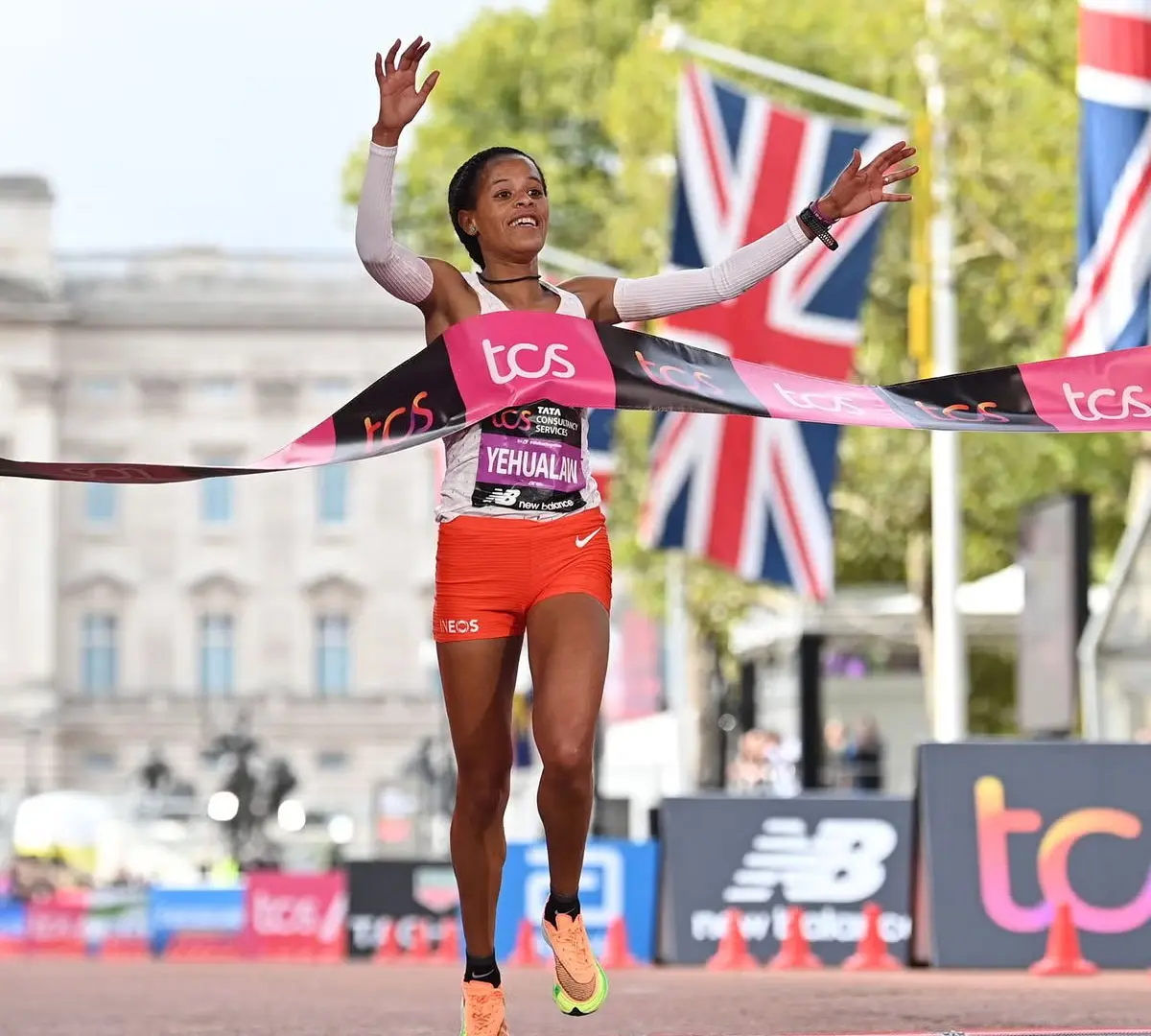
Ethiopia’s distance-running legacy, from Abebe Bikila’s barefoot Olympic victory in Rome in 1960 to Haile Gebrselassie, Kenenisa Bekele’s world records and Tirunesh Dibaba’s triple Olympic gold, was not an accident. It was the output of conditions that had to be actively maintained. This analysis argues that the legacy now depends on rebuilding the institutions behind it, strained by the Tigray conflict and by runners leaving to compete for other countries, through investment in coaching, athlete welfare, administration and facilities.
What Rome meant
When Bikila ran barefoot through Rome and became the first Black African Olympic champion, he established Ethiopia’s place in distance running. He returned four years later in Tokyo with shoes and a faster time. The legacy he established was never simply about speed. It was about what speed could mean in 1960, when an African man, running without shoes, representing a country that had resisted colonisation when the rest of the continent was being carved up at European conference tables, crossed the finish line first in the capital of the country that had invaded Ethiopia a generation earlier. The setting gave the victory political symbolism. The barefoot choice, whether by necessity or design, became the frame through which a geopolitical statement was made through sport.
It was also a structural signal. Ethiopia had produced an elite distance runner because the conditions for producing elite distance runners existed there: high-altitude training grounds, a culture of running as both subsistence activity and community practice, and a military sporting infrastructure that, however imperfect, identified and developed talent. Six decades of champions since have been the compounding output of those conditions, and Ethiopia’s running identity now functions as cultural capital independent of any single race.
Pressures on the system
The talent pipeline remains well stocked. What is in question is the institutional infrastructure that converts talent into sustained, internationally competitive performance. The Tigray conflict, which ran from 2020 to 2022 with an aftermath well beyond that, confronted Ethiopian athletics with pressures external to sport: resources diverted to the war, logistics disrupted, and national teams prepared for international competition in a country managing a serious internal conflict. Ethiopian athletes continued to win during this period, which speaks to individual resilience. How far the institutions bent under the pressure still needs an honest accounting.
Talent drain adds a second pressure. Elite Ethiopian runners have moved to represent Gulf states and other nations willing to pay premiums that Ethiopian athletics federation support cannot match, replicating the nationality-switching patterns visible elsewhere on the continent. The economic logic is not complicated. A runner who can compete for Bahrain under a professional contract with guaranteed income, medical support and post-career stability has rational grounds for that choice regardless of where the training that produced that capability occurred.
Camps, administration and value
The training environment that Bikila’s era produced and Gebrselassie’s generation refined has been partly preserved in camps around Bekoji, Sendafa and other high-altitude communities that continue to function as development nurseries. The Addis Ababa-centred training environment (the altitude, the established training culture, the generational mentorship networks) remains a genuine competitive advantage. The question for the next decade is whether these environments receive the investment required to sustain them: safe road access, training facilities that operate to international standard, and medical and sports science support that keeps athletes performing across longer career spans.
The administrative side has been less consistent. Athlete welfare, international representation, doping control compliance and the commercial aspects of athletics all demand capacity in an era when personal branding and global media presence determine how much financial support an elite athlete can sustain. Where that support falls short, it decides who can afford to keep competing at the highest level.
Ethiopian distance running generates real economic value, but much of it flows through international marathon circuits, where prize money passes through agents and contracts negotiated with unequal information, and through broadcasting rights for events in which Ethiopian athletes are a leading draw. In the author’s view, the country that produces the runners has not built the commercial structures to capture a fair share of the value they generate.
The development pipeline
The youth development pipeline is built substantially on informal community structures (families, local coaches, peer networks) rather than state institutional design. This is both its resilience and its vulnerability. Informal structures are harder to destroy because they do not depend on state budget cycles. They are also harder to scale, because they cannot be systematically replicated without the state investment that converts informal excellence into formal capacity. Ethiopia’s challenge is to formalise enough of this infrastructure to ensure quality and consistency while preserving the relationship to running as a communal rather than purely professional activity.
Gebrselassie’s contribution to the legacy was institutional as much as athletic. After his competitive career, he invested in training camps and youth development programmes, engaged with the Ethiopian government on sports infrastructure, and kept Ethiopian athletics visible in international discourse between major championship cycles. His model, the elite athlete who becomes an institutional actor in the sport that made him, is the template Ethiopian athletics needs to replicate at scale. But private capital filling gaps that state institutions have not closed is not a substitute for public investment at the level a state that considers athletics one of its competitive advantages ought to provide.
A wider asset
The soft power dimension of Ethiopian athletics extends well beyond national team performance. Ethiopia’s running culture has inspired a global diaspora of recreational runners who identify with the country’s heritage. It runs from the thousands of participants in the Great Ethiopian Run to the international training camps in the highlands that attract serious club runners from Europe, North America and Japan. This cultural capital is an underused asset in Ethiopia’s international relationships. A country that can draw international visitors to its highlands for a sporting experience is a country with tourism infrastructure, hospitality investment and a narrative that competes in the global attention economy on its own terms.
A race for institutional depth
The race to rebuild is not a race for speed. It is a race for institutional depth, the kind of sustained investment in coaching pipelines, administrative capacity, athlete welfare systems and facility maintenance that keeps a sporting legacy alive between the moments when a champion’s name illuminates a scoreboard. Ethiopia has the talent, the heritage, the altitude and the culture. What it needs is the unglamorous, generationally committed work of building the system that delivers them reliably rather than sporadically. Bikila made that first mark on Rome’s streets more than six decades ago. The institution-builders working today determine whether it deepens or fades.



