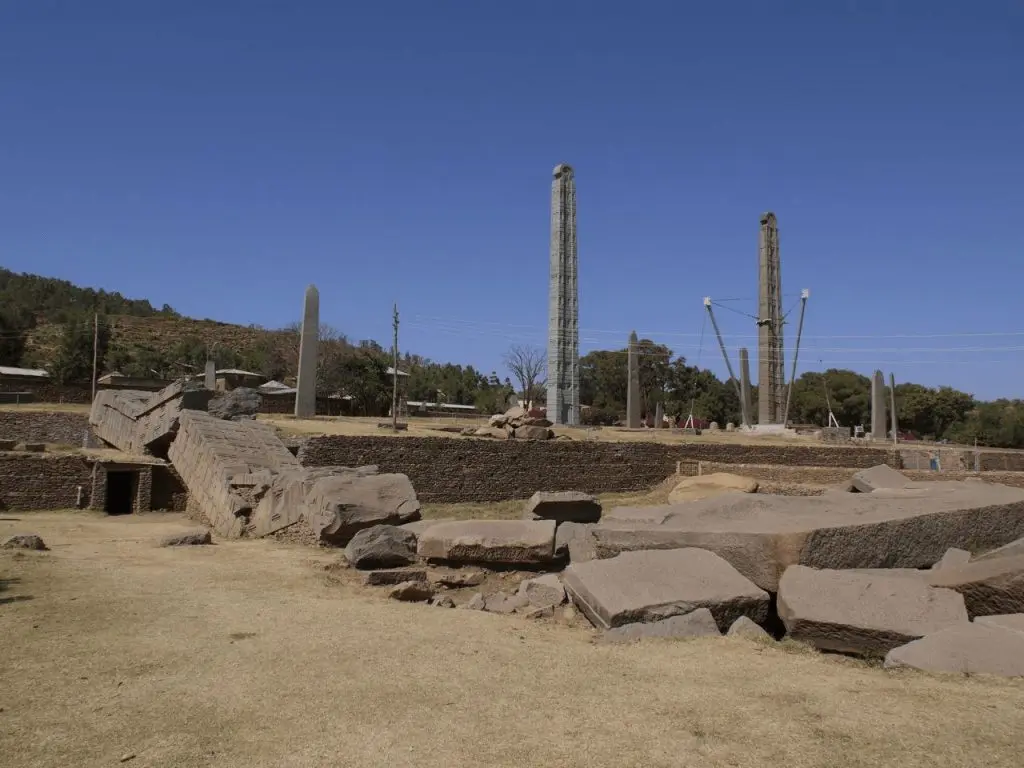
At its height the Kingdom of Aksum was one of the great powers of the world. In the third century the Iranian prophet Mani counted it among the four great powers of his time, alongside Persia, Rome and China. Its wealth came from trade, and its legacy still shapes the Horn of Africa: its own script, its towering stelae and one of the oldest Christian churches in the world.
The kingdom, also written Axum, stretched across most of present-day Eritrea and northern Ethiopia and, at times, into Sudan, western Yemen and southern Saudi Arabia. Its capital, Aksum, now a town in northern Ethiopia, sat at the centre of a state whose economy depended almost entirely on exports and international trade. Aksum grew out of the proto-Aksumite Iron Age, around the fourth century BCE, and had risen to prominence by the first century CE. Ethiopian tradition holds that it is the resting place of the Ark of the Covenant and the home of the Queen of Sheba.
The rise of Aksum
Aksum drew on several peoples and cultures. Among the main influences were the Sabaeans of southern Arabia, the local people of Da’amot and the declining Kingdom of Kush in what is now Sudan.
Before Aksum became the leading economic force in the Horn of Africa, Meroë in Kush was the region’s economic centre. That changed when Aksum invaded Kush in about 330 CE (some date the invasion to around 350). It was one of several blows that brought down the Kingdom of Kush, whose last great city Meroë had become after the decline of Kerma and Napata. Aksum was already flourishing before the conquest, but it reached its peak only as Meroë declined. By 350 it was the political and economic power of the region.
Much of its wealth came from a new way of sailing that used the seasonal monsoon winds to cross the Red Sea and the Arabian Sea, which greatly increased the trade passing through the region. Aksum lay where the routes from the Mediterranean met these seas, and it came to dominate that international trade.
Economy and foreign trade
Aksum’s commerce reached India and Byzantium. It exported ivory, tortoiseshell, gold and emeralds, and imported silk and spices. With access to both the Red Sea and the upper Nile, Aksum profited from trade between African (Nubian), Arabian (Yemeni) and Indian states, and its navy guarded the coastal routes and the trade networks along the Nile and the southern Red Sea that were the source of its wealth. Aksumites traded with Roman, Egyptian and Persian merchants.
As was usual for a state of the period, its main products were agricultural. The land was far more fertile then than it is now, and the main crops were grains such as wheat and barley. Aksumites also raised cattle, sheep and camels, and hunted wild animals for ivory and rhinoceros horn. The kingdom was rich in gold and iron, both valuable in trade, and in salt, which was traded widely.
Trade in Aksum ran on its own coinage, and it was one of the first African polities to issue coins. After the kingdom’s conversion its coins carried a cross, a sign of the central place of the Christian faith in society. Minting its own currency gave Aksum control over its own economic affairs.
The Aksumite army was known for its iron weapons, spears and shields, and its tactics included the use of elephants in battle.
Culture and religion
Among Aksum’s achievements is its own script, Ge’ez. It grew out of Epigraphic South Arabian in the late pre-Aksumite and proto-Aksumite periods and was later modified to include vowels, becoming an abugida. The obelisks, or stelae, are perhaps the most recognisable part of Aksum’s legacy. These stone towers marked graves or represented grand buildings, and were often carved with a pattern or emblem showing the rank of the king or noble. Most of their mass stands above ground, held steady by massive counterweights below. The largest would have stood 33 metres high had it not fallen.
Around 325 CE, under King Ezana, Aksum gave up its earlier polytheistic and Judaic religions for Christianity, which tied it culturally to a growing number of Christian kingdoms. From that conversion descend the Ethiopian Orthodox Tewahedo Church, which became self-governing in 1959, and the Eritrean Orthodox Tewahedo Church, which did so in 1993. Since the split that followed the Council of Chalcedon in 451, the tradition has been Miaphysite, and its scriptures and liturgy are still in Ge’ez.
Aksum was a cosmopolitan state and a meeting place of Egyptian, Sudanic, Arabian and Indian cultures. Its main cities had Sabaean, Jewish, Nubian, Christian and even Buddhist minorities.
According to tradition, the Ark of the Covenant is kept in Aksum, at the Church of Our Lady Mary of Zion, under heavy guard. The story holds that the son of King Solomon and the Queen of Sheba brought it to Aksum. Because no one but the single guardian monk is allowed to see it, no one can verify that the Ark is there, and the claim remains disputed.
The decline of Aksum
Historians are not sure exactly what brought about Aksum’s decline, but several factors seem to have played a part. In the seventh century Islam spread rapidly across the Middle East and Africa, and the new Islamic powers grew in size and strength and clashed repeatedly with rival Christian kingdoms. Aksum kept good relations with its Muslim neighbours, because it had sheltered the early followers of the faith in 615. But as the Islamic states grew, they came to dominate the region’s economy and took control of the most important ports. Aksum began a slow decline towards the end of the seventh century.
Pressure had been building on land since the late sixth century CE. Whether because farmland was overused or because Beja herders from the west moved in, small Beja kingdoms took parts of Aksum’s territory as grazing for their cattle and repeatedly raided its camel caravans. The kings’ habit of leaving conquered chiefs a large measure of autonomy also backfired, giving some of them the means to rebel.
Changes in climate probably also played a part. As income from international trade fell, Aksum lost control of its sources of raw materials and its trading network collapsed. A large population had already strained the land to keep up food production, and that strain now grew. On one widely cited reconstruction, soil erosion began on a local scale around 650 and became catastrophic after 700. Social and economic pressures probably made it worse: marginal fields were neglected and abandoned, land was turned over to destructive grazing, and much of it was ruined for good. A decline in the reliability of the rains, beginning between 730 and 760, may have sped up the process. It shortened the growing season considerably and did not ease until well into the ninth century.
Despite the kingdom’s collapse, Aksum is still a living town. Its population was put at 66,900 in 2015.



