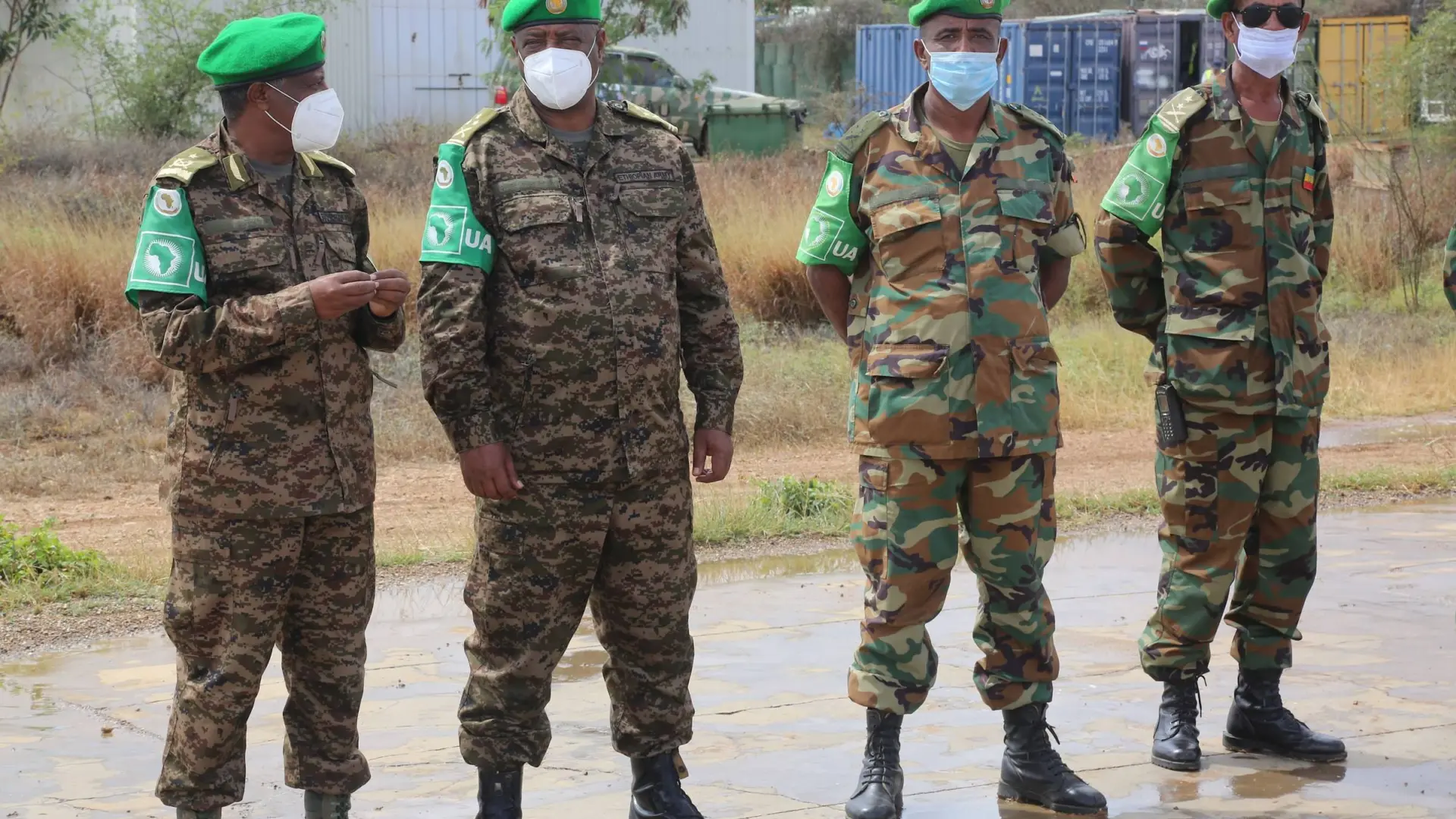
The African Standby Force was conceived in 2003 as the instrument that would let the African Union respond to a genocide, a coup, or a mass-atrocity crisis on the continent’s own terms, deployable within days rather than the months a United Nations mandate typically requires, staffed by five regional brigades drawn from member states and answerable to Addis Ababa rather than New York or a foreign capital. More than two decades later, the force exists on organisational charts, in periodic joint exercises with names like Amani Africa, and in the annual reports of the AU Peace and Security Council. Its record depends on how deployment is defined. The AU endorsed the SADC mission in Mozambique within the Standby Force framework, but that was a regional bloc acting for itself, not the continental force at work. Every major crisis the continent has faced since 2003, Darfur, the Central African Republic, Mali, eastern Congo, Sudan’s civil war, has been met by a foreign-led mission, a foreign-backed coalition, or nothing, while the continental force built to make that dependency unnecessary sat in reserve.
Readiness and political commitment
The gap between the force’s mandate and its record is not a story about incompetence so much as a story about what member states were actually willing to fund and cede control over when the moment to use it arrived. Each of the five regional brigades depends on troop and equipment commitments from national militaries that remain, first and foremost, national assets, answerable to the president who commands them before they answer to any continental structure. A government facing its own domestic security pressures has a strong incentive to hold its best-trained units in reserve for its own use rather than commit them to a continental force it does not control the deployment decision for. The African Standby Force was designed on the assumption that member states would subordinate that instinct to a collective interest. The design assumed away the actual politics.
Funding compounds the problem. The African Union’s operational budget for peace and security has historically depended heavily on external partners, the European Union chief among them, for the money that would actually move troops, aircraft, and logistics into a live conflict zone. A continental force meant to reduce dependence on foreign intervention has, in practice, needed foreign financing to move at all, which reintroduces exactly the external veto point the force was designed to eliminate. A donor uneasy about a specific deployment’s politics can simply decline to fund it, achieving through the budget line what a Security Council veto achieves through the vote.
A continental force meant to reduce dependence on foreign intervention has needed foreign financing to move at all.
Regional missions and coalitions
What has emerged instead is a series of ad hoc coalitions assembled crisis by crisis. These include the G5 Sahel Joint Force, backed heavily by France before its collapse; the multinational force fighting Boko Haram around Lake Chad, built from Nigeria, Chad, Niger, and Cameroon without waiting for continental machinery; and the Southern African Development Community’s mission against Mozambique’s Cabo Delgado insurgency, a regional bloc acting because its members chose to organise. Each of these arrangements demonstrates that African states can and do mobilise military force regionally when the interest is concentrated enough among a small number of directly affected neighbours. What they also demonstrate is that the continental layer, the level at which the Standby Force was supposed to operate, is consistently bypassed in favour of narrower coalitions with clearer, more immediate stakes for the states involved.
The institutional choices ahead
The realistic alternative to the full five-brigade concept is a smaller, faster, better-funded rapid-deployment capability. Choosing it would be an honest downsizing of ambition to match actual political will, which is a defensible outcome, over continuing to fund an aspirational structure that has never deployed as a continental force while insisting, in AU communiqués, that it remains the strategic answer to the next mass-atrocity crisis. The Standby Force’s non-deployment is not primarily a logistics failure or a training gap, though both exist. It is the accurate record of what happens when fifty-five sovereign states are asked to build a force premised on ceding, at the critical moment, exactly the decision-making autonomy each of them has the strongest incentive to keep. Until that trade-off is resolved, crisis response will keep running through whichever coalition happens to be closest and most interested, precisely the arrangement the Standby Force was created to replace.
The cost of that unresolved trade-off is not abstract. In every crisis met by an ad hoc coalition, the response’s speed, mandate and legitimacy depend on which neighbours happen to have the capacity and will that month, rather than on a pre-agreed framework any member state could invoke. An honest reckoning with what member states will and will not cede would let the continent stop budgeting for a force it has shown no intention of empowering, and start building the narrower capability it has repeatedly shown it is willing to fund.



