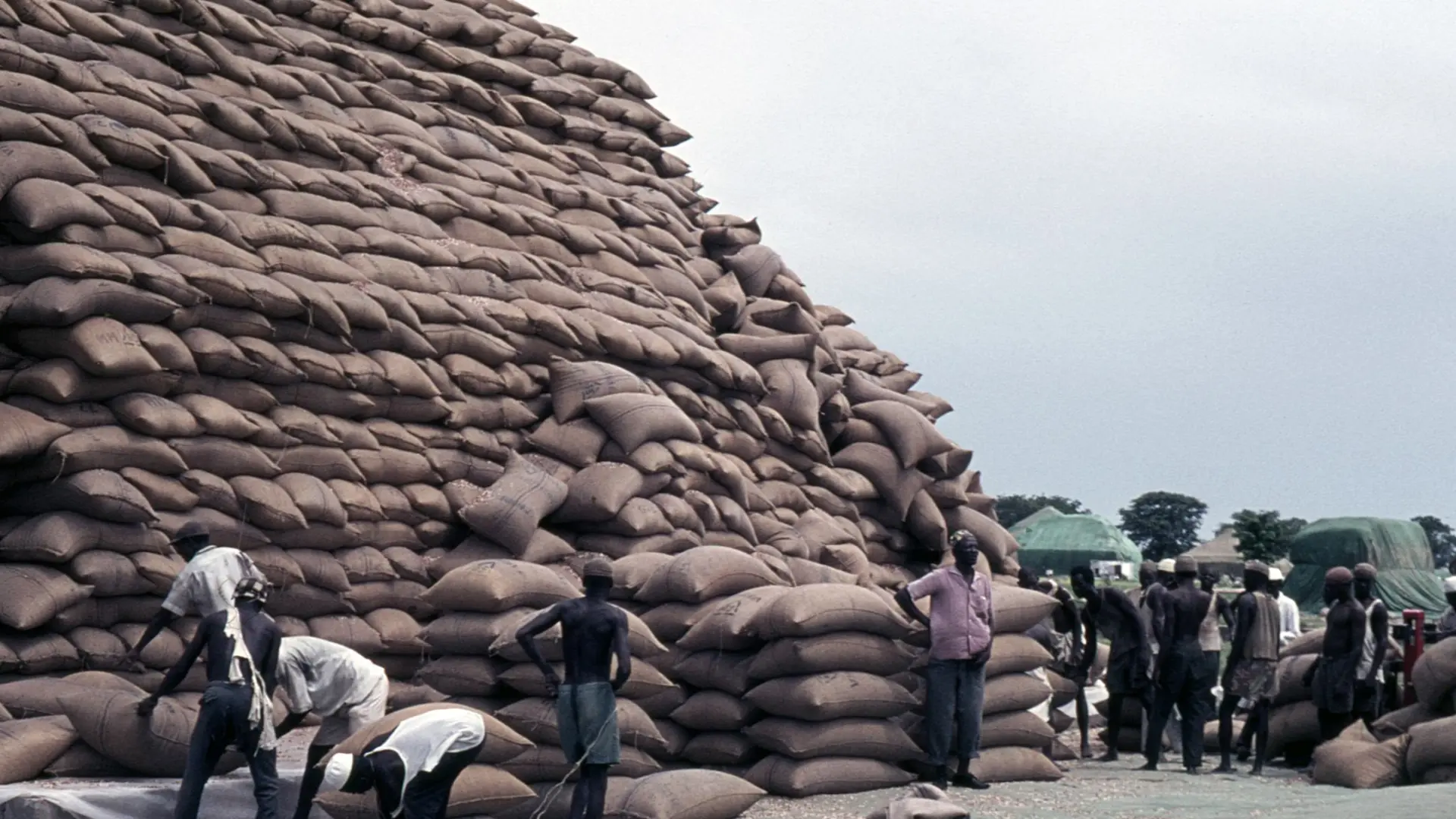
Kano’s groundnut pyramids, built from stacked sacks awaiting shipment, became a symbol of northern Nigeria’s agricultural trade. Their disappearance is a lesson for any commodity economy. As oil revenue grew, the institutions that had made groundnut farming viable were neglected and then dismantled, and disease did the rest. Windfalls that are not used to sustain productive capacity end up displacing it.
A system built on purpose
Commercial groundnut farming in Nigeria traces to 1912, when farmers in the north responded to economic incentives by shifting towards large-scale cultivation. The marketing system that supported this expansion was deliberate and coherent. Produce moved from rural collection centres to Kano, was sold at fixed prices set by the marketing board, then went by railway to Lagos for export. Alhaji Alhassan Dantata, one of Nigeria’s most significant early entrepreneurs, built his commercial empire partly on the groundnut trade. He supplied the Niger Company (the former Royal Niger Company, later part of the United Africa Company) and helped establish Kano as the hub of a regional agricultural economy. The infrastructure existed because the colonial administration understood that groundnut revenue needed reliable logistics.
Oil, disease and neglect
From the early 1970s, government attention and revenue calculations shifted towards petroleum. Young people who might once have entered agriculture were drawn towards the urban centres of the oil economy instead.
Disease struck at the same time. The groundnut rosette virus outbreak of 1975 destroyed approximately 750,000 hectares of farmland, and further outbreaks in 1983, 1985 and 1988 deepened the damage. Institutional support can help farmers recover from disease and drought; without it, crop losses accelerate a shift to other livelihoods. Farmers who lost their groundnut crops switched to cowpea, millet and sorghum. Those crops were not superior. They were more manageable without the coordinated support that had made groundnut cultivation economically rational.
By the mid-1980s, total groundnut production had fallen from over 1.6 million tonnes to below 0.7 million tonnes. The pyramids were gone. The railway that had connected northern farms to Lagos port was deteriorating. Agro-processing industries that depended on groundnut had closed or converted. The knowledge accumulated over decades of organised groundnut farming (soil management, variety selection, disease response, market logistics) was dispersing as the farming generation aged without replacement.
Structural adjustment finished the job
The Structural Adjustment Programme, designed to address the fiscal crisis that followed the oil shocks, accelerated the deterioration. The marketing boards, which had provided price floors, organisation and market access, were dissolved in 1986. Farmers lost their route to market and their price stability at the same time. Subsidies for fertiliser and improved seed were removed or reduced, making farming more expensive just as its economic logic was being undermined. The logic was fiscal discipline. The outcome was the abandonment of a productive base in exchange for lower public spending.
Contemporary attempts to revive Nigerian agriculture work against this history. The mechanisms that made the groundnut economy function (coordinated marketing, price support, agricultural research and extension, rural infrastructure) were dismantled over roughly twenty years and have been only partially and inconsistently rebuilt. Agricultural research institutions have developed drought-resistant groundnut varieties. Getting them to farmers at scale, through functioning extension services, has proved beyond the consistent capacity of Nigerian agricultural policy.
The lesson of the groundnut pyramids is not primarily about groundnuts. It is about what happens when a commodity windfall becomes a reason to neglect the patient, institutional work of building diversified productive capacity. Nigeria is not the only oil exporter whose non-oil sectors declined during boom years. Resources that are not converted into institutional capacity are not development. They are a loan that comes due when the commodity price falls.



