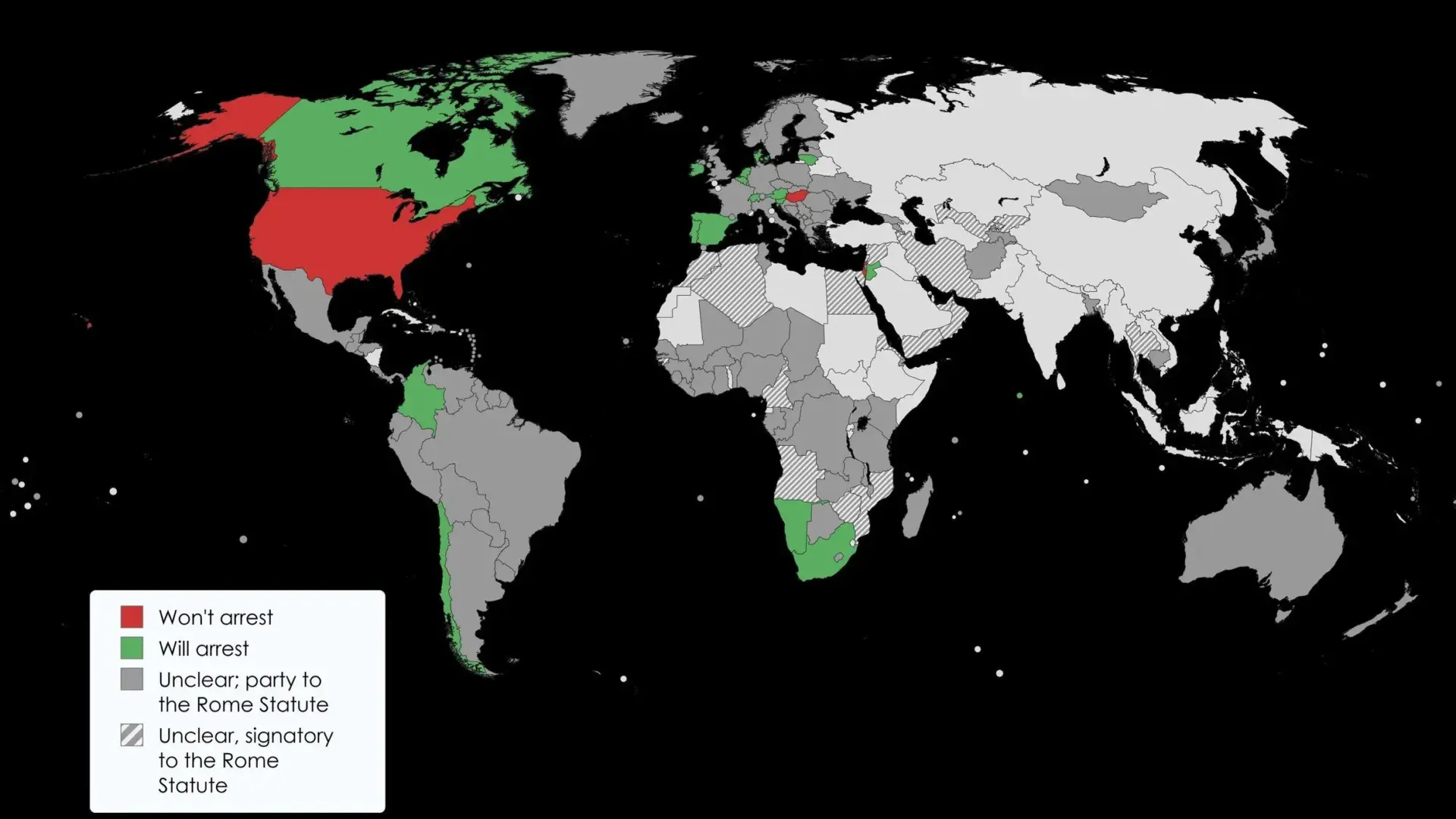
The International Criminal Court issued arrest warrants for Benjamin Netanyahu, Yoav Gallant and Mohammed Deif on 21 November 2024. The decisions tested whether governments would apply their commitments to international justice when politically influential allies were involved.
The warrants allege war crimes and crimes against humanity arising from the 7 October 2023 Hamas attacks on Israel and from Israel’s subsequent military campaign in Gaza. The judges found reasonable grounds to believe the alleged offences were committed; the warrants are not findings of guilt. Several Western governments that support international justice mechanisms opposed them. The United States condemned the warrants; the United Kingdom’s previous government had questioned the ICC’s jurisdiction, a challenge its successor dropped in July 2024; Hungary declared it would not arrest Netanyahu should he visit.
For Africa, the warrants carry specific historical resonance. African states and leaders have been the primary subjects of ICC proceedings since the court was established, and the African Union has at various points criticised the court as an instrument of Western pressure on African governments. The warrants do not resolve that critique. But they create a precedent that African states can invoke, and that cannot easily be confined to African cases.
The jurisdiction question
Israel is not a party to the Rome Statute and contests the ICC’s jurisdiction over its conduct in Gaza. The court’s claim to jurisdiction derives from Palestine’s accession to the Rome Statute in 2015 and the determination that crimes allegedly committed on Palestinian territory, including Gaza, fall within its territorial jurisdiction. Israel and the United States, which is also not a State Party, contest this on the ground that the court cannot exercise jurisdiction over nationals of non-party states.
Cooperation and arrest
The warrants depend on cooperation from states under the Rome Statute. The court has no police force of its own, and disputes over jurisdiction, immunity and cooperation can complicate enforcement. African states parties form a substantial group, but they do not include every African country.
International justice is universally declared and selectively applied, and the selection has, until now, disproportionately pointed at Africa.
The African context
Africa’s relationship with the ICC is the longest and most fraught of any region. A substantial majority of the court’s investigations and cases have involved African situations and African defendants. The AU’s periodic calls for collective non-cooperation, articulated most forcefully during the proceedings against Sudan’s president Omar al-Bashir, rested on its view that the court’s attention was geographically skewed in ways that reflected the interests of its major funders rather than the universality of its mandate.
The al-Bashir case, in which African Union members broadly declined to arrest Sudan’s president despite ICC warrants, showed that enforcement depends on political will. The warrants for Netanyahu and Gallant will test whether that will is more consistently present when the suspect is a Western ally. European states parties that criticised African non-compliance now face the same obligation, and African governments will watch whether they meet it when compliance is politically costly.
The enforcement test
The warrants expose the gap between the international legal order’s declared principles and the politics that determine which principles are enforced. The gap is not new; it has shaped international justice since Nuremberg, where the victors tried the defeated. What is new is that it now creates genuine arrest obligations for Western governments in a case involving one of their allies.
The warrants will not resolve the Gaza conflict, will not immediately produce trials and may never result in the custody that would allow prosecution. But they create a legal record, a formal judicial finding of reasonable grounds to believe the named individuals committed the alleged offences, that diplomatic non-compliance cannot erase. For Africa, whose leaders have borne a disproportionate share of international accountability proceedings, the warrants are both a partial vindication of the principle that international justice should apply universally and a test of whether the Western powers that championed that principle will respect it when it applies to their allies. How they answer is likely to shape African views of the court.



