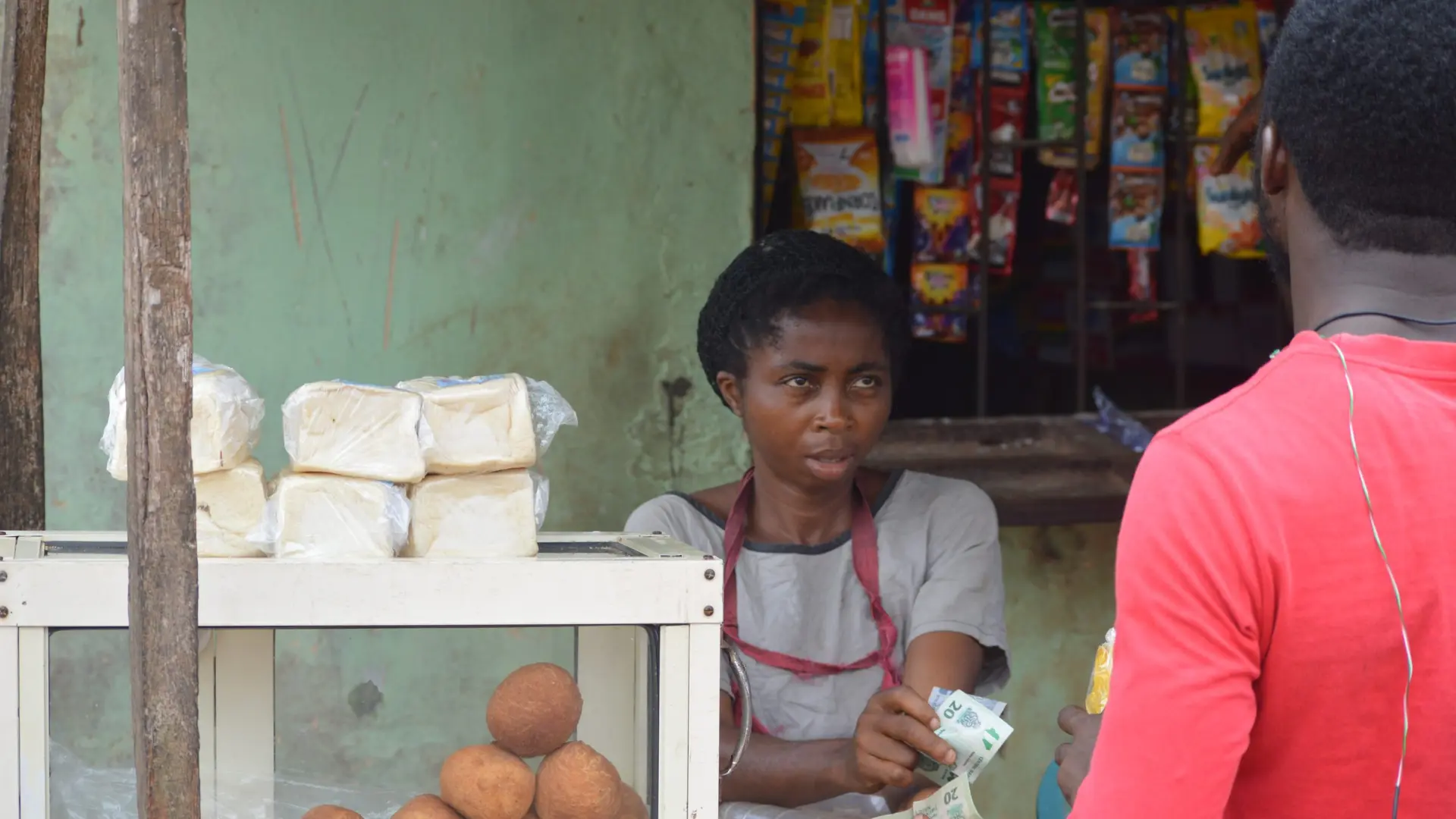
Walk into a neighbourhood grocery in Casablanca and the transaction you can see is the small one. Somebody buys oil, tea, a sachet of detergent. The transaction that determines whether any of it is on the shelf happened days earlier and involved no money at all. A supplier handed over stock the shopkeeper could not yet pay for, on terms that were never written down, at a price that reflected the supplier’s private assessment of whether this particular shop settles its debts. That trade credit is what keeps many informal shops stocked. Platforms such as Chari in Morocco and OmniRetail in Nigeria are now taking it over and pricing it on evidence rather than relationship. This analysis argues that the shift is a gain for shopkeepers that leaves them unable to take their own records with them.
Chari, founded in Morocco in 2020, began by making that supply relationship faster. Neighbourhood retailers order through an application rather than waiting for a representative, and the goods arrive. It is a straightforward proposition and it worked. In October 2025 the company raised a twelve million dollar Series A. It says its commerce and financial products now reach more than 20,000 merchants and users. Alongside the raise it obtained something considerably more revealing than any funding figure. It secured a payment-institution authorisation from Bank Al-Maghrib, Morocco’s central bank, as described in its June 2026 service terms.
Companies that deliver groceries do not become regulated financial institutions by accident. A payments authorisation expands the regulated services the business may offer. It is not a banking licence or proof that unrestricted lending is permitted. It tells you that the ordering application was never the business, or at least not the whole of it, and that what Chari is assembling is the apparatus to occupy the position the distributor held all along. The shopkeeper’s supplier was always also the shopkeeper’s bank. That role is now changing hands, and it is being reported as a logistics story.
The distributor was always the bank
Trade credit in informal retail is a large lending system that formal lending statistics do not consistently capture. A distributor extends stock and is repaid on the next delivery, or the one after. No interest is charged explicitly. The cost is embedded in the unit price, which is why shops buying on credit pay more per case than shops paying cash, and why the difference is rarely described as a rate.
Stock handed over before it is paid for. The cost is buried in the unit price rather than expressed as an interest rate, which is why this lending rarely shows up in measures of credit to the private sector.
Because the price of that credit was set by relationship rather than by evidence, it allocated in ways that had nothing to do with the shopkeeper’s actual reliability. Proximity mattered. Family connection mattered. Longevity mattered. A capable operator new to a neighbourhood paid more for stock than a mediocre one whose father had known the distributor, and both of them financed their inventory at a cost neither could calculate. That system had one considerable virtue. It was flexible, forgiving of a bad month and administered by somebody with local knowledge. It had one considerable defect. It was arbitrary, and its arbitrariness compounded across every shop it touched.
Order history as collateral
A platform replaces the relationship with a record. Once ordering, payment and settlement run through a single system, the platform knows exactly what a shop buys, how often, with what seasonality and how reliably it pays. That is an underwriting file of a quality no distributor could ever assemble, and it prices credit accordingly. The good operator new to the neighbourhood now gets better terms than the connected mediocrity, because the file says so.
That is a real gain, though its size will show only in the actual terms and borrower outcomes.
The cost is that the file is not theirs. A shopkeeper may struggle to transfer a platform repayment record to another provider if contracts and data-access arrangements do not support portability. The asset they created belongs to the party that recorded it. Their bargaining position weakens as their credit history improves, which is the inverse of how credit is supposed to work.
The shopkeeper’s own trading history has become an asset, and it belongs to somebody else.
Who sets the shopkeeper’s shelf
The consequence that follows is structural rather than incidental. A lender manages exposure, and a lender who also controls the ordering interface manages it by shaping what the borrower buys. Credit lines can be drawn against some categories and not others. Products appear in a particular order on a screen. Slower-moving lines become harder to finance and quietly disappear from the assortment. Manufacturers who want prominence discover there is a party to negotiate with, and that party is not the shopkeeper.
The delivery: the visible service, and the least valuable. The loan: the relationship the distributor actually held. The decision: what is financeable, and therefore what the shelf is allowed to stock.
Nothing here requires anyone to behave badly. Every step is commercially rational and most are beneficial to the retailer in isolation. But the composite is a private company acquiring influence over product availability across tens of thousands of outlets, funded by capital that expects that influence to be monetised, and supervised by nobody who is looking at it in those terms. Morocco’s central bank licensed a payment institution. Payment institutions are supervised for prudential soundness and consumer protection in payments, not for whether they are steering national retail assortment.
That the mechanism is not Moroccan is what makes it worth the space. In Nigeria, OmniRetail runs a recognisably similar architecture at greater scale, digitising the fast-moving consumer goods chain between manufacturers, distributors and informal retailers while adding payments, credit and logistics on top. The company reports more than 160,000 retailers across four countries, and external reporting describes it as EBITDA-positive in 2023 and net profitable in 2024. Those profitability claims come from reporting rather than from audited accounts and should be held loosely. What matters is the direction they indicate: the version of this model that embeds credit into an asset-light network appears to make money.
Profitability does not by itself settle what these companies are, because it can come from procurement margins, logistics, software, payments or credit. The architecture is more telling. The delivery is the acquisition channel and the underwriting is the product, which is the shape of the businesses that came to dominate consumer credit in other markets, arriving in Africa through the corner shop rather than through the bank branch.
Africa 360°’s position is that this transition is worth having and is being supervised as the wrong thing. The corner shop deserves credit priced on evidence rather than on family connection, and no argument for the old arrangement survives contact with how arbitrary it was. But a lending relationship spanning tens of thousands of micro-enterprises, in which the borrower cannot port their own record and the lender shapes what they may stock, is a competition question and a financial conduct question at once. Neither the payments regulators now licensing these companies nor the competition authorities assessing digital platforms and retail markets are currently framed to see it. The single most consequential intervention available is also the most boring. Make the trading record portable, so that the shopkeeper who built the file can carry it to whoever offers the better rate. Until that happens, the digitisation of African retail will keep being described as a logistics revolution, when what is actually changing hands is the debt.



