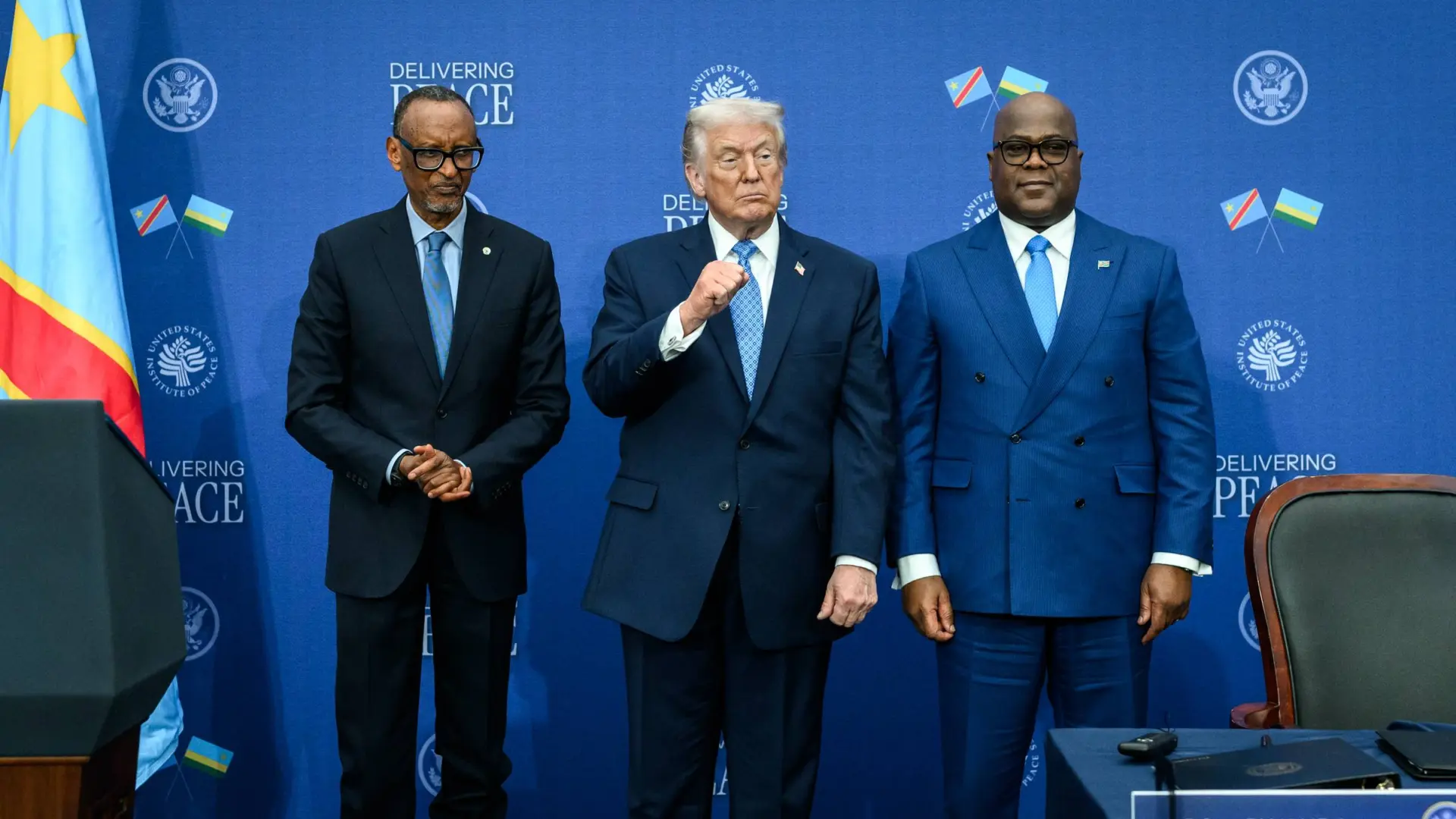
On 4 December 2025, the leaders of the Democratic Republic of the Congo and Rwanda signed the Washington Accords for Peace and Prosperity, presented as the end of a war. The Washington Accords promised regional economic integration, transparency in the critical-minerals supply chain and a basis for lasting peace. Signed the same day, a bilateral Strategic Partnership Agreement between the United States and the DRC gives American investors a right of first offer over a reserve of Congolese mineral assets. Seven months later the fighting in the east has not stopped, and petitioners in a pending Congolese court challenge argue that the agreement breaches the constitution. The accords offered peace in exchange for a share of Congolese economic sovereignty. So far the exchange has not delivered the peace.
What the Washington Accords and the partnership agreement say
The economic terms sit in the Strategic Partnership Agreement published by the US State Department. It requires Kinshasa to establish a Strategic Asset Reserve made up of designated critical mineral assets, gold assets and unlicensed exploration areas. The text states that “The DRC shall grant U.S. persons the right of first offer for SAR Projects.” A US person that submits a proposal within three months of a project being notified receives a negotiation window. Oversight rests with a 10-member Joint Steering Committee, split equally between American and Congolese officials and operating by consensus. The DRC also commits to regulatory and fiscal reforms within 12 months, including a 10-year tax and regulatory stabilisation regime and centralised tax administration for qualifying projects.
The bargain was not imposed on Kinshasa from outside. After M23 took Goma, the capital of North Kivu, in late January 2025 and Bukavu, the capital of South Kivu, on 15 to 16 February 2025, President Félix Tshisekedi wrote to Washington in February 2025 proposing preferential American access to Congolese critical minerals in return for security backing and pressure on Kigali, according to the Institute for Security Studies. He repeated the offer in a New York Times interview in March 2025. Congo designed this deal as much as it received it.
The mechanism still deserves scrutiny. A minerals-for-security arrangement presents the extraction of value from Congo as the solution to Congo’s insecurity, when the region’s record suggests the two are connected. The wealth beneath the eastern provinces is part of what makes the violence there profitable and persistent. An accord that addresses the conflict by formalising who gets the minerals does not remove that logic. It changes the beneficiary.
Conditions after signing
The test of a peace deal is the situation on the ground afterwards. In its final report dated 5 June 2026 (S/2026/466), the UN Group of Experts on the DRC found that Rwandan military movements after withdrawal pledges were largely rotations and reinforcements rather than disengagement. The experts estimated that thousands of Rwanda Defence Force personnel remained in eastern Congo, exercising centralised operational control over AFC/M23. They also documented an M23 parallel administration over mining zones, with coltan from Rubaya and gold from South Kivu moving along rebel-controlled routes into Rwanda. Rwanda denies commanding M23 or deploying troops to exploit Congolese minerals, and says its security posture is defensive, directed at the FDLR militia.
As the UN Security Council heard in a briefing on 26 June 2026, AFC/M23 still held Goma and Bukavu and major mining centres, notably the Rubaya coltan mines in Masisi territory, North Kivu.
Washington has kept sanctioning. On 2 March 2026 the US Treasury designated the Rwanda Defence Force itself and four senior commanders, including the chief of defence staff, for what it said was fighting alongside, training and equipping M23 in violation of the accords. On 30 April it designated Joseph Kabila, Congo’s former president, for what it described as financial support to the rebellion, a case Africa 360° reported in May. On 2 June it designated an M23 intelligence chief and an FDLR commander. On 25 June it designated Kigali’s Gasabo Gold Refinery, two of its executives and three Rwandan mining firms, which Treasury said laundered gold smuggled from M23-held mines in South Kivu. A peace in which the guarantor must sanction one signatory’s armed forces three months after signing is a framework under strain.
A peace in which the guarantor must sanction one signatory’s armed forces three months after signing is a framework under strain.
The constitutional claim
On 21 January 2026, a collective of Congolese lawyers and human rights defenders led by attorney Jean-Marie Kalonji asked the Constitutional Court of the DRC in Kinshasa to annul the Strategic Partnership Agreement, as the Oakland Institute reported. They argue that concluding it without Parliament breached Article 214, which requires parliamentary ratification or a referendum for treaties that modify national law. They also cite Articles 9 and 217 on permanent sovereignty over natural resources, and Article 12 on equality before the law, which they say the preferential tax stabilisation and right of first offer for American investors violate.
The agreement’s text does not expressly require Congo to amend its constitution. It contains a standard representation that the DRC has legal authority to sign. The constitutional reading comes from the petitioners, whose case is that the agreement’s transfer of resource rights, its consensus veto and its investor privileges cannot be implemented within the 2006 constitution as it stands. If they are right, a security guarantee will have reached into the instrument through which Congolese citizens decide who owns the national patrimony and on what terms. The lawsuit is not a technicality. It puts the sovereignty question in front of a judge.
Kinshasa’s choice deserves a fair reading. The government entered this arrangement, and proposed its core idea, because it faced a war it was losing and provincial capitals under occupation. It weighed two losses of sovereignty. One was the de facto loss represented by foreign-backed forces holding its territory. The other was the de jure loss represented by granting preferential mineral access and committing to legal reform. It accepted the second in the hope of ending the first. Seven months on, it is sustaining both.
Who benefits and what remains unresolved
The United States converts a strategic dependence, its need for critical minerals it does not control, into a right of first offer secured by agreement, which fits a wider push to secure supply discussed in Africa’s mineral processing debate. Rwanda, whatever the sanctions, remains a party whose forces, according to UN experts, are on the ground alongside an armed group that holds the mines. The Congolese state has offered the most concrete concessions for the least concrete return so far.
What comes next depends on whether Congolese institutions, its courts and its legislature, test the bargain against the constitution or let it stand untested. If the challenge forces the terms back into public contest, Congo will have shown that a concession made under duress can still be reviewed through law. If it fails, the accord becomes a template that other resource-rich, conflict-affected African states should study closely. Congo has been offered peace and asked to pay for it with its minerals and, if the petitioners’ reading holds, its constitution. Whether the payment was worth a peace that has not yet arrived is now being argued not in Washington but in a courtroom in Kinshasa.