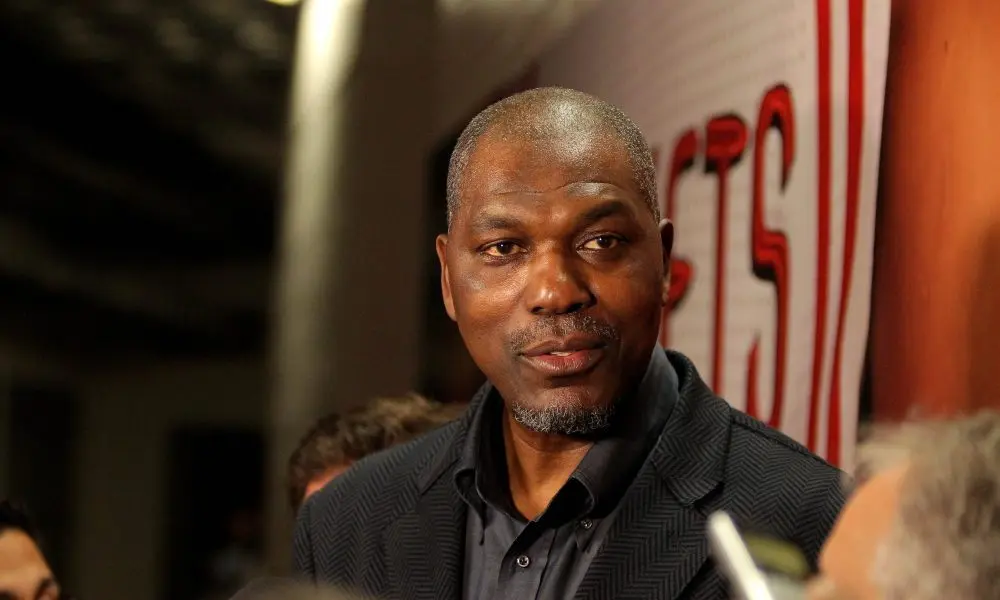
Hakeem Abdul Olajuwon was born in Lagos on 21 January 1963 and did not touch a basketball until his mid-teens. He went on to lead the Houston Rockets to consecutive National Basketball Association (NBA) championships in 1994 and 1995, and he is counted among the finest centres the game has produced.
He earned the nickname “The Dream” because his dunks looked so effortless that his college coach said they “looked like a dream”.
A goalkeeper in Lagos
His parents, Salim and Abike Olajuwon, were middle-class Yoruba who ran a cement business in Lagos. Hakeem was the third of their six children, and he credits them with teaching him and his siblings hard work and discipline.
Like many Nigerian boys of his generation he played football, in goal. Years between the posts gave him the footwork and agility that later balanced his size and strength on the court. He only took up basketball at 15. In 1980 he played for a Nigerian junior team at the All-Africa Games, and he then left for the University of Houston, where the Cougars were coached by Guy Lewis.
The Houston Cougars
He spent 1980 to 1981 training as a redshirt before joining the Cougars in National Collegiate Athletic Association (NCAA) competition. That first season ended with defeat in the Final Four. Rather than sulk, he asked the coaches how to improve. They sent him to work out with Moses Malone, a Houston resident, multiple NBA Most Valuable Player (MVP) and then the Houston Rockets’ centre. Olajuwon spent the summer going head to head with Malone, and he says he came out of it a much better player.
From his second season he took the Cougars to two NCAA championship games, in 1983 and 1984. They lost in 1983, but he was still named the 1983 NCAA Tournament’s Most Outstanding Player, the last man from a losing side to receive the honour.
Rookie of promise
The Houston Rockets took him with the first pick of the 1984 NBA draft, ahead of a class that included Michael Jordan, Charles Barkley and John Stockton. His rookie numbers justified the choice: 20.6 points and 11.9 rebounds a game, shooting .538 from the field. Only Jordan finished ahead of him in the Rookie of the Year vote.
The Rockets, 29-53 the season before he arrived, went 48-34. He was fourth in the league in rebounding and second in blocked shots, with 2.68 a game. He played in the 1985 All-Star Game and made both the NBA All-Rookie Team and the NBA All-Defensive Second Team. Alongside Ralph Sampson, he formed the first pair of teammates since Wilt Chamberlain and Elgin Baylor in 1970 to both average more than 20 points and 10 rebounds.
Among the league’s best big men
A year later Olajuwon and Sampson carried the Rockets to the 1986 NBA Finals, beating the reigning champions, the Los Angeles Lakers, in five games in the Western Conference Finals on the way. Injuries began to wear Sampson down in 1986, and the following season he was traded to the Golden State Warriors.
Olajuwon only grew. He led the Rockets in 13 statistical categories, scoring, rebounding, steals and blocked shots among them. He was named to the All-NBA First Team from 1987 to 1989 and to the NBA All-Defensive First Team in 1987, 1988 and 1990, and he started at centre for the Western Conference All-Stars four years running, from 1987 to 1990.
He won the rebounding title in 1989 and 1990, with 13.5 and 14.0 a game. In 1989 he became the first player to finish in the league’s top 10 for scoring, rebounding, steals and blocked shots in two straight seasons. On 29 March 1990, against the Milwaukee Bucks, he recorded a rare quadruple-double of 18 points, 16 rebounds, 11 blocks and 10 assists. He also led the league in blocked shots in 1989–1990, with 4.59 a game, and in 1990–1991, with 3.95.
Injury and a new game
Midway through the 1990–1991 season an elbow from Bill Cartwright of the Chicago Bulls caused a blowout fracture of the bones around his eye, and he missed the Rockets’ next 25 games. Early in 1991–1992 an episode of atrial fibrillation, an irregular heartbeat, kept him out of seven more.
From 1992–1993, the midpoint of his career, he became better still and lifted the Rockets with him. At the end of the 1992–1993 season he finished second to Charles Barkley in the MVP vote, won his first NBA Defensive Player of the Year award and returned to the All-NBA First Team and the NBA All-Defensive First Team.
His reinvention was a repertoire of spins, fadeaways and jump shots that made him close to unstoppable in attack. Fast footwork with the ball and head fakes, whether he had his back to the basket or faced his defender, left opponents stranded. The whole package became known as the “Dream Shake.”
Two championships
The 1993–1994 season was his peak. He was named both league MVP and NBA Finals MVP as Houston won its first championship, and after an outstanding regular season he also took his second straight Defensive Player of the Year award.
In 1994–1995 he averaged a career-best 27.8 points and 10.8 rebounds a game, yet the MVP award went to David Robinson, whose San Antonio Spurs had the league’s best record. That season he passed Calvin Murphy to become the Rockets’ all-time leading scorer.
The NBA Finals set him against the Orlando Magic and the league’s outstanding young centre, Shaquille O’Neal. Their numbers were close: Olajuwon averaged 32.8 points, 11.5 rebounds and 5.5 assists, O’Neal 28.0 points, 12.5 rebounds and 6.3 assists. But Houston swept the series and became the fifth NBA franchise to win back-to-back titles, and Olajuwon was named Finals MVP for the second year in a row.
He stayed productive for two more seasons. The Seattle SuperSonics swept the Rockets in the 1996 conference semifinals. Barkley’s arrival before 1996–1997 strengthened the team, but the Utah Jazz still beat them in six games in the Western Conference Finals.
Faith and the final seasons
From 1997–1998 injuries began to cost him games, and he played just 47 that season. He was back for close to a full schedule in the lockout season of 1998–1999, but his output was falling. He played two more years in Houston, averaging under 12.0 points and 7.5 rebounds a game.
Olajuwon believes his faith drove his career. He kept the Ramadan fast during the NBA season, rising before dawn for the suhur meal, drinking a gallon of water and praying for strength, then going without food or drink until sunset.
Retirement and honours
He left Houston in 2001 after 20 years there, college included, and retired after a single season with the Toronto Raptors in 2001–2002. Houston did not forget him. When he left the game he led the franchise in a host of categories, including points, rebounds, steals and blocked shots, and his 3,830 blocks remain the NBA’s all-time record. The Rockets retired his No. 34 jersey on 9 November 2002.
At that ceremony the club announced a life-sized statue for its new downtown arena, due to open for the 2003–2004 season. Because his Muslim beliefs ruled out a statue, the Rockets unveiled a bronze monument outside the arena instead. In 2008 he was inducted into the Naismith Memorial Basketball Hall of Fame, and in 2016 he entered the International Basketball Federation (FIBA) Hall of Fame.
After his playing days he spent off-seasons teaching post footwork to young NBA stars, from Kobe Bryant to Dwight Howard and Amar’e Stoudemire.
Family life
On 8 August 1996 he married Dalia Asafi in Houston, and the couple have four children. At college he met Lita Spencer, and they had a daughter, Abisola, who played for the West Girls in the McDonald’s All American Game and went on to the Women’s National Basketball Association (WNBA).
Besides English, he is fluent in French, Arabic and Yoruba. In 1996 he published his autobiography, Living the Dream, written with Peter Knobler. Over his 18-year NBA career he earned more than $110 million in salary.



