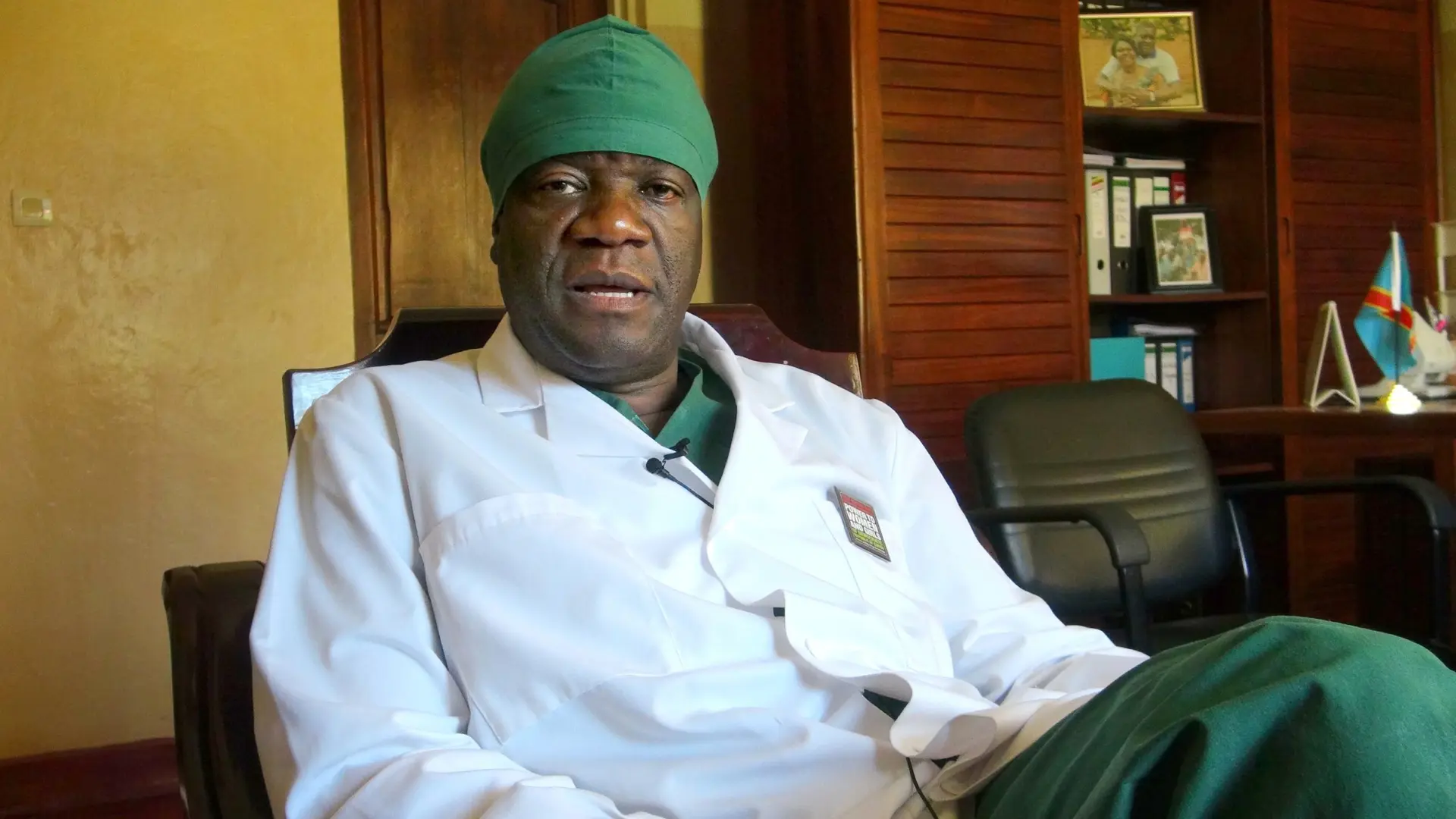
It is not for nothing that the Democratic Republic of Congo has been called the “rape capital of the world”. In eastern DRC, where the country borders Uganda, Rwanda and Burundi, armed men rape to punish and to terrorise, and those who command them have long gone unpunished.
The violence goes on because the conflicts behind it go on, and ending those conflicts is the government’s responsibility.
The children of Kavumu
Ruth Maclean of The Guardian wrote in December 2016: “The mothers of Kavumu hardly sleep. But on rainy nights, they don’t even try. The rain pounds on their tin roofs so noisily that they worry they won’t hear rapists breaking in to steal their daughters. So they sit up all night, just watching their front doors”.
The Guardian also reconstructed one of those nights in the South Kivu village. Shortly before midnight at the end of December 2015, an intruder entered a wooden house and took a small girl from the bed she shared with her mother. Nobody else in the house woke. When her mother reached for her and found the space empty, she saw the iron bar that usually held the door shut lying on the floor and a machete driven into the ground outside. Women in Kavumu knew those signs, because the same thing had happened many times over the previous years. Neighbours set out in search parties and found the child in a nearby field, raped and badly injured.
A weapon of war
What sets rape in DR Congo apart is its scale and its purpose. It is used as a weapon of war in its own right, meant to break homes and families through the stigma survivors then face. Beyond the physical harm, rape leaves lasting trauma, and survivors may never overcome it without psychological help.
Rape victims in DR Congo number in their thousands. The UN recorded more than 113,000 cases of sexual violence in 2023, and conflict-related cases roughly doubled in 2024, according to the figures collected on Wikipedia’s page on sexual violence in the country.
Sexual violence in DR Congo is not only aimed at women. Men are raped too, though in smaller numbers.
Even Congolese who cross into neighbouring Angola, many of them migrants looking for work in the mining trade, are not safe. The Economist reported that Congolese women were being systematically raped in Angola as a way of driving Congolese migrants out. An Italian aid agency with a UN grant to monitor the border documented more than 21,000 serious human rights violations, including rape, beating, torture and looting, among some 26,000 people expelled since April 2011. Human Rights Watch said the aim of the abuse was to instil fear.
The international community, aid agencies and individuals such as Dr Denis Mukwege are working to save these lives and rebuild them. Dr Mukwege, a gynaecologist who treats and cares for rape survivors, won the 2018 Nobel Peace Prize for that work, jointly with the Yazidi activist Nadia Murad.
Is the government complicit?
Most of the rapes reported in the region are committed by armed militias drawn from the various ethnic groups. The state’s failure to stop them is part of the story.
The case of Ntabo Ntaberi Sheka shows how far impunity went. The UN named the militia leader among the commanders responsible for the rape of at least 387 civilians (300 women, 55 girls, 23 men and 9 boys) in 13 villages in Walikale between 30 July and 2 August 2010, carried out by his Nduma Defence of Congo and two other armed groups. A national arrest warrant was issued in 2011. Yet in 2011 Sheka ran openly for a seat in parliament as an independent candidate in Walikale. In November that year, Human Rights Watch reported, he and his fighters marched openly through Walikale town, and when an army officer was ordered to arrest him he was tipped off and fled. He finally surrendered to UN peacekeepers in North Kivu on 26 July 2017. In November 2020 a Congolese military court sentenced him to life imprisonment for war crimes including murder, sexual slavery and the recruitment of child soldiers.
For Dr Mukwege, the Congolese government’s detachment and its failure to end the conflicts amount to complicity in the rise of sexual violence. In an interview with The Guardian in October 2018 he said:
“The Congolese people live with unheard-of violence. Unheard of. He [Kabila] is responsible for not putting an end to the violence. His role is to protect his people and their belongings. We see that 20 years after it came to power, this government does not protect women. I’ve always said that it’s an illegal and illegitimate government. They must hand over to a caretaker government, which can organise free, fair, credible elections, and this transition must also put in place the foundations to build a solid democracy. I think we’ll have elections on 23 December, but I think we’ll elect the same people, and the same actors will produce the same system that perpetuates the violence. The December elections do not seem credible or transparent … it’s a parody of an election.”
What the law says
On paper, the law is clear. The Constitution of the Democratic Republic of the Congo treats sexual violence as a form of gender-based violence and discrimination (article 14), as a crime against humanity (article 15), as cruel, degrading and inhuman treatment (article 16) and as a violation of the right to peace (article 52).
Dr Mukwege told a high-level UN panel in September 2012: “The women victims of sexual violence in Eastern Democratic Republic of the Congo are in dishonor.” Many, he said, were still held in sexual slavery or used as a weapon of war. “And this has been going on for sixteen years!” He listed sixteen years of wandering, torture and mutilation, of the destruction of women and of the breakdown of an entire society.
The onus is on the government of DR Congo. This sexual violence cannot stop until the conflicts are brought to an end.
The vote Dr Mukwege doubted was in fact held a week late, on 30 December 2018. Félix Tshisekedi was declared the winner and sworn in on 24 January 2019, replacing Kabila in what was described as the country’s first peaceful transfer of power since independence, although the runner-up, Martin Fayulu, rejected the result, the record of the election shows.
Dr Mukwege later took his argument to the ballot box himself. He stood for president in the December 2023 election and finished sixth, with 39,639 votes.



