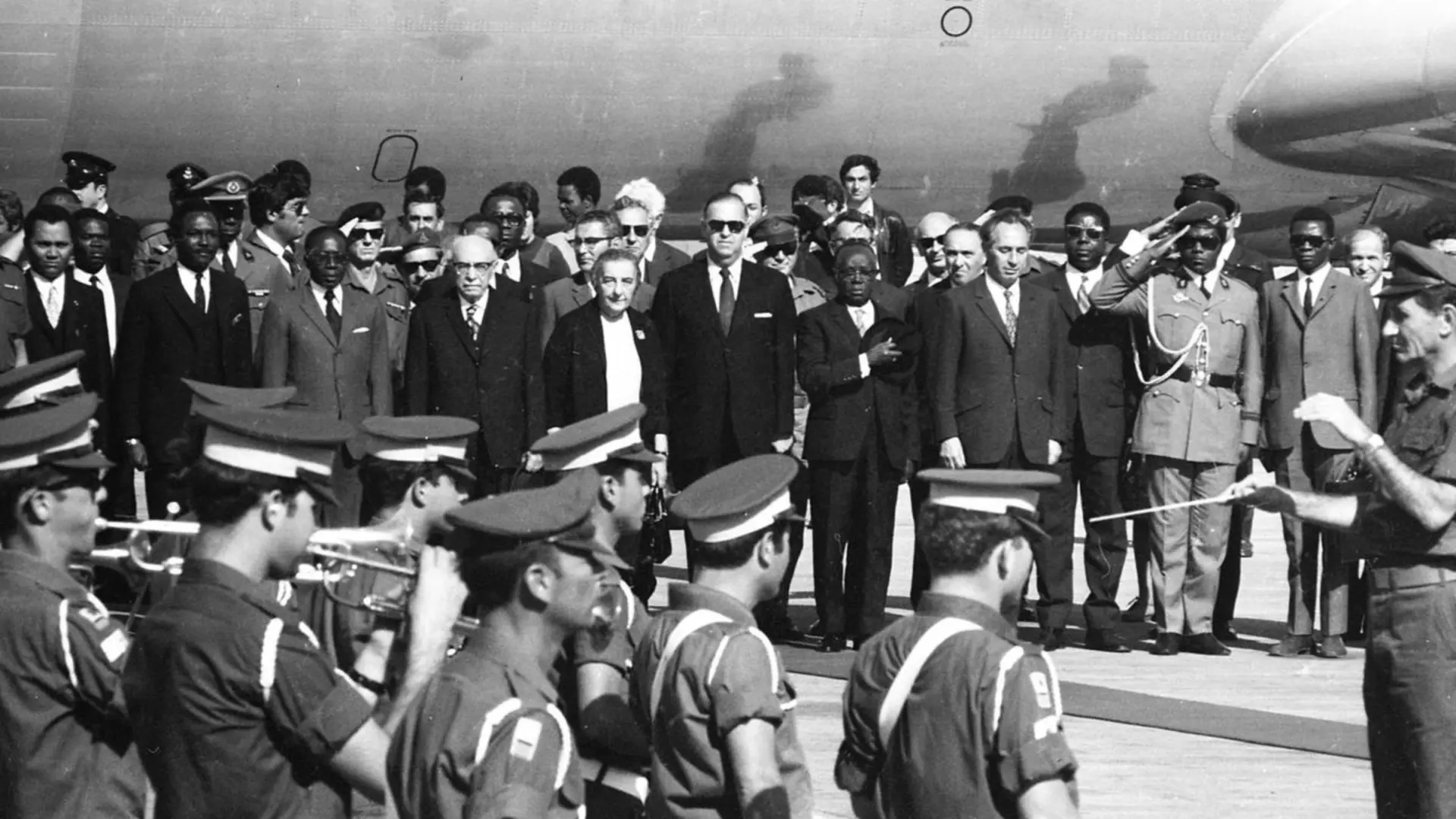
General Yakubu “Jack” Dan-Yumma Gowon ruled Nigeria through its deadliest years. Under his leadership the federal government defeated the Biafran secession in the civil war of 1967 to 1970, a conflict that by some estimates killed almost 3 million people, most of them civilians. He came to power on the back of one military coup and lost it to another.
He also remains the most federalist of Nigeria’s military rulers. At the end of the war in 1970 he declared that there was no victor and no vanquished, and his government gave that pledge substance through the policy of the three Rs, Reconstruction, Rehabilitation and Reintegration. His name was even turned into an acronym for “Go On With One Nigeria”.
Early life
Gowon was born on 19 October 1934, the fifth of 11 children of Nde Yohanna and Matwok Kurnyang. He is Ngas (Angas) by origin, from Lur, a small village in what is now the Kanke Local Government Area of Plateau State. He grew up and went to school in Zaria, in present-day Kaduna State.
At school he was a gifted athlete. He kept goal for the football team, pole-vaulted and ran long distances, and he broke the school’s mile record in his first year. He is also said to have captained the school’s boxers.
A career soldier
Gowon joined the Nigerian Army in 1954. On 19 October 1955, his twenty-first birthday, he was commissioned as a second lieutenant. His training took him to the Royal Military Academy Sandhurst in the United Kingdom (1955 to 1956), the Staff College at Camberley (1962) and the Joint Staff College at Latimer (1965). He served with the United Nations peacekeeping force in the Congo (later Zaire) in 1960, 1961 and 1963, and by 1966 he commanded a battalion, still with the rank of lieutenant colonel.
Until then he had been a soldier and nothing else, with no involvement in politics. The upheavals of that year changed it. As a Northerner who was neither Hausa nor Fulani, and not a Muslim, he was an unusually safe choice to lead a country divided by ethnic tension.
Two coups and the road to war
In January 1966 a group of junior officers led by Major Chukwuma Kaduna Nzeogwu staged a coup that brought down the First Republic of Prime Minister Sir Abubakar Tafawa Balewa. In its wake Gowon, aged 31, became army chief of staff. After a counter-coup in July 1966 he was named head of state on 1 August 1966, still a lieutenant colonel.
Once he took power, Gowon tried to calm the ethnic tensions that threatened to tear Nigeria apart. He managed in the end to halt the attacks on Igbo people in the North, but he could not secure a lasting peace. In a last attempt to settle the crisis, on 27 May 1967 he declared a state of emergency and divided Nigeria’s four regions into 12 states. Three days later the Eastern Region declared itself the independent Republic of Biafra under Odumegwu Ojukwu, and fighting began on 6 July 1967.
War and reconciliation
Gowon told his forces to remember that the people they were fighting were Nigerians, to be encouraged back into the country. He also allowed a team of international observers to monitor how his troops behaved. After the federal victory in January 1970 he made reconciliation the official policy of his government. By the mid-1970s he was emerging as an international figure, and he took part in founding the Economic Community of West African States (ECOWAS).
His government also had real achievements at home. The indigenisation decree of 1972 was among the most important. The regime followed careful four-year national development plans, under which it built major infrastructure such as Eko Bridge and the Ijora Causeway complex in Lagos, and roads across the country. It widened access to the universities, scrapping tuition fees and heavily subsidising meal tickets, a sign of a military government willing to spend the new oil wealth on its citizens.
A broken promise and a coup
On 1 October 1974, contradicting his own earlier promises, Gowon announced that Nigeria would not be ready for civilian rule by 1976 and that the handover would be postponed indefinitely. The decision radicalised his civilian opponents. Among them was the late educationist Dr Tai Solarin, who published a statement titled “The Beginning of the End” and handed it out himself at the roadside. It also gave the military a pretext to move against him. The growing bureaucracy brought allegations of rising corruption, and the country’s new wealth led to the issue of fake import licences. These failings of his administration caused serious discontent in the army.
On 29 July 1975, while Gowon was at a summit of the Organization of African Unity (OAU) in Kampala, a group of officers led by Colonel Joe Nanven Garba announced that he had been overthrown. The plotters made Brigadier Murtala Mohammed head of the new government, with Brigadier Olusegun Obasanjo as his deputy.
Exile and return
After his removal Gowon went into exile in Britain, where he went back to study and earned a PhD in political science at the University of Warwick. In February 1976 a coup attempt led by Lieutenant Colonel Buka Suka Dimka killed the head of state, General Murtala Mohammed. Before his execution, Dimka claimed that the aim of the coup had been to restore Gowon to power.
On the strength of the coup tribunal’s findings, the federal government declared Gowon wanted, stripped him of his rank in his absence and stopped his pension. He was pardoned during the Second Republic under President Shehu Shagari, as was the former Biafran leader Emeka Ojukwu. His rank of general was restored only in 1987, by General Ibrahim Babangida. In the mid-1980s he became a professor of political science at the University of Jos, and he grew into an elder statesman of Nigerian politics. He is married to Victoria (née Zakari).
The image that endures
Gowon’s record shows what Nigeria’s military rulers might have been. He handled the country’s federal diversity and the military’s chain of command with real skill, and he broke his own promise on civilian rule. He still carries the nobler image of the Nigerian military, from before its long years in power cost it its standing.



