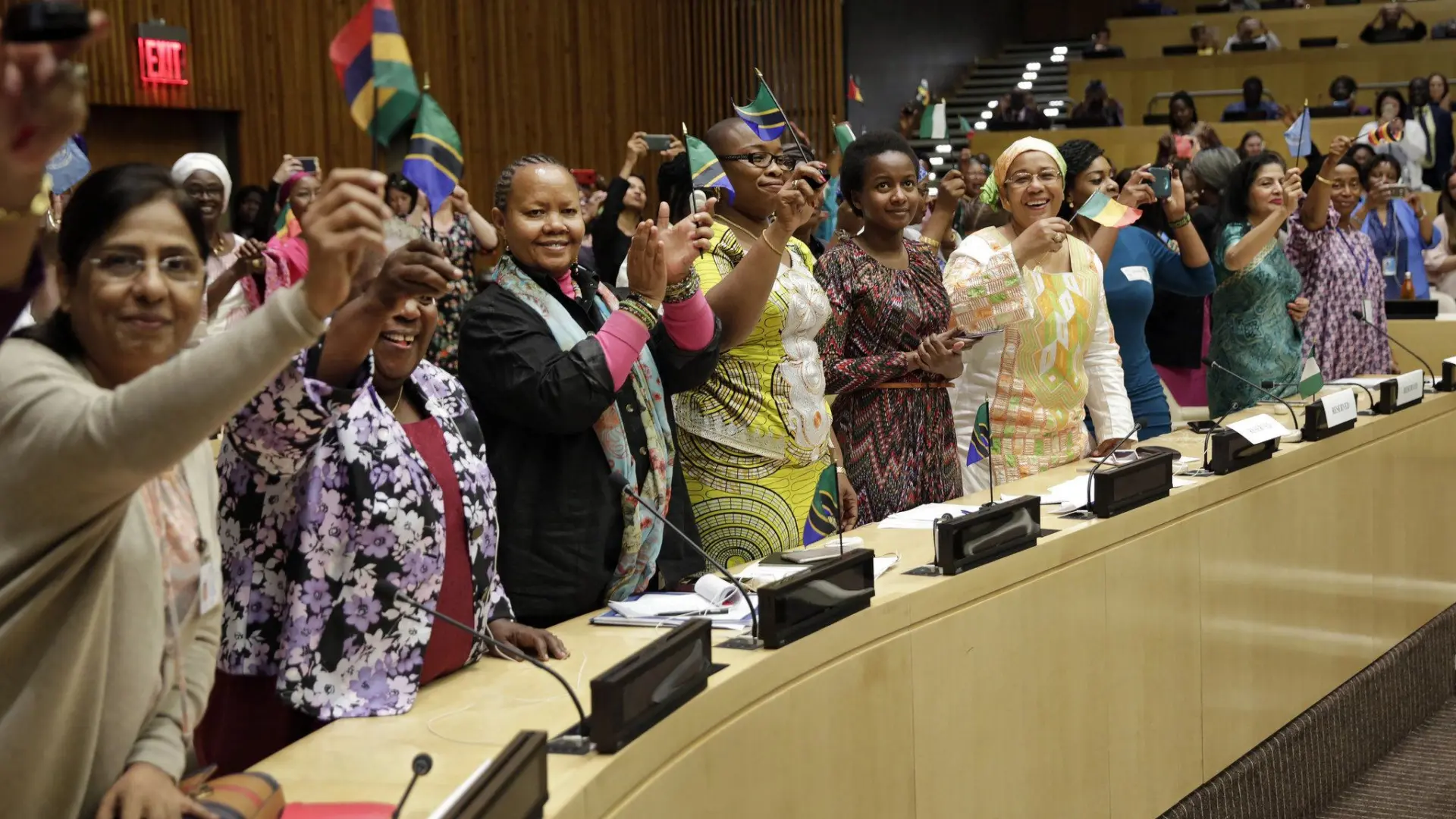
When people see a woman in a leading position, the question everyone asks is whether she can do the job. Is she capable of holding such a position? A woman who volunteers for a prominent role is often seen as aggressive, or as too career-minded, and is told she will turn men off.
Yet more and more women are breaking the norms, and Africa is no exception. In Rwanda, women made up 64 per cent of parliament after the 2013 elections. Half of South Africa’s cabinet is now female. The question is no longer whether women can lead, but what still keeps so many of them from the chance. This piece argues that unequal schooling is the main barrier, and that education and mentoring are where change must begin.
In the past, the man was seen as the head and the woman as the supporting character whose main role was to assist him. In any group the man automatically took the lead and the woman took the back seat. As a woman, the bulk of domestic responsibilities fell on you. The movement for gender equality challenged the many restrictions women faced, and it opened up more opportunities for them in society.
Access to education and work, mentoring by both men and women, support from family, employers, supervisors, teachers and colleagues, and successful lobbying by gender activists have given more women the courage to take up leadership positions.
Women in power across Africa
Today, sub-Saharan Africa is not far behind the leaders. On 1 January 2019 women held 23.7 per cent of seats in its parliaments, against 30.7 per cent in the Americas and 28.5 per cent in Europe, according to the Inter-Parliamentary Union.
In Rwanda, the 2003 Constitution set a quota of 30 per cent for women in parliament, which paved the way for more women in politics. After the 2008 elections, women made up 56 per cent of parliament. After the 2013 elections the figure reached a record-breaking 64 per cent.
In Kenya, Article 27(8) of the constitution requires the State to take measures to implement the principle that not more than two-thirds of the members of elective or appointive bodies shall be of the same gender. The aim is to bring women into leadership and national affairs, which were dominated by men before the constitution.
In Ethiopia, the new cabinet has women in the top security posts, defence and peace, for the first time in the country’s history. Last year the Ethiopian parliament elected Sahle-Work Zewde as the country’s first female president.
The same seems to be true in business. The second edition of the Mastercard Index of Women’s Entrepreneurship (MIWE) found that 46.4 per cent of businesses in Ghana are owned by women. In Uganda the figure is 33.8 per cent.
On Wednesday 29 May 2019, President Cyril Ramaphosa announced that women would make up half of South Africa’s new cabinet, for the first time in the country’s history. Patricia de Lille, former mayor of Cape Town and leader of the GOOD party, was appointed minister of public works.
Where progress stalls
Sadly, the gains do not hold across the continent. Variation is significant, in parliaments as in the private sector. By 2021 women held 25 per cent of parliamentary seats across Africa on average, according to the OECD. North Africa stood just below that at 24 per cent and Central Africa at 18 per cent, while West Africa had the lowest representation at 16 per cent.
Poverty, social exclusion, distance from schools and poor-quality education are still serious problems in some communities. Girls do not have equal access to education in fields traditionally dominated by men, such as science, technology, engineering and mathematics (STEM). As a result, far fewer women have the training and skills to enter these fields and the pipeline to leadership.
The United Nations Statistics Division reports that “an estimated 781 million people aged 15 and over remain illiterate” and that “Nearly two thirds of them are women” (The World’s Women 2015). In sub-Saharan Africa, girls still fall further behind as they move up from primary to secondary and tertiary education.
What needs to change
There is much work to be done to get more women into leadership roles. It has to start at school and continue into the workforce, with investment in education, health and economic opportunities for girls and women. Quality education should be open to girls at every level, especially those who are marginalised and disadvantaged. Girls should be encouraged into STEM, finance and politics, fields traditionally dominated by men.
Women should be offered training and mentoring so they can be hired into roles dominated by men, and women in rural communities need support for career advancement. Nations and community leaders should give girls proper legal protection from harmful cultural practices, such as early marriage, that keep them from school or a career. Economic empowerment programmes should give women entrepreneurs training and resources, so that they gain financial independence and leadership at home and in their businesses. International organisations such as the United Nations (UN) could sponsor this.
Why it matters
Women’s participation in leadership is essential to gender diversity in politics and business. The corporate world needs a mix of people to make sure employers act responsibly, rather than deciding for women what they can or cannot handle.
McKinsey & Company’s 2016 report Women Matter Africa makes the same point: “Women can also bring different ways of working to management teams that enhance decision-making.” It adds: “These include openness to new perspectives, collaboration and inclusiveness and strength in ethics and fairness.”
Research on boards points the same way. The study found that male directors tend to lean on rules, regulations and established ways of doing business when they decide. Women directors are more willing to weigh new ideas and a wider range of solutions, and more likely to cooperate, build consensus and take account of several groups of stakeholders. On average, women also score higher than men on tests of sophisticated moral reasoning, which suggests they are more likely to decide fairly when interests compete. With more women in leadership, decisions would be more inclusive and reflect more points of view.
For this to happen, women need to take an active part in their own professional development and see it as an investment in themselves and in their community.



