A handful of African presidents have stayed in office for 20, 30 or even 40 years, often by rewriting the constitutions that should limit them. Those same constitutions make no provision for a reliable, peaceful transfer of power, so these leaders tend to let go only when they are forced out. The countries that have broken the pattern, among them Ghana, Botswana and Zambia, did so by building institutions that outlast any one ruler. This analysis looks at the power hoarders who still refuse to give up office, and at what has worked elsewhere.
Omar al-Bashir of Sudan was, until April 2019, among the longest-serving rulers on the continent. He came to power in a coup in June 1989 and was ousted by the military on 11 April 2019, after months of mass protests. By then he had led Sudan for nearly 30 years. He was arrested within days and convicted of corruption in December 2019 (source).
Constitutions bent to fit the ruler
The African Union’s Charter on Democracy, Elections and Governance, which came into force in 2012, was designed to guard against undemocratic government and to promote good governance, democracy and security. Many African countries adopted it and agreed to uphold its terms. Not every leader was willing to accept these reforms.
In December 2017 Yoweri Museveni of Uganda, one of Africa’s longest-serving leaders, signed a bill removing the presidential age limit from the constitution. Uganda’s 1995 Constitution had barred anyone younger than 35 or older than 75 from serving as president. It was the second time the constitution had been changed in a way that kept him in the country’s highest office. An amendment in 2005 had already scrapped presidential term limits.
Several of Africa’s long-serving leaders are shielded by constitutions that they have been able to alter. Constitutional change is one of several features these systems share. Others are electoral processes that keep the form of competition without its substance; security forces whose loyalty has been converted from institutional into personal; and economic arrangements in which state resources flow through networks attached to the ruler rather than through institutions that operate independently of him.
Africa’s longest-serving leaders
The figures below describe the position in April 2019, with an update on each leader as of November 2026.
Teodoro Obiang Nguema, Equatorial Guinea
Teodoro Obiang is the president of Equatorial Guinea and the longest-serving non-royal president, having been in power for 39 years. Aged 76, he took power in an August 1979 military coup that ousted his uncle, Francisco Macías Nguema.
He is the second president of the oil-producing country. His long rule has been marked by accusations of corruption and abuse of power, among others.
He is still in office. In November 2022 the government said he had won about 97% of the vote in an election that international observers widely regarded as a sham, and the United States said it had “serious doubts about the credibility of the announced results” (source). By November 2026 he had been in power for 47 years.
Paul Biya, Cameroon
Paul Biya is the second longest-serving president in Africa, with 36 years in office. Now 86, he became president of Cameroon in November 1982.
Like Obiang, he is his country’s second president, and he is the oldest leader on this list. Biya was serving as prime minister when he succeeded President Ahmadou Ahidjo, who resigned unexpectedly in 1982.
He won the 1992 presidential election with about 40% of the vote in a single round and was re-elected by wide margins in 1997, 2004, 2011 and 2018, although all of these elections were dogged by allegations of fraud and irregularities. After winning the 2018 election, which was marked by low turnout, he began another seven-year term.
In October 2025, at 92, he was declared the winner of an eighth term. The Constitutional Council gave him 53.66% of the vote to 35.19% for Issa Tchiroma, who claimed victory himself. Protests followed in several cities, and Cameroon’s Catholic bishops, who monitored the vote, reported irregularities (source).
Yoweri Museveni, Uganda
Next on the list is Uganda’s president, Yoweri Museveni, who has ruled for 33 years. Now 74, he came to power in January 1986 when his National Resistance Army overthrew the military government of Tito Okello. (Idi Amin had been toppled seven years earlier, in 1979, by Tanzanian-backed forces that Museveni’s group fought alongside.) He was elected for a fifth term in February 2016.
He has since won two more terms. He was declared re-elected with 58.6% of the vote in January 2021 and with 71.65% in January 2026, when he was 81 (source).
Idriss Déby, Chad
President Idriss Déby took power in December 1990, giving him more than 28 years in office. He seized power at the head of a rebellion against President Hissène Habré and won a controversial fifth term in April 2016.
Déby did not leave office alive. He died on 20 April 2021, and his son Mahamat succeeded him (source).
Isaias Afwerki, Eritrea
Isaias Afwerki is the first president of Eritrea. He has held the office since independence in 1993, which makes 25 years in power.
He led the Eritrean People’s Liberation Front (EPLF), whose victory ended a 30-year war of independence.
He remains president. The National Assembly chose him in May 1993, the 1997 constitution was never put into effect, and Eritrea has not held a presidential election since (source).
Denis Sassou Nguesso, Congo-Brazzaville
President Denis Sassou Nguesso of Congo-Brazzaville has spent a total of 34 years in office, though not in one stretch.
He first served as president from 1979 to 1992 and returned in 1997 at the end of a civil war, taking office on 25 October 1997. He was re-elected in March 2016 and was eligible to run again when that term ended. His current stretch has lasted 21 years.
He did run again. He was declared re-elected with 88.4% of the vote in March 2021 and with 94.82% in March 2026 (source).
The standing record of longest rule
Among Africa’s past leaders, Emperor Haile Selassie of Ethiopia tops the list with 44 years in power before he was overthrown in 1974.
Next comes Libya’s dictator Muammar Gaddafi, who ruled for 42 years before he was killed in 2011. Omar Bongo ruled Gabon for 41 years until his death in 2009.
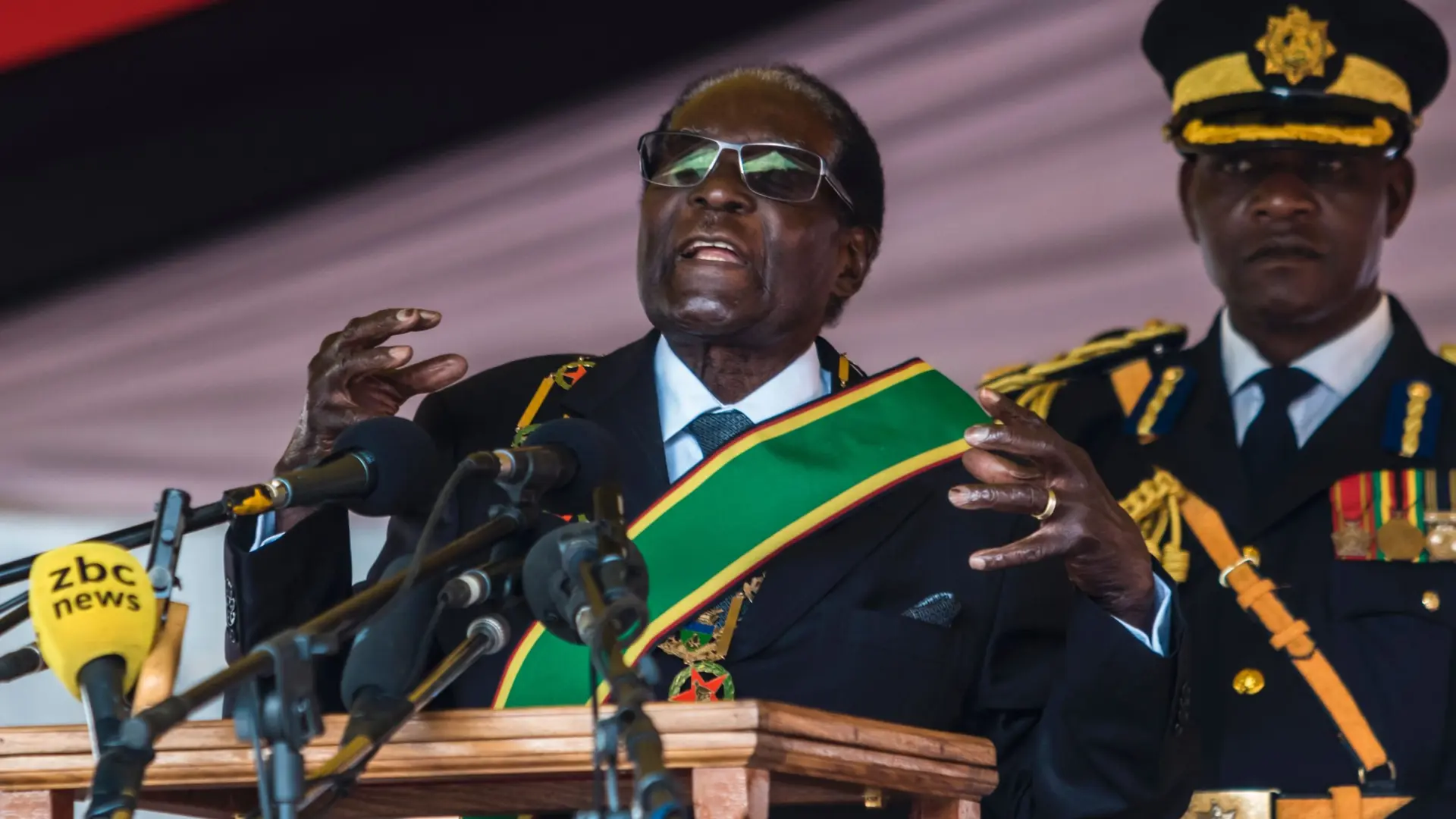
Others include José Eduardo dos Santos of Angola, who stepped down in September 2017 after 38 years in power; Gnassingbé Eyadéma, who ruled Togo for 38 years until his death in 2005 and was succeeded by his son, Faure Gnassingbé; and Robert Mugabe of Zimbabwe, who was forced from office in 2017 after ruling the country for 37 years.
How peaceful transfer was built
The Ibrahim Prize for Achievement in African Leadership, created to reward dignified, voluntary departure from power, has been awarded only a handful of times since 2006. The rarity of its recipients is its most informative data point.
The contrast with the democratic outliers is instructive. Ghana, Botswana and Zambia, each of which has demonstrated peaceful, competitive transfer of power, have done so by building specific institutions. These include electoral bodies with genuine operational independence, civil society organisations with the capacity and legal freedom to monitor and report, judiciaries that have shown willingness to rule against executive preferences in specific cases, and political cultures in which peaceful transfer has been repeated often enough to create expectation.
These features did not emerge spontaneously. Ghana did not become a model of democratic transfer in one election. It became one through institutional decisions across several electoral cycles that gradually made peaceful transfer a norm that even ambitious incumbents found it costly to violate.
The cultural argument
The argument that African political longevity reflects cultural acceptance of elder authority is frequently advanced and rarely examined carefully. It conflates the legitimacy that African cultures historically attached to wisdom and experience, embedded in institutional forms that included accountability mechanisms, with the manufactured permanence of modern authoritarian incumbency. Traditional rulers in some pre-colonial African political systems operated within constraints (lineage accountability, council oversight, the possibility of deposition for failures of governance) that many modern executives have removed. Cultural continuity is not the explanation for autocracy. It is one of its rhetorical resources.
Systems with a breaking point
The sustained street mobilisation in Sudan before Omar al-Bashir’s fall, and in Zimbabwe before Robert Mugabe’s removal, was not only about individual leaders. It was about systems built to be impermeable to popular demand. When those systems finally gave way, they did so because accumulated pressure exceeded their capacity to contain it. They have a breaking point, even if the path to it is long and costly.
The alternative is neither glamorous nor rapid. It means building, slowly and consistently, electoral bodies that earn credibility through consistent independence, judiciaries that resist executive capture and civil society organisations that work as permanent accountability infrastructure rather than episodic crisis responders. What that requires is the political will to put institutions before individuals, and an international environment that stops treating individual leaders as the main variable in African governance and starts treating institutional quality as the measure that matters.



