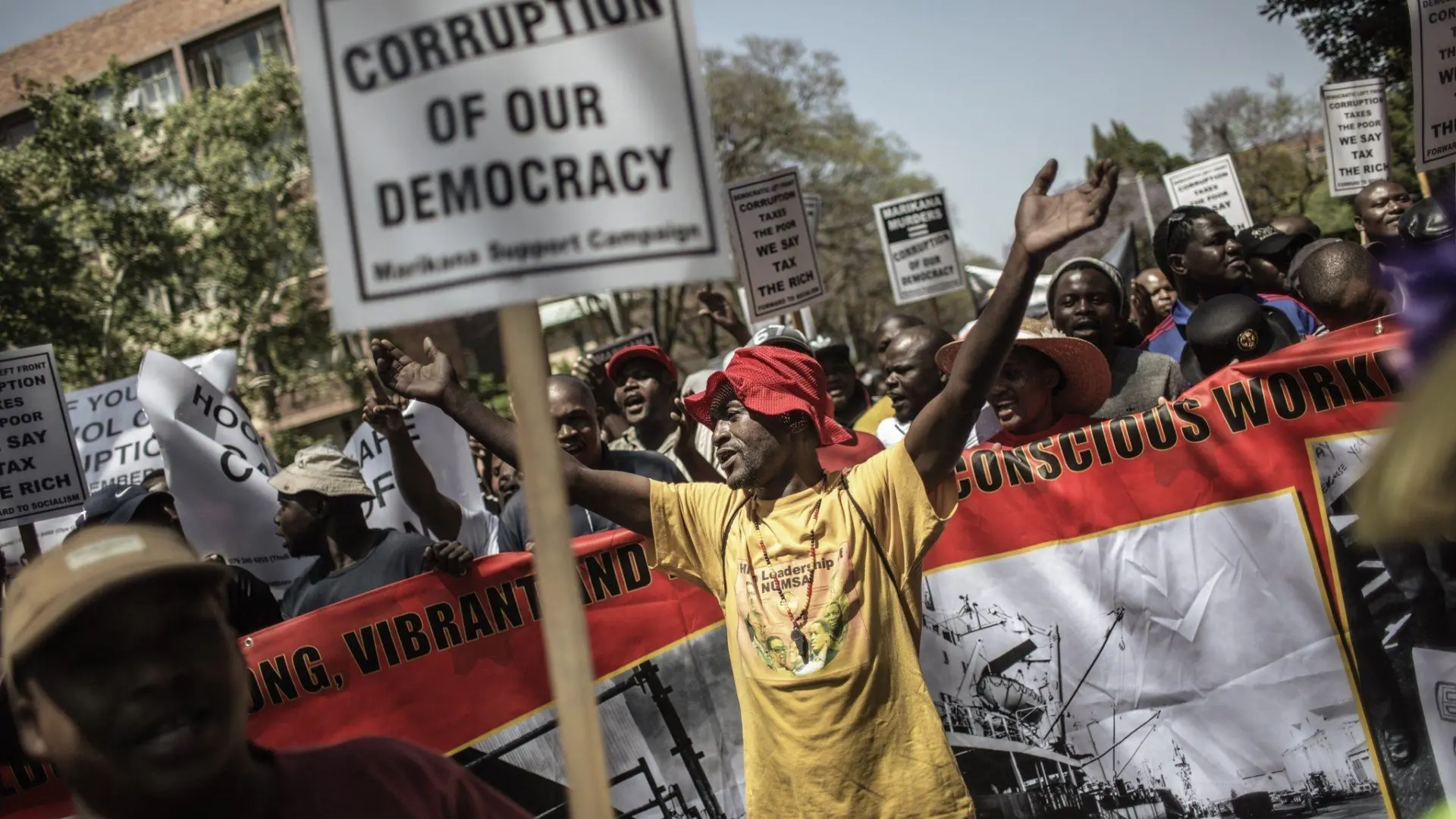
African Union leaders declared 2018 the African Year of Anti-Corruption, under the theme “Winning the Fight Against Corruption: A Sustainable Path to Africa’s Transformation”. The year’s scorecard showed little to match the slogan. When Transparency International (TI) published its Corruption Perceptions Index (CPI) for 2018 on 29 January 2019, sub-Saharan Africa was once again the lowest-scoring region in the world, and the fight against corruption across the continent was moving at a snail’s pace.
The CPI ranks 180 countries and territories by how corrupt their public sector is perceived to be, drawing on the assessments of experts and business people. Scores run from 0 (highly corrupt) to 100 (very clean). The 2018 edition painted a gloomy picture worldwide, of stalled progress against corruption alongside a decline in democracy. TI found that more than two-thirds of countries scored below 50, and that the global average was 43.
“Corruption is much more likely to flourish where democratic foundations are weak and, as we have seen in many countries, where undemocratic and populist politicians can use it to their advantage,” said Delia Ferreira Rubio, who then chaired the global civil society group.
How African countries ranked in 2018
| Country | 2018 rank (of 180) | 2018 score (of 100) | 2017 score | 2017 rank |
|---|---|---|---|---|
| Seychelles | 28 | 66 | 60 | 36 |
| Botswana | 34 | 61 | 61 | 34 |
| Cabo Verde | 45 | 57 | 55 | 48 |
| Rwanda | 48 | 56 | 55 | 48 |
| Namibia | 52 | 53 | 51 | 53 |
| Mauritius | 56 | 51 | 50 | 54 |
| São Tomé and Príncipe | 64 | 46 | 46 | 64 |
| Senegal | 67 | 45 | 45 | 66 |
| Morocco | 73 | 43 | 40 | 81 |
| South Africa | 73 | 43 | 43 | 71 |
| Tunisia | 73 | 43 | 42 | 74 |
| Burkina Faso | 78 | 41 | 42 | 74 |
| Ghana | 78 | 41 | 40 | 81 |
| Lesotho | 78 | 41 | 42 | 74 |
| Benin | 85 | 40 | 39 | 85 |
| Eswatini (listed as Swaziland) | 89 | 38 | 39 | 85 |
| Gambia | 93 | 37 | 30 | 130 |
| Tanzania | 99 | 36 | 36 | 103 |
| Algeria | 105 | 35 | 33 | 112 |
| Côte d’Ivoire | 105 | 35 | 36 | 103 |
| Egypt | 105 | 35 | 32 | 117 |
| Zambia | 105 | 35 | 37 | 96 |
| Ethiopia | 114 | 34 | 35 | 107 |
| Niger | 114 | 34 | 33 | 112 |
| Liberia | 120 | 32 | 31 | 122 |
| Malawi | 120 | 32 | 31 | 122 |
| Mali | 120 | 32 | 31 | 122 |
| Djibouti | 124 | 31 | 31 | 122 |
| Gabon | 124 | 31 | 32 | 117 |
| Sierra Leone | 129 | 30 | 30 | 130 |
| Togo | 129 | 30 | 32 | 117 |
| Guinea | 138 | 28 | 27 | 148 |
| Comoros | 144 | 27 | 27 | 148 |
| Kenya | 144 | 27 | 28 | 143 |
| Mauritania | 144 | 27 | 28 | 143 |
| Nigeria | 144 | 27 | 27 | 148 |
| Central African Republic | 149 | 26 | 23 | 156 |
| Uganda | 149 | 26 | 26 | 151 |
| Cameroon | 152 | 25 | 25 | 153 |
| Madagascar | 152 | 25 | 24 | 155 |
| Eritrea | 157 | 24 | 20 | 165 |
| Mozambique | 158 | 23 | 25 | 153 |
| Zimbabwe | 160 | 22 | 22 | 157 |
| Democratic Republic of the Congo | 161 | 20 | 21 | 161 |
| Angola | 165 | 19 | 19 | 167 |
| Chad | 165 | 19 | 20 | 165 |
| Republic of the Congo | 165 | 19 | 21 | 161 |
| Burundi | 170 | 17 | 22 | 157 |
| Libya | 170 | 17 | 17 | 171 |
| Equatorial Guinea | 172 | 16 | 17 | 171 |
| Guinea-Bissau | 172 | 16 | 17 | 171 |
| Sudan | 172 | 16 | 16 | 175 |
| South Sudan | 178 | 13 | 12 | 179 |
| Somalia | 180 | 10 | 9 | 180 |
Read against the 2017 index, the table shows a handful of real movers. Seychelles rose from 60 to 66 points and from 36th to 28th place. Gambia gained seven points, from 30 to 37, and climbed from 130th to 93rd. Eritrea, Egypt, Morocco and the Central African Republic each gained three or four points. At the other end, Burundi lost five points, falling from 22 to 17, and Mozambique, Togo, Zambia and the Republic of the Congo each lost two. Most countries moved by a point or not at all, and several that rose in the rankings did so only because others fell.
Corruption and a crisis for democracy
Corruption is feeding a crisis of democracy in many parts of the world, and African nations are no exception. Sub-Saharan Africa was the lowest-scoring region on the index, with an average of just 32.
A large number of the region’s countries have adopted democratic principles of governance, but several are still run by authoritarian or semi-authoritarian leaders.
Democracy is more than a free and fair election. It includes civil and political rights such as freedom of speech and the right to protest, and it needs strong, independent institutions.
TI’s regional analysis blamed autocratic regimes that hold elections all the same, civil strife, weak institutions and unresponsive political systems for undermining anti-corruption efforts in sub-Saharan Africa. Under those conditions, democracy cannot flourish in the region.
Significant improvers
Despite the region’s poor overall performance, a few countries pushed back against corruption with notable success.
TI counted Côte d’Ivoire and Senegal among its significant improvers for the second year running, on the strength of gains over several years rather than in 2018 alone. Côte d’Ivoire rose from 27 points in 2013 to 35 in 2018, and Senegal from 36 points in 2012 to 45 in 2018. Legal, policy and institutional reforms in both countries, and the political will their leaders showed in fighting corruption, may explain the gains.
Gambia improved by seven points in a single year, while Seychelles and Eritrea improved by six and four points respectively.
In Gambia and Eritrea, TI credited political commitment combined with laws, institutions and their implementation for helping to control corruption.
Seychelles made significant progress after its Anti-Corruption Act of 2016 set up a new commission, launched in April 2017. By January 2019 the commission had recorded 117 cases of corruption, and four cases at the Attorney-General’s office were being re-examined.
Transparency Initiative Seychelles, a non-governmental organisation that is part of the global Transparency International movement, was also launched in 2017 to help fight corruption and bribery.
Significant decliners
Several countries have seen sharp falls in their CPI scores over the last few years, among them Burundi, Congo, Mozambique, Liberia and Ghana. Comparing 2017 with 2018 alone, Burundi, Congo, Mozambique and Burkina Faso all lost ground.
Mozambique has declined steadily. Over six years it dropped 8 points, from 31 in 2012 to 23 in 2018.
TI linked the fall to a rise in abductions and attacks on political analysts and investigative journalists, which has created a culture of fear that works against the fight on corruption.
The country is also home to one of Africa’s biggest corruption scandals. US prosecutors indicted several former Mozambican officials, among them Manuel Chang, the finance minister from 2005 to 2015, who was charged with concealing more than US$2 billion in hidden loans and bribes. He was arrested in South Africa in December 2018 and extradited to the United States in July 2023. A federal jury convicted him in August 2024 of conspiracy to commit wire fraud and conspiracy to commit money laundering, and in January 2025 he was sentenced to 8.5 years in prison.
Countries that made no significant progress
South Africa, Nigeria, Kenya, Senegal and Angola made no significant progress in the table, even where they appear to have moved up the rankings.
Corruption was one of the biggest items on the agenda of the Buhari administration in Nigeria, and it took a number of positive steps. It improved the anti-corruption legal and policy framework in areas such as public procurement and asset declaration, and developed a national anti-corruption strategy, among other measures. These efforts clearly did not yield the desired results.
Eight sub-Saharan countries ranked above South Africa, a daunting result for the country, even though its score of 43 matched the global average. The score was unchanged from 2017. TI noted that since Cyril Ramaphosa replaced Jacob Zuma, the administration has taken additional steps against corruption at national level, including through the work of the Anti-Corruption Inter-Ministerial Committee.
Citizens are also using social media to question abuses. Social media has played a big part in driving public conversation about corruption in South Africa, and in Kenya too.
Angola, on the other hand, had gained four points since 2015. President João Lourenço has been tackling corruption and championing reforms since he took office in 2017. According to TI, he fired more than 60 government officials, among them Isabel dos Santos, the daughter of his predecessor, José Eduardo dos Santos.
The former president’s son, José Filomeno dos Santos, was charged over a fraudulent US$500 million transaction from Angola’s sovereign wealth fund. The problem of corruption in Angola goes far beyond the dos Santos family, and the current leadership needs to show consistency in the fight against it.
Nigeria, South Africa and Senegal all hold general elections in 2019. The votes will test perceptions of corruption in these countries, though a free and fair election is only a small part of what makes up a country’s CPI score.
What separates the top scorers from the bottom
Seychelles, with 66 out of 100, tops the region, followed by Botswana with 61 and Cabo Verde with 57.
The countries that score highest, such as Seychelles and Botswana, share a few traits. Both have relatively well-functioning democratic and governance systems, which help their scores. They are the exception rather than the norm in a region where most democratic principles are at risk and corruption is high.
Somalia sits at the very bottom of the index for the seventh year in a row, with 10 points, and South Sudan, with 13, has the second-lowest score in the region.
Many low-performing countries have several things in common, including few political rights, limited press freedom and a weak rule of law. In these countries laws often go unenforced, and institutions are poorly resourced, with little capacity to handle complaints of corruption. Internal conflict and unstable governance structures add to high rates of corruption.
A great deal has happened in African countries that may push their scores up or down, such as the removal of some cabinet members in South Africa and the suspension of Nigeria’s Chief Justice by the country’s president.
The author’s argument is that governments in the region should reform weak institutions such as the police, and guarantee freedom of speech and association without fear of the consequences. Media houses must also be free to operate independently, without interference from government.
What happened next
Nigeria’s suspended Chief Justice, Walter Onnoghen, was convicted by the Code of Conduct Tribunal on 18 April 2019 of false asset declaration and barred from public office for 10 years. In Angola, José Filomeno dos Santos was sentenced to five years in prison in August 2020 over the US$500 million transfer, but in April 2024 the Constitutional Court overturned the conviction. José Eduardo dos Santos died in Barcelona on 8 July 2022.
Seven years on, the regional picture has barely moved. In the 2025 index, published on 10 February 2026 and covering 182 countries and territories, sub-Saharan Africa’s average was still 32, the lowest of any region, and only four of its 49 countries scored above 50. Seychelles led again with 68, followed by Cabo Verde with 62 and Botswana and Rwanda with 58 each. South Sudan and Somalia shared the bottom of the region with 9. Angola, at 32, had climbed 17 points since 2015, while Mozambique had fallen to 21. Nigeria scored 26 and ranked 142nd, and South Africa scored 41 and ranked 81st, according to TI’s country pages for Nigeria and South Africa.



