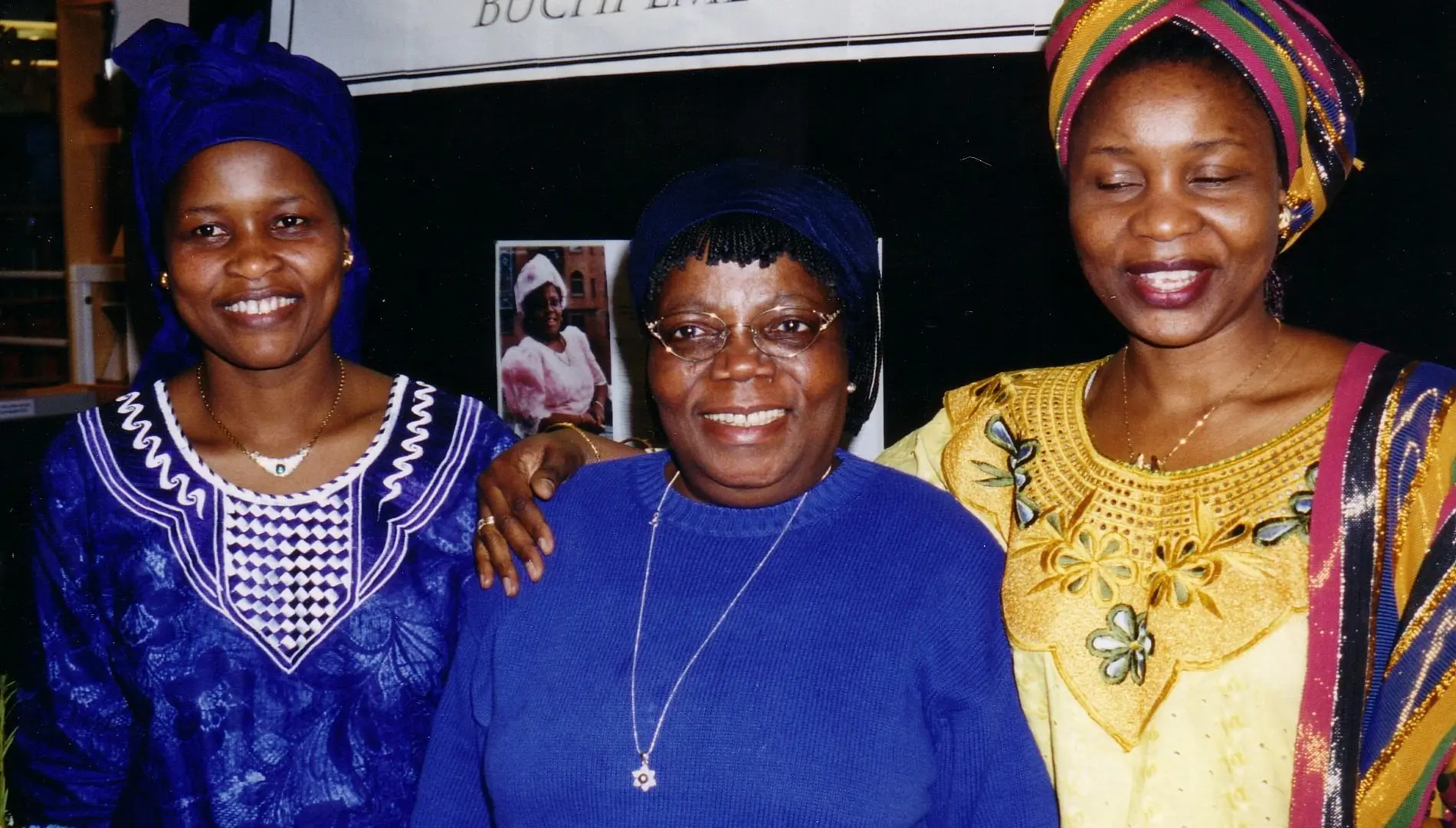
Buchi Emecheta’s novels examine how family expectations, migration and economic insecurity shape women’s lives, and show who absorbs the costs of tradition. Across a body of fiction beginning in the 1970s, some of it drawn closely from her own life, she wrote reproductive labour, displacement and coercion as the record of how African women actually lived.
The novels as evidence
In “The Joys of Motherhood” (the title itself a controlled act of irony) Nnu Ego sacrifices everything the culture demanded she sacrifice: her youth, her desires, her ambition, her sense of self. She raises children and achieves what she was told was her purpose. Then she dies alone on a roadside. Emecheta does not editorialise this ending. She simply presents it, with the flatness of a verdict being read aloud. The joys were never there. The novel’s achievement is that it forces the reader to understand exactly how that absence was administered.
Double displacement
“Second-Class Citizen” is more directly autobiographical. Adah, determined and educated, emigrates to Britain with a husband who is threatened by her ambition and resourceful in his cruelty. Emecheta captures the compound violence of double displacement. The African woman is subordinated in both her country of origin and her country of arrival, subject to racial condescension in one space and patriarchal control in the other. The London Adah navigates is not the cosmopolitan ideal of postcolonial promise. It is a set of nested structures, each one claiming a piece of her autonomy. Adah survives them, not through rescue but through the unglamorous work of self-preservation.
“The Bride Price” reaches further back into the architecture of control, examining the transaction through which a young Igbo woman named Aku-nna is positioned as commodity rather than person. The bride price system (an institution often defended in cultural discourse as evidence of a woman’s social value) is shown by Emecheta as a mechanism for maintaining male authority over female mobility. Aku-nna’s love affair and eventual marriage to a man her family rejects do not liberate her. The narrative punishes her for the transgression in ways that expose the system’s enforcement logic. The price that cannot be paid is not about money. It is about who owns the right to belong.
Resisting narrow labels
Emecheta occupied an uncomfortable position in the feminist canon because she refused to be recruited by either Western feminism or African cultural nationalism. Western feminist critics in the 1970s and 1980s sometimes received her work as evidence of African backwardness, a reading she rejected. African male literary circles, meanwhile, found her analysis of traditional institutions inconvenient. She was accused of washing dirty linen in public, of writing for Western audiences rather than African ones. Her novels answer that charge: African women’s experience, written plainly, is not dirty linen but historical record.
That positioning (rigorous, specific, unapologetic) is what makes her work a template rather than simply a monument. The question her novels raise about who benefits from cultural tradition and who absorbs its costs has not lost its urgency. Contemporary debates about bride price, inheritance rights, reproductive coercion and the educational gap between African girls and boys all have an Emecheta text that anticipated them with structural clarity. She was not ahead of her time. She was precise about her time in ways that remain applicable because the structures she described have not been fully dismantled.
Her legacy includes expanding the place of African women’s interior lives in fiction, not as an exotic supplement to the “real” story of colonial encounter or national politics, but as the story itself. The systems she exposed (patriarchy as economic architecture, tradition as enforced compliance, migration as compounded marginalisation) are not peripheral phenomena. They are the operating conditions of women’s lives. Emecheta wrote them, novel after novel, and the discomfort her honesty caused is a measure of how necessary it was.



